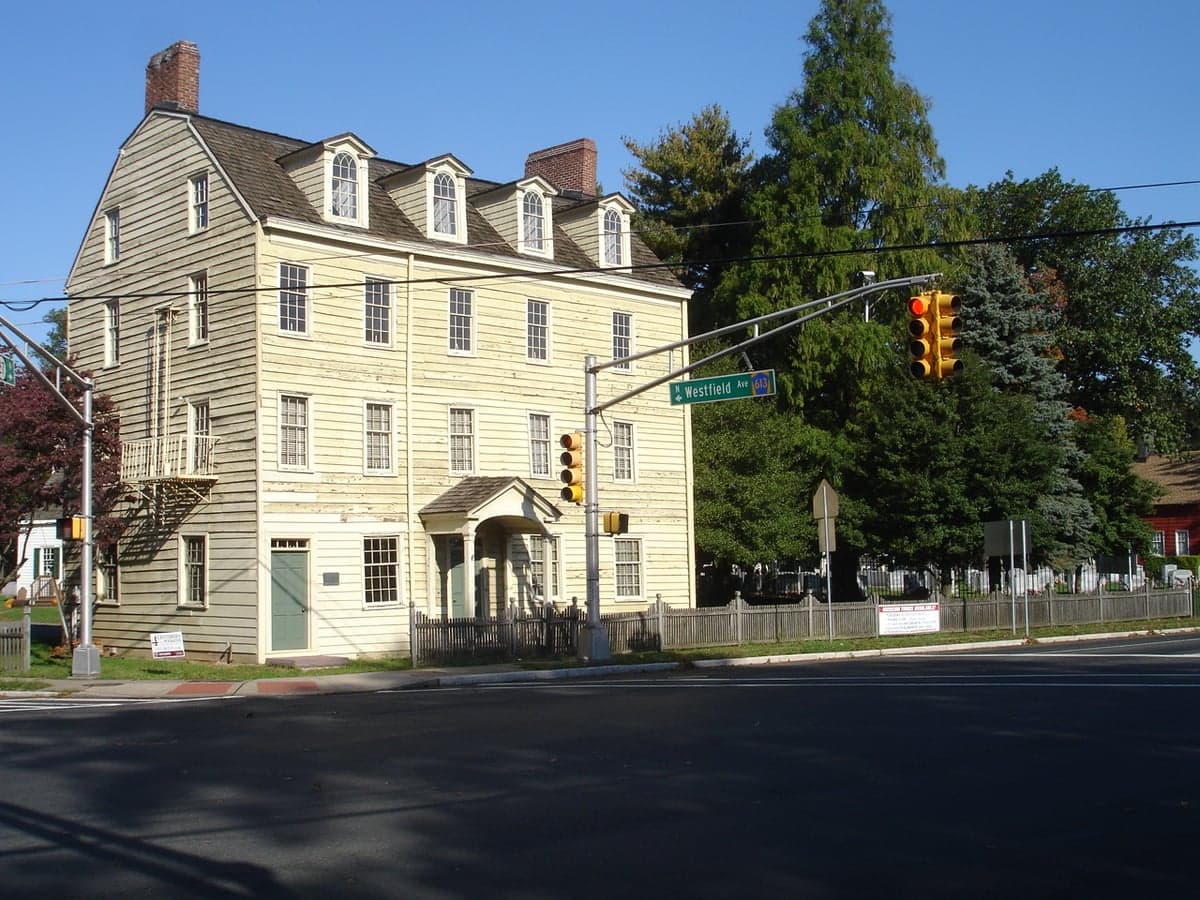
Photo: Wikipedia
Personal Sovereignty in Rahway, NJ
Viable for self-reliance. Generally workable, though some barriers may limit total independence.
What does Personal Sovereignty tell us?
Personal Sovereignty measures your capacity for self-reliance and independence with minimal government friction. Higher scores mean fewer barriers between you and the way you want to live... but it assumes you have the space you need and good neighbors.
What does this tell us?
Personal Sovereignty measures your capacity for self-reliance and independence with minimal government friction. Higher scores mean fewer barriers between you and the way you want to live... but it assumes you have the space you need and good neighbors.
State Policy
Energy independence: Importer (8% of energy produced in-state)
Personal Liberty
Homesteading

Personal Liberty Analysis
For the individualist or prepper evaluating Rahway, New Jersey, personal sovereignty here operates under a dense canopy of state-level mandates that constrain autonomy far more than in most of the country. While the city itself is a dense, transit-oriented suburb of roughly 30,000, the real constraints on self-determination come from Trenton—not City Hall. If your relocation calculus prioritizes minimal government intrusion, maximum self-reliance, and the ability to keep what you earn and own, Rahway presents a challenging environment that demands clear-eyed trade-offs.
Tax burden and regulatory posture: what you keep vs. what the state takes
New Jersey’s tax burden is the highest in the nation, and Rahway residents feel it directly. The combined state and local tax rate on income can exceed 10% for higher earners, while property taxes in Union County average around 2.5% of assessed home value—among the steepest in the U.S. For a median-priced home near $400,000 in Rahway, that’s roughly $10,000 annually in property taxes alone, with no homestead exemption that meaningfully offsets the bite. The state also levies a sales tax of 6.625%, applied to most goods and some services, and maintains an estate tax that can claw back wealth transfers above a modest threshold. Regulatory posture is similarly heavy: New Jersey imposes some of the strictest environmental, building, and business licensing requirements in the Northeast. Starting a home-based side hustle or workshop requires navigating layers of municipal and state permits, and the state’s right-to-work laws are absent, meaning union influence can affect employment options in trades and logistics. For the prepper focused on capital accumulation and minimal overhead, this tax and regulatory climate acts as a persistent drag on financial sovereignty.
Self-defense and gun law specifics: what you can and cannot do
New Jersey’s gun laws are among the most restrictive in the nation, and Rahway residents must comply with a regime that prioritizes state control over individual self-defense. The state requires a Firearms Purchaser Identification Card (FPID) for handgun and long gun purchases, a process that involves fingerprinting, background checks, and a multi-month wait. Concealed carry is technically legal after the 2024 Bruen-inspired reforms, but the state’s “justifiable need” standard has been replaced with a shall-issue system that still imposes extensive training, mental health records review, and character references. In practice, obtaining a carry permit in Union County can take 6-12 months and cost several hundred dollars. Magazine capacity is capped at 10 rounds, and the state bans a wide range of “assault weapons” by feature, including common semi-automatic rifles with pistol grips or flash suppressors. Stand-your-ground laws do not exist; New Jersey imposes a duty to retreat in public spaces before using deadly force. For the self-reliant individual, this means defensive firearm options are limited, legally burdensome, and subject to change with shifting political winds in Trenton. Home defense with a registered handgun or shotgun remains possible, but the regulatory overhead is a constant friction point.
Self-reliance and homesteading viability: lot sizes, zoning, and off-grid feasibility
Rahway is a densely developed city of about 10 square miles, with most residential lots averaging 0.1 to 0.2 acres—tight by any standard. Zoning is predominantly single-family and multi-family, with strict codes that prohibit livestock, extensive gardening for commercial sale, or any structure that deviates from standard suburban norms. Off-grid feasibility is near zero: the city mandates connection to municipal water and sewer, and solar panel installations require permits and utility coordination. Rainwater collection for potable use is not explicitly banned but is heavily regulated by state health codes. For the prepper seeking land for food production, water independence, or energy self-sufficiency, Rahway offers little room. The city’s community garden program provides small plots for personal vegetable growing, but this is a far cry from the acreage needed for serious subsistence. If homesteading is a priority, look to rural areas of Sussex or Warren counties, where lot sizes of 1-5 acres and looser zoning allow for chickens, small orchards, and backup power systems. In Rahway, self-reliance means stockpiling supplies in a basement or garage, not producing your own resources.
Personal liberties: parental rights, medical autonomy, speech, and property
New Jersey’s legal framework generally prioritizes state authority over individual or parental discretion. Parental rights in education are limited: the state mandates comprehensive sex education starting in elementary school, and parents cannot opt children out of LGBTQ-inclusive curriculum without a specific religious exemption that is narrowly applied. Medical autonomy is similarly constrained—New Jersey has some of the strictest vaccine mandates for school attendance, with no philosophical exemption and a rigorous medical exemption process. During the COVID-19 era, the state imposed broad mask and vaccine mandates that were enforced locally, and Rahway’s municipal government generally aligned with state directives. Free speech is protected under the First Amendment, but New Jersey’s bias intimidation laws and hate crime statutes can criminalize speech perceived as threatening or harassing, with broad definitions that worry some conservatives. Property rights are curtailed by the state’s eminent domain powers, which have been used aggressively for redevelopment projects in transit-oriented cities like Rahway. The city’s ongoing downtown revitalization has involved condemnation of older properties for mixed-use development, a process that can displace long-term residents. For the individualist, these dynamics create an environment where personal choices—from healthcare to education to property use—are subject to significant state oversight.
Overall, personal sovereignty in Rahway is a study in trade-offs. The city offers proximity to New York City employment, a walkable downtown, and a diverse community, but these come at the cost of high taxes, restrictive gun laws, limited homesteading potential, and a legal culture that favors state authority over individual autonomy. Compared to areas in the South or Midwest, where property taxes are lower, gun laws are more permissive, and zoning allows for greater self-reliance, Rahway ranks low on the sovereignty scale. For the prepper or conservative individualist, it may serve as a temporary base for career advancement, but long-term self-determination likely requires looking elsewhere—perhaps to Pennsylvania’s more rural counties or to states with stronger protections for personal liberty. If you value minimal government friction and maximum control over your life, Rahway is a place to pass through, not to put down deep roots.

* Values derived from national, state, county, city and local statistics and may differ in a specific area. Last updated: 2026-05-03T09:54:53.000Z
Narrative content on this page is AI-generated and may contain mistakes. Verify any details that matter before acting on them.
ReloMaps may earn a commission from affiliate links at no extra cost to you.

