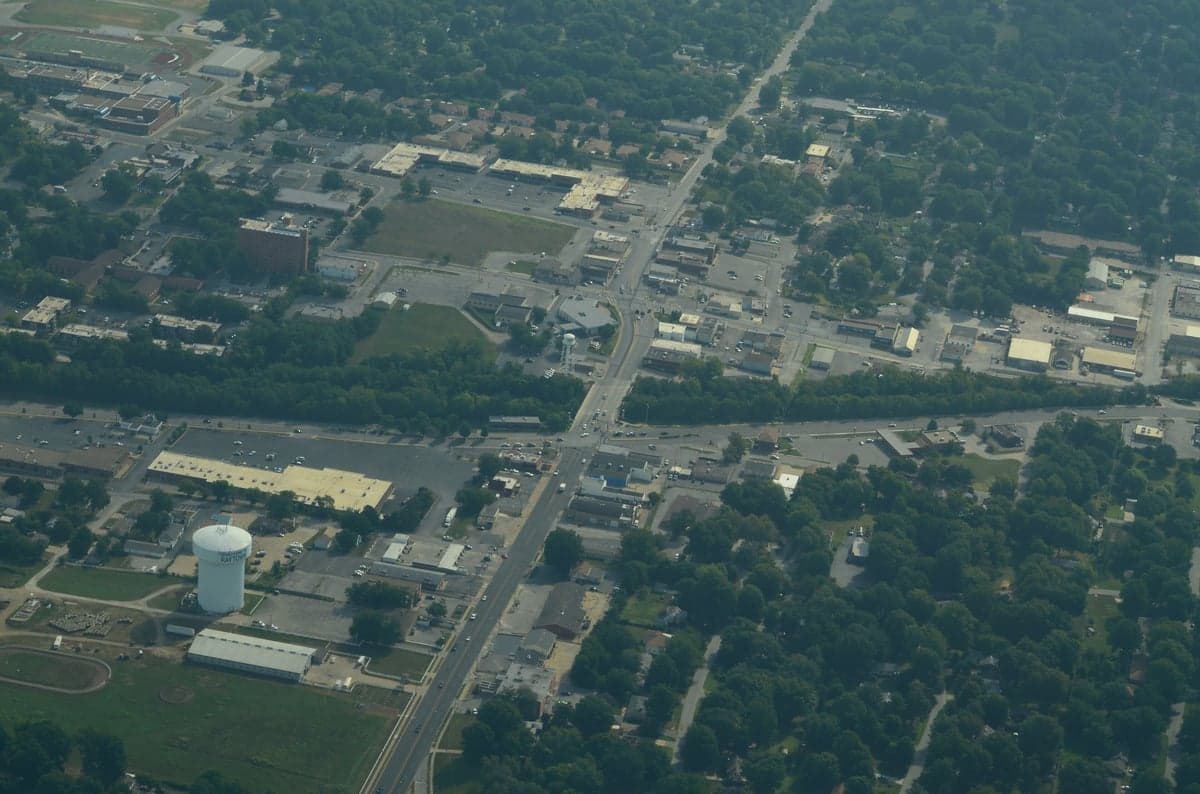
Photo: Wikipedia
Demographics of Raytown, MO
Affluence Level in Raytown, MO
A middle-class area roughly in line with national averages across income, home values, education, and employment.
People of Raytown, MO
The people of Raytown, Missouri, today form a predominantly middle-class, family-oriented community of 29,593 residents, characterized by a notable racial and ethnic diversity that reflects decades of suburban evolution. The city is roughly split between white (48.8%) and Black (36.5%) populations, with a growing Hispanic community (8.5%) and small East/Southeast Asian (0.5%) and Indian (0.2%) enclaves. Raytown retains a distinct suburban identity within the Kansas City metro, marked by modest single-family homes, a strong sense of local pride, and a population that is less transient than many nearby suburbs. Only 3.0% of residents are foreign-born, and 22.8% hold a college degree, underscoring a community built more on blue-collar and service-sector roots than on professional-class migration.
How the city was settled and grew
Raytown’s human history begins not with colonial settlement but with post-Civil War agricultural expansion. The area was originally part of the vast farmland of Jackson County, with the first permanent settlers arriving in the 1840s and 1850s, primarily of German and English stock, drawn by cheap land and the promise of the Santa Fe Trail corridor. The town itself was platted in 1857 around the intersection of what is now 63rd Street and Raytown Road, a crossroads serving local farmers. The arrival of the Kansas City, Raytown & Eastern Railroad in the 1880s spurred the first real population wave, transforming Raytown from a rural hamlet into a commuter suburb for Kansas City’s growing industrial workforce. The Raytown Heights neighborhood, developed in the 1910s and 1920s, became the first distinct residential enclave, housing railroad workers and small business owners. The post-World War II boom brought a second major wave: returning veterans and their families, aided by the GI Bill, flocked to new subdivisions like Raytown Hills and Blue Ridge Estates, which filled with ranch-style homes and young families. By 1960, Raytown’s population had surged past 17,000, overwhelmingly white and middle-class, with a strong civic identity centered on the Raytown School District and local churches.
Modern era (post-1965)
The 1965 Hart-Cellar Act and subsequent suburbanization of Kansas City’s Black population reshaped Raytown’s demographics dramatically. From the 1970s through the 1990s, Black families moved east from Kansas City’s urban core, drawn by affordable housing and the reputation of Raytown’s schools. The Raytown South area, particularly neighborhoods around 85th Street and Blue Ridge Boulevard, absorbed much of this migration, transitioning from nearly all-white to significantly Black by the 2000 census. White flight to farther exurbs like Lee’s Summit and Blue Springs accelerated in the 1980s and 1990s, but Raytown avoided the steep population decline seen in some inner-ring suburbs. The Hispanic population began growing in the 1990s, concentrated in the Eastwood Hills and Raytown East neighborhoods, driven by construction and service-sector jobs in the metro. East/Southeast Asian and Indian communities remain very small, with no distinct ethnic enclave, instead scattered across the city. The foreign-born share (3.0%) is low compared to the metro average, reflecting Raytown’s character as a second- and third-generation American community rather than a first-stop immigrant gateway.
The future
Raytown’s population is likely to continue its gradual diversification, though the pace may slow. The white share has declined from roughly 65% in 2000 to 48.8% today, while the Black share has stabilized around 36-37%. The Hispanic share (8.5%) is the fastest-growing segment, projected to reach 12-15% by 2040, driven by natural increase and continued in-migration from the Kansas City metro. The city is not homogenizing into a single demographic bloc; instead, distinct enclaves are solidifying. Raytown Heights and Blue Ridge Estates remain predominantly white and older, while Raytown South and Eastwood Hills are increasingly Black and Hispanic. The East/Southeast Asian and Indian populations are likely to remain small, as Raytown lacks the professional job base or ethnic infrastructure (e.g., temples, ethnic grocery stores) that attract larger communities. The college-educated share (22.8%) is below the national average and unlikely to rise sharply, as the city’s housing stock and school district do not strongly attract the professional class. The population is aging slightly, with a median age of 38.5, but family formation remains robust in the Hispanic and Black communities.
For someone moving in now, Raytown offers a stable, affordable, and genuinely diverse suburban environment, but one that is increasingly segmented by race and age. It is not a melting pot but a collection of distinct neighborhoods with different trajectories. New residents should expect a community that values its history, supports its schools, and offers a lower cost of living than most of the Kansas City metro, but with limited upward mobility for those seeking a professional-class lifestyle. The city’s future is one of slow, organic change rather than rapid transformation, making it a solid choice for families and individuals who prioritize stability and community over trendiness or rapid appreciation.

* Values derived from national, state, county, city and local statistics and may differ in a specific area. Last updated: 2026-04-24T13:18:21.000Z
Narrative content on this page is AI-generated and may contain mistakes. Verify any details that matter before acting on them.
ReloMaps may earn a commission from affiliate links at no extra cost to you.

