
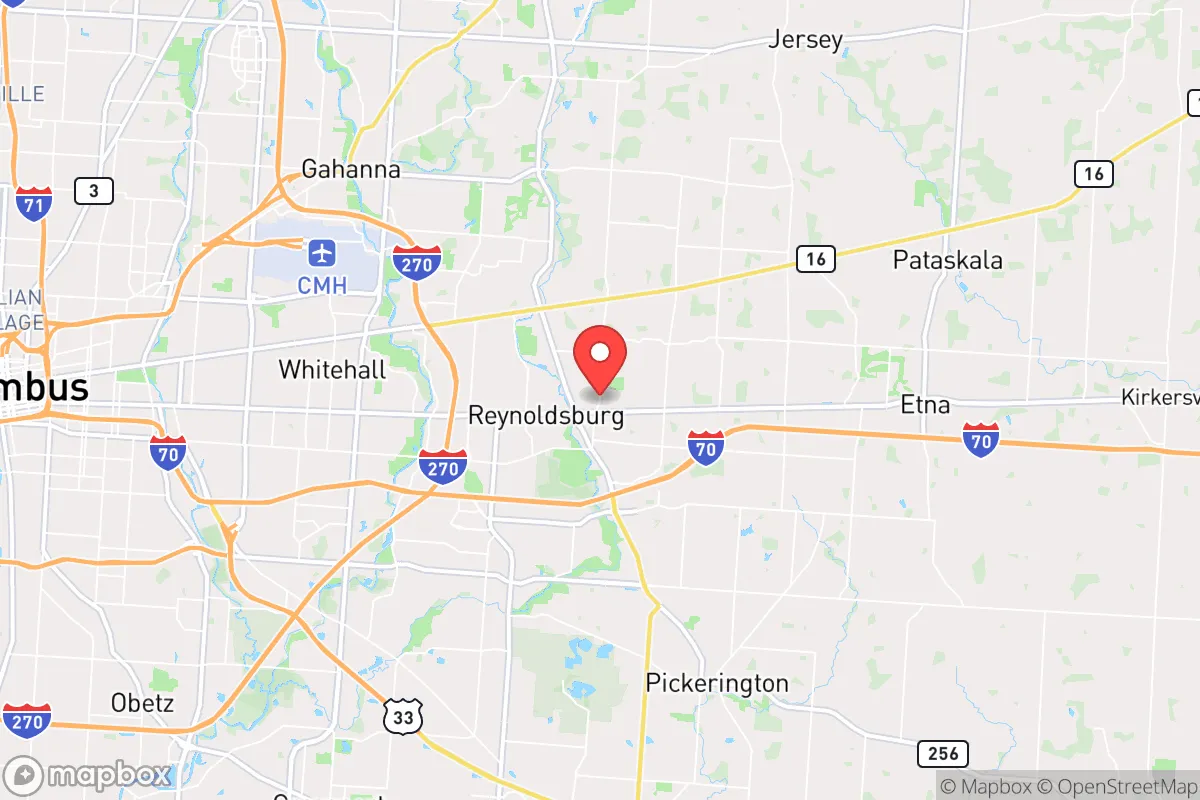
Photo: Wikipedia
Personal Sovereignty in Reynoldsburg, OH
Viable for self-reliance. Generally workable, though some barriers may limit total independence.
What does Personal Sovereignty tell us?
Personal Sovereignty measures your capacity for self-reliance and independence with minimal government friction. Higher scores mean fewer barriers between you and the way you want to live... but it assumes you have the space you need and good neighbors.
What does this tell us?
Personal Sovereignty measures your capacity for self-reliance and independence with minimal government friction. Higher scores mean fewer barriers between you and the way you want to live... but it assumes you have the space you need and good neighbors.
State Policy
Energy independence: Importer (40% of energy produced in-state)
Personal Liberty
Homesteading

Personal Liberty Analysis
For the individual or family who values personal sovereignty above all else, Reynoldsburg, Ohio, offers a surprisingly strong foundation within a state that has largely resisted the most aggressive forms of government overreach seen in coastal and Mid-Atlantic regions. While no location is a perfect libertarian paradise, Reynoldsburg sits in a state with a constitutional carry law, a flat income tax, and a political culture that still broadly respects the idea of the citizen as the primary unit of society. The key is understanding where the local and state lines of authority fall—and where they don't—so you can make an informed decision about how much autonomy you'll actually have on a day-to-day basis.
Tax burden and regulatory posture: How much the state takes and how much it interferes
Ohio's tax structure is a mixed bag, but it leans favorably for those seeking to keep more of their own earnings. The state imposes a flat income tax rate of 3.5% as of 2026, a significant simplification from the progressive brackets of the past. Reynoldsburg itself adds a municipal income tax of 2.5%, which is standard for central Ohio suburbs. Combined, you're looking at a 6% effective rate on earned income before federal taxes—annoying, but far from the punishing rates in states like California or New York. Property taxes in Reynoldsburg (Franklin County) run about 1.8% to 2.2% of assessed value, which is moderate for the region. The regulatory posture at the state level is generally business-friendly and skeptical of new mandates. Ohio has no state-level rent control, no broad plastic bag bans, and no statewide energy mandates that would force you off a gas stove. The building codes are standard International Residential Code (IRC) but are enforced with reasonable flexibility in the suburbs. For a prepper or survivalist, the key takeaway is that Ohio's regulatory environment is not actively hostile to self-reliance—it's more of a "don't ask, don't tell" posture, which is often the best you can hope for in a modern state.
Self-defense and gun law specifics: Constitutional carry and castle doctrine realities
This is where Reynoldsburg and Ohio shine for the sovereignty-minded individual. Ohio is a constitutional carry state as of 2022, meaning any law-abiding adult 21 or older can carry a concealed firearm without a permit. No training requirement, no government permission slip, no fee. This is a bedrock principle of personal sovereignty—the state recognizes your inherent right to defend yourself without first begging for a license. The state also has a strong castle doctrine, with no duty to retreat in your home, vehicle, or occupied structure. Stand-your-ground applies in any place you are lawfully present. Reynoldsburg is a suburban city, not a rural county, so you'll want to be aware of local ordinances regarding discharging firearms within city limits (generally prohibited except at ranges or in self-defense). But the state preempts local gun laws, so Reynoldsburg cannot ban carry or impose its own magazine restrictions. For the prepper, this means you can keep a defensive rifle, handguns, and standard-capacity magazines without worrying about local bans. The only real limitation is the federal NFA framework for suppressors and short-barreled rifles, but Ohio has no state-level restrictions on those items. If you value the ability to defend your home and family without government interference, this is a solid jurisdiction.
Self-reliance and homesteading viability: Lot sizes, zoning, and off-grid feasibility
Here's where the suburban reality of Reynoldsburg meets the prepper ideal, and the picture is mixed. Most residential lots in Reynoldsburg are 0.25 to 0.5 acres, typical of a mid-century suburb. That's enough for a substantial vegetable garden, a few fruit trees, and maybe a small chicken coop (check local ordinances—Reynoldsburg allows backyard hens with restrictions, but no roosters). You are not going to achieve full self-sufficiency on a quarter-acre, but you can significantly reduce your grocery dependence. The zoning code is conventional suburban: no livestock larger than poultry, no commercial agriculture, and no unpermitted structures like shipping container homes or yurts. Off-grid feasibility is limited—the city requires connection to municipal water and sewer, and solar panels are allowed but must be permitted and grid-tied. You cannot legally disconnect from the grid in a standard residential zone. For the serious homesteader or off-grid survivalist, Reynoldsburg is a compromise: you can practice significant self-reliance within the bounds of suburban rules, but you won't be living off the land. The real value here is as a base of operations—a place to store supplies, raise some food, and live quietly while maintaining access to the wider region's resources. If you want true rural autonomy, you'd need to look 30-45 minutes east toward Perry or Muskingum counties, where acreage is cheap and zoning is minimal.
Personal liberties: Parental rights, medical autonomy, speech, and property
Ohio has become a battleground for personal liberties, and the current trajectory is favorable for those who prioritize parental rights and medical freedom. The state passed the Parents' Bill of Rights in 2023, which requires schools to notify parents of any medical or mental health services offered to their children and to obtain parental consent for most non-emergency care. This is a concrete legal protection against the kind of school-based medical overreach that has alarmed many conservative parents. On medical autonomy, Ohio has no vaccine passport mandate and no state-level forced vaccination requirement for adults. The COVID-era emergency orders were allowed to expire, and the legislature has since passed laws limiting the governor's ability to impose future mandates without legislative approval. Speech is protected under the First Amendment and Ohio's own constitution, with no state-level hate speech laws that would criminalize political or religious expression. Property rights are strong—Ohio has no statewide rent control, no forced inclusionary zoning, and the eminent domain process is constrained by the 2006 Kelo reform that limits takings for private economic development. The one major liberty concern is the state's abortion law, which bans the procedure after cardiac activity is detected (roughly 6 weeks), with exceptions for life of the mother and rape/incest with reporting. For the conservative audience, this is likely a positive, but it's worth noting that the legal landscape remains in flux. Overall, the state's posture is one of deference to the individual and the family, with the notable exception of the medical marijuana program, which is tightly controlled and not a true free market.
In the broader national context, Reynoldsburg offers a level of personal sovereignty that is increasingly rare. You are not in a state that will mandate your medical choices, dictate what you can say, or require permission to defend your home. The trade-offs are the suburban zoning limits and the municipal tax, but these are manageable for anyone willing to adapt. Compared to the Pacific Northwest or the Northeast, where regulatory overreach has become a way of life, central Ohio feels like a pocket of relative freedom. For the strategic relocator who values autonomy and is willing to accept the constraints of suburban life as a trade for security and community, Reynoldsburg is a solid, defensible choice—not a frontier, but a well-fortified outpost.

* Values derived from national, state, county, city and local statistics and may differ in a specific area. Last updated: 2026-04-21T19:24:44.000Z
Narrative content on this page is AI-generated and may contain mistakes. Verify any details that matter before acting on them.
ReloMaps may earn a commission from affiliate links at no extra cost to you.

