Photo: Wikipedia
Demographics of Rhode Island
Affluence Level in Rhode Island
An upper-middle-class area. Household wealth, education levels, and homeownership run ahead of national benchmarks.
People of Rhode Island
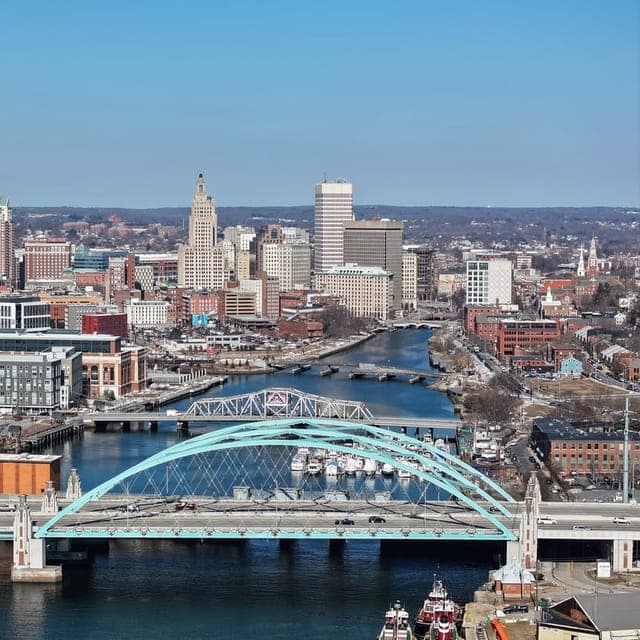
Rhode Island’s 1.1 million residents form the second-most densely populated state in the U.S., a compact coastal society shaped by nearly four centuries of layered immigration. Its population is 69.1% white, 17.1% Hispanic, 5.0% Black, 2.4% East and Southeast Asian, and 1.0% Indian, with just 6.8% foreign-born — a figure well below the national average, reflecting a state where later immigration waves have been smaller than in neighboring Massachusetts. The state’s identity remains deeply rooted in its historic mill towns, Catholic parish culture, and a distinctive New England insularity that newcomers often find both welcoming and hard to penetrate.
Settlement & growth (pre-1960)
Long before European arrival, the region was home to the Narragansett, Wampanoag, and Niantic peoples, who lived in coastal villages and seasonal fishing camps. The Narragansett were the dominant tribe, controlling most of what is now Rhode Island and eastern Connecticut. English settlers, led by Roger Williams, founded Providence in 1636 after being exiled from Massachusetts Bay for his religious views. Williams purchased land from the Narragansett and established a colony based on religious freedom and separation of church and state — a radical experiment that attracted dissenters from across New England. Newport, founded in 1639, became a major port and a center of the transatlantic slave trade, with a significant Jewish community arriving from Barbados and Curaçao by the mid-1600s. Touro Synagogue in Newport, dedicated in 1763, remains the oldest surviving synagogue building in the United States.
The 19th century brought the first massive immigration wave, driven by the Industrial Revolution. Rhode Island’s Blackstone River Valley became the birthplace of the American textile industry, with Samuel Slater’s mill in Pawtucket (1793) drawing workers from rural New England and then from abroad. Irish immigrants arrived in large numbers during the 1840s and 1850s, fleeing the Great Famine, and settled in Providence’s Federal Hill and the mill villages of Central Falls and Woonsocket. They built the Catholic churches and parish schools that still anchor many neighborhoods. French Canadians followed from the 1860s through 1900, recruited by mill agents who traveled to Quebec to offer jobs. They concentrated in Woonsocket, which became the most French-speaking city in New England, and in Pawtucket and Central Falls. By 1900, French Canadians made up roughly one-third of the state’s population.
Italian immigrants arrived in force between 1890 and 1920, settling in Providence’s Federal Hill and Cranston, working in textiles, jewelry manufacturing, and construction. Polish and Portuguese immigrants came in the same period, with Poles settling in Central Falls and Warren, and Portuguese from the Azores and Cape Verde establishing communities in East Providence, Bristol, and Newport. The Portuguese became the state’s largest ethnic group by the mid-20th century, though they are often undercounted in census data because many identify as white. Eastern European Jews, fleeing pogroms, arrived between 1880 and 1920 and settled in Providence’s South Side and Pawtucket, building synagogues and Yiddish-language institutions. By 1960, Rhode Island was a mosaic of white ethnic enclaves — Irish, French Canadian, Italian, Polish, Portuguese, and Jewish — with a small Black population concentrated in Providence’s South Side and Newport.
Modern era (post-1965)
The 1965 Hart-Cellar Act reshaped Rhode Island’s demographics, though less dramatically than in gateway states. The most significant post-1965 change has been the growth of the Hispanic population, which rose from under 1% in 1970 to 17.1% today. Dominican and Puerto Rican immigrants began arriving in the 1980s and 1990s, drawn by low-skilled manufacturing and service jobs in Providence and Central Falls. Central Falls, a one-square-mile city, is now majority Hispanic, with a strong Dominican and Puerto Rican character. Guatemalan and Colombian communities have grown since 2000, settling in Providence’s Olneyville and Elmwood neighborhoods. The Hispanic population is younger and less affluent than the state average, with higher birth rates driving continued growth.
East and Southeast Asian immigration has been smaller but concentrated. The 2.4% Asian population includes Cambodian and Laotian refugees who arrived in the 1980s and 1990s, settling in Providence and Cranston. A smaller Chinese and Vietnamese professional class has grown since 2000, drawn by jobs in healthcare and higher education at Brown University and Rhode Island Hospital. The Indian population, at 1.0%, is primarily composed of tech and medical professionals who arrived after 2000, living in East Greenwich, Barrington, and suburban Providence. The Black population, at 5.0%, includes both African American families with roots in the Great Migration (1910-1970) and more recent immigrants from Liberia, Cape Verde, and Nigeria, concentrated in Providence’s South Side and Newport.
Domestic migration has been net negative since the 1970s, as manufacturing jobs left and younger residents moved to Sun Belt states. The state’s population grew only 4.3% between 2010 and 2020, the slowest in New England. Suburbanization has hollowed out Providence and the mill cities, with middle-class families moving to North Kingstown, South Kingstown, and Bristol. The coastal towns of Newport and Narragansett have seen seasonal population surges and second-home development, but year-round population growth has been modest.
The future
Rhode Island’s population is projected to grow slowly, if at all, over the next two decades. The state’s birth rate is below replacement, and out-migration of young adults continues. The Hispanic population will likely grow to 25-30% by 2040, driven by higher birth rates and continued immigration, while the white population will shrink in absolute numbers. The East and Southeast Asian and Indian populations will grow modestly, concentrated in professional suburbs. The state is not homogenizing; instead, it is tribalizing into distinct enclaves — Hispanic-majority cities like Central Falls and Providence’s Olneyville, white ethnic suburbs like Cranston and Warwick, and affluent coastal towns like Barrington and East Greenwich that remain overwhelmingly white and college-educated.
In-migration from other states is unlikely to reshape the cultural identity significantly, as the state’s high housing costs and weak job growth deter large-scale domestic migration. The foreign-born share, at 6.8%, is low and likely to remain so. The biggest demographic story is the aging of the white population — Rhode Island has the second-highest median age in New England — and the gradual replacement of older white residents by younger Hispanic families. This will shift the state’s political and cultural center of gravity toward Providence and the mill cities, while the coastal suburbs and rural towns remain older and whiter.
For someone moving to Rhode Island now, the state offers a dense, historic, and ethnically layered society that is slowly becoming more Hispanic and more urban. The white ethnic enclaves that defined the state for a century are fading, replaced by a new divide between the diverse, younger cities and the older, whiter suburbs. The state’s small size means that no neighborhood is far from another, but the cultural distance between Central Falls and Barrington can feel vast. Newcomers should expect a place that prizes its history, resists rapid change, and rewards those who take the time to understand its intricate local loyalties.

Most Diverse Cities in Rhode Island
Most Homogenous Cities in Rhode Island
* Values derived from national, state, county, city and local statistics and may differ in a specific area. Last updated: 2026-04-19T01:38:18.000Z
Narrative content on this page is AI-generated and may contain mistakes. Verify any details that matter before acting on them.
ReloMaps may earn a commission from affiliate links at no extra cost to you.

