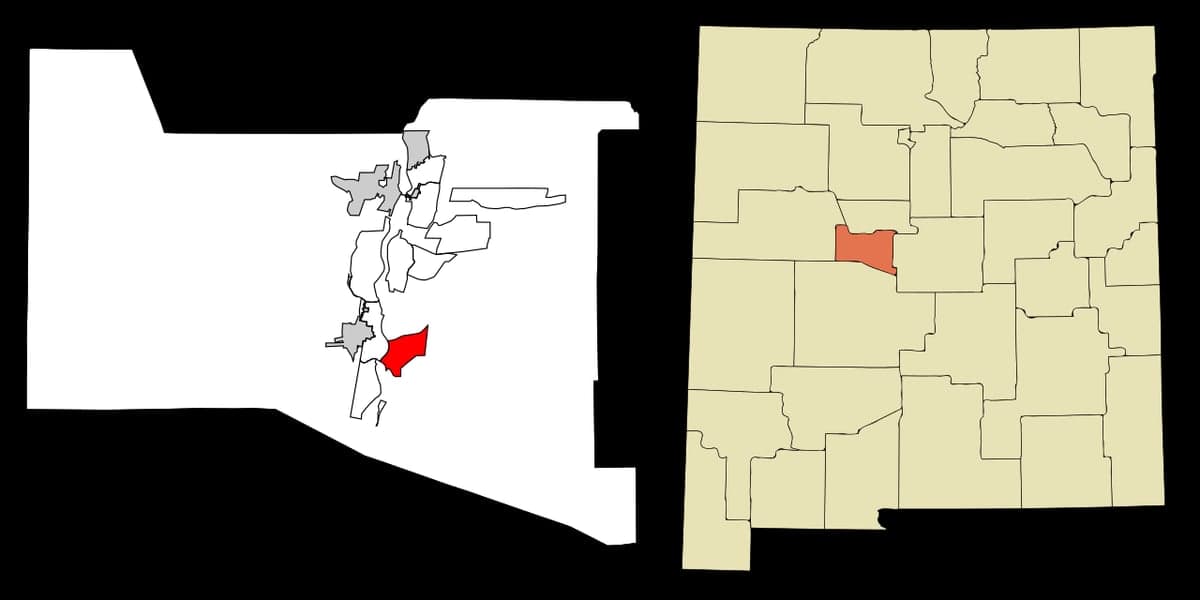
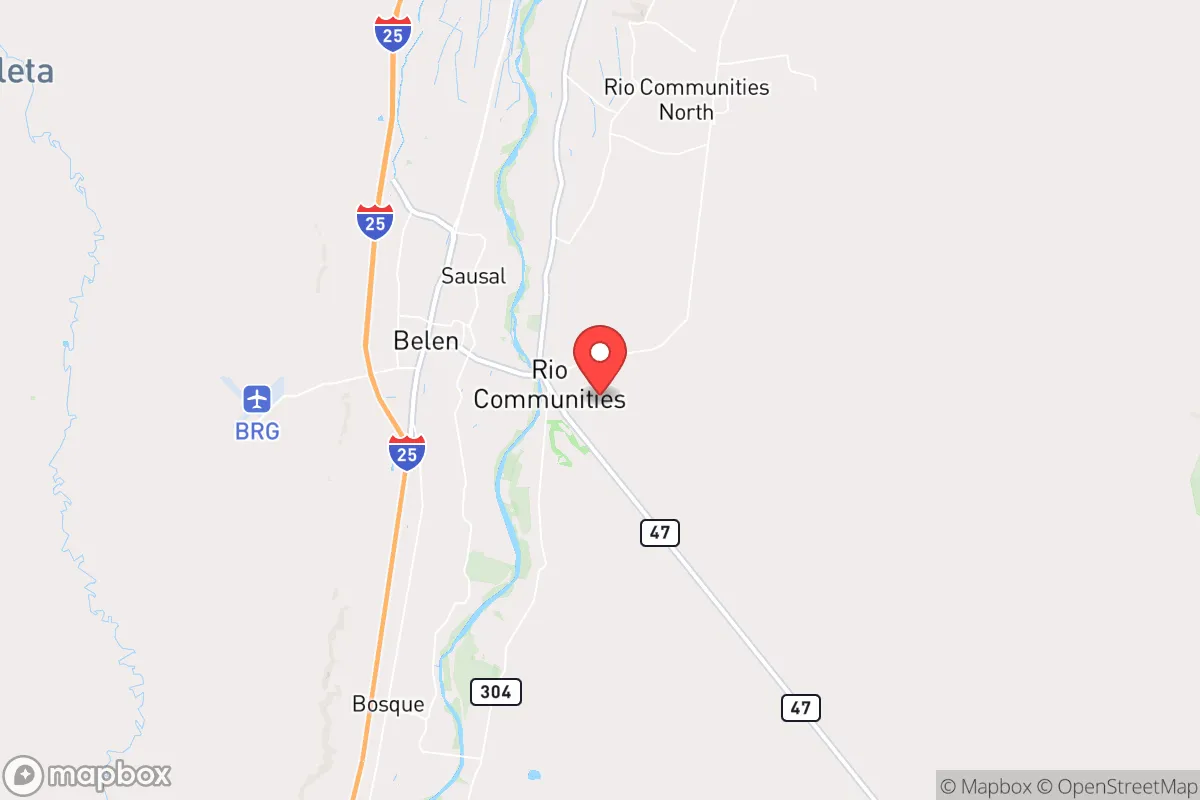
Photo: Wikipedia
Demographics of Rio Communities, NM
Affluence Level in Rio Communities, NM
A below-average socioeconomic profile. Incomes, home values, and educational attainment trail the U.S., with higher poverty and unemployment.
People of Rio Communities, NM
Rio Communities, New Mexico, is a small, unincorporated community of roughly 4,924 residents that blends a predominantly Hispanic and White population with a modest but growing East/Southeast Asian presence. The community is characterized by a low density of about 200 people per square mile, a strong family-oriented atmosphere, and a notably low foreign-born share of 4.7%, indicating a population that is largely native-born and rooted in the region for generations. Its identity is shaped by a mix of rural New Mexican heritage and recent suburban expansion, making it a quiet, affordable alternative to nearby Albuquerque.
How the city was settled and grew
Rio Communities was never a colonial-era settlement; its history begins in the mid-20th century as a planned suburban development on former agricultural land along the Rio Grande. The area was originally part of the Spanish land grant system, but the modern community took shape in the 1960s and 1970s when developers subdivided large tracts into affordable housing lots. The first wave of residents were primarily working-class Hispanic families from nearby Belen and Los Lunas, drawn by the promise of homeownership and open space. These early settlers concentrated in the Rio Communities North neighborhood, where modest ranch-style homes on large lots became the norm. A smaller number of White families, many employed at the nearby Kirtland Air Force Base or in Albuquerque’s growing service sector, arrived in the 1980s and settled in the Rio Communities South area, which offered newer, slightly larger homes and a more suburban feel.
Modern era (post-1965)
After the 1965 Hart-Cellar Act, immigration patterns shifted nationally, but Rio Communities saw only a modest impact due to its inland, non-metropolitan location. The foreign-born population remains low at 4.7%, with most immigrants arriving from Mexico and Central America rather than from Asia or the Indian subcontinent. The Hispanic share grew from roughly 40% in 1990 to 49.1% today, driven by natural increase and domestic migration from other parts of New Mexico. White residents, now 37.4%, have declined slightly as younger families moved to larger cities. The Black population, at 3.6%, is small but stable, concentrated in the Meadow Lake subdivision, a mid-2000s development that attracted some African American families from Albuquerque seeking lower housing costs. East/Southeast Asian residents, at 1.7%, are a newer presence, mostly Vietnamese and Filipino families who arrived after 2000 and settled in the Sunset Hills neighborhood, drawn by affordable lots and proximity to the Belen rail yard. The Indian subcontinent population is effectively zero, reflecting the community’s lack of tech-sector or professional-service jobs that typically attract that group.
The future
The population of Rio Communities is slowly homogenizing into a predominantly Hispanic and White community, with the Hispanic share expected to approach 55% by 2040 due to higher birth rates and continued domestic migration from nearby Valencia County. The East/Southeast Asian community is likely to plateau at around 2-3%, as the area lacks the ethnic infrastructure—such as temples, grocery stores, or language schools—that would sustain rapid growth. The Black population is stable but not growing, as younger African American residents tend to move to Albuquerque for more diverse employment and social opportunities. The community is not tribalizing into distinct enclaves; rather, neighborhoods like Rio Communities North and Sunset Hills are becoming more mixed, with Hispanic and White families living side by side. The biggest demographic shift will be an aging population: the median age is already 42, and without significant in-migration of young families, the community could see a gradual decline in school-age children and a rise in retirees.
For someone moving in now, Rio Communities is becoming a quieter, more Hispanic, and older suburb—a place where affordability and space outweigh diversity and urban amenities. The population is stable and rooted, with little turnover, meaning new residents will find a tight-knit but welcoming community. The lack of Indian subcontinent or significant Asian growth means the area will remain culturally homogeneous, appealing to those seeking a traditional New Mexican lifestyle rather than a multicultural hub.

* Values derived from national, state, county, city and local statistics and may differ in a specific area. Last updated: 2026-05-01T02:54:28.000Z
Narrative content on this page is AI-generated and may contain mistakes. Verify any details that matter before acting on them.
ReloMaps may earn a commission from affiliate links at no extra cost to you.

