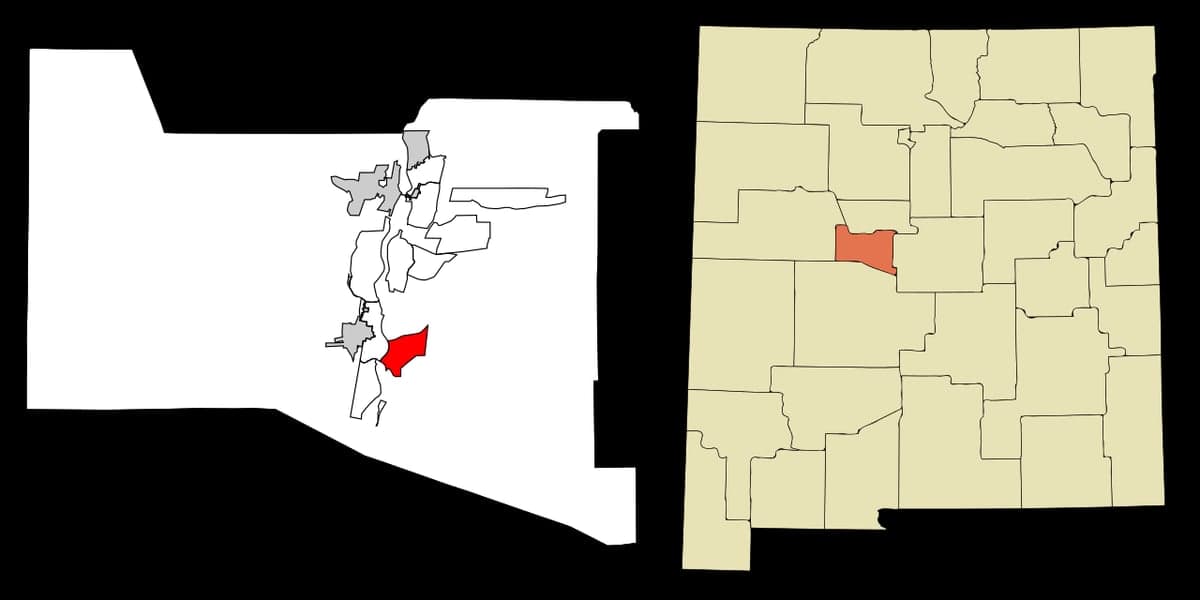
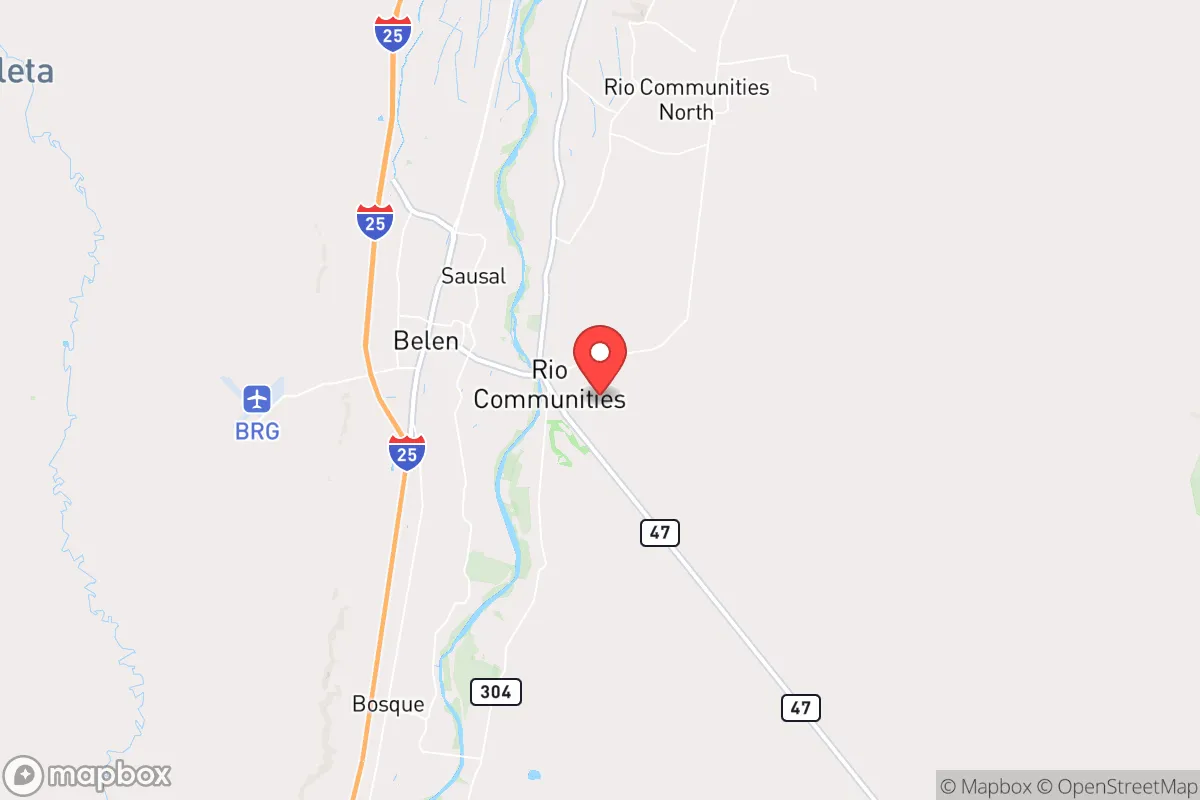
Photo: Wikipedia
Strategic Assessment of Rio Communities, NM
Meaningful friction. Expect exposure to either population pressure, blast zones, or natural disaster risk. Consider buying a retreat property.
What does the Strategic Assessment tell us?
Our Strategic Assessment grades tactical survivability of an area. Major population centers, military targets, fallout zones, natural disasters, and border exposure all drive risk — lower exposure means a more defensible position in a crisis.
This is heavily inspired by Joel Skousen's Strategic Relocation book. Highly recommended you checkout the book ($)What does this tell us?
Our Strategic Assessment grades tactical survivability of an area. Major population centers, military targets, fallout zones, natural disasters, and border exposure all drive risk — lower exposure means a more defensible position in a crisis.
This is heavily inspired by Joel Skousen's Strategic Relocation book. Highly recommended you checkout the book ($)Strategic Pillars

Key Distances
Regional Safe Places
Below is our recommended "safe zones" in New Mexico and the surrounding area based on our strategic heuristics. For most people, it's unrealistic to live in a “safe zone” full-time due to work, family or other personal reasons. They tend to be more rural. However, many of these areas are perfect for second homes and retreat properties that double as a vacation home or even a short-term rental.

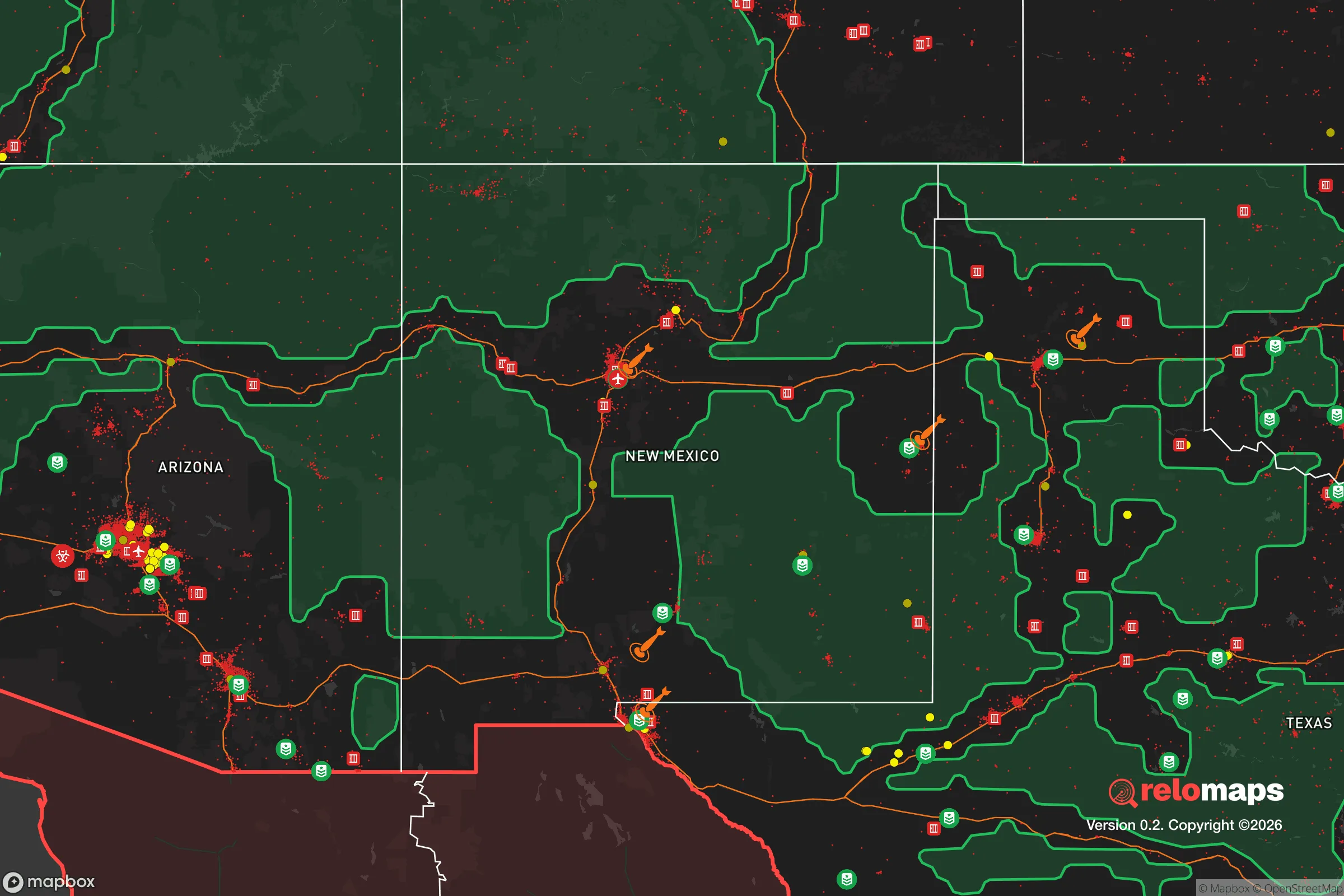


Important Note: For informational purposes only. This does not mean nothing bad ever happens in the green zones. Please use common sense. This is based on public data and modeled with AI. We tried to take a conservative approach but mistakes happen. We update this regularly as new information becomes available.
Solar Generator Recommendations
Backup power matters more here than in safer locations. We've picked three solar generators across budgets and capacity tiers — start with the budget unit if you only need a few essentials, or step up if you want to run a fridge and HVAC for days at a time.

Jackery Portable Power Station Explorer 300
Budget OptionPower on the Go: Weighing only 11 lbs, it's convenient to set up and store with book-sized foldable solar panels

BLUETTI Portable Power Station AC180
Designed for both indoor and outdoor scenarios, AC180 is highly capable as it has a robost capacity and continuous output power.

EF ECOFLOW DELTA Pro Ultra Power Station
Upgraded PickEcoFlow DELTA Pro Ultra is a whole-home energy system designed to grow with your family. Integrated with the Smart Home Panel 2, it scales to meet your evolving energy needs — keeping your home powered, intelligent, and secure through every stage of life.
We earn a commission, at no additional cost to you.
Strategic Assessment Analysis
Rio Communities, New Mexico, sits in a geographic pocket that offers a blend of strategic isolation and practical access—a combination that matters when you’re thinking about long-term stability. Located roughly 35 miles south of Albuquerque along the I-25 corridor, this unincorporated area in Valencia County provides a buffer from the immediate chaos of a major city while keeping supply routes and medical facilities within a reasonable drive. For a relocator with a prepper mindset, the key question isn’t whether the area is perfect—it’s whether the trade-offs favor resilience over convenience. On balance, Rio Communities scores well on defensibility and resource access, but it carries specific exposure risks that demand honest assessment.
Geographic position and natural advantages for long-term stability
Rio Communities sits in the Rio Grande Valley, flanked by the Manzano Mountains to the east and the Rio Puerco valley to the west. This positioning gives it a natural defensive buffer: the mountains create a barrier against eastward movement, while the river valley provides a reliable water source—a critical asset in any extended disruption scenario. The area’s elevation, around 4,800 feet, means a semi-arid climate with low humidity, reducing the risk of mold and decay in stored supplies. Winters are mild compared to the northern Rockies, with average January highs in the upper 40s, so cold-weather survival gear is manageable without extreme investment. The growing season runs about 180 days, long enough for a serious garden if you’re willing to manage irrigation. From a strategic standpoint, the land is cheap relative to the Front Range or Texas Hill Country—acreage under $10,000 per acre is still findable—which allows a relocator to secure a defensible property without breaking the bank. The I-25 corridor gives you a straight shot north to Albuquerque for medical or supply runs, but the highway is also a chokepoint that could be monitored or blocked during unrest. That’s a trade-off you need to plan around, not ignore.
Risks, exposures, and proximity to fallout-relevant landmarks
The most significant risk for Rio Communities is its proximity to Kirtland Air Force Base and Sandia National Laboratories, both located about 30 miles north in Albuquerque. These are high-value targets in any major conflict scenario—conventional or nuclear. A ground burst at either facility would produce fallout that could drift south over Valencia County depending on wind patterns, which in this region are predominantly from the southwest. That means a strike on Kirtland or Sandia could put Rio Communities in a downwind plume within hours. The area is also within 50 miles of the Waste Isolation Pilot Plant (WIPP) near Carlsbad, though that’s a deep geological repository, not a reactor—still, any incident there would be a contamination event, not an explosion. On the natural disaster front, the Rio Grande Rift runs through the region, and while major earthquakes are rare, the area does experience minor seismic activity. Wildfire risk is moderate, especially in the Manzanos, but the valley floor is less exposed than the foothills. Flooding along the Rio Grande is a periodic concern, particularly during spring snowmelt or heavy monsoon rains—check FEMA flood maps before buying low-lying land. The real exposure, though, is human: Albuquerque’s population of roughly 560,000 means that any collapse of civil order in the city could send a wave of refugees south along I-25. Rio Communities is close enough to feel that pressure but far enough that you’d have time to react—if you’re paying attention.
Practical resilience for a relocator: food, water, energy, and defensibility
Water is the first thing to solve in Rio Communities. The area relies on groundwater from the Rio Grande aquifer, and most properties have private wells or access to community water systems. A well depth of 200–400 feet is typical, and water quality is generally good, though arsenic and uranium occur naturally in some parts of the basin—test your well before buying. A hand pump or solar-powered pump on a deep well gives you a reliable off-grid water source, which is non-negotiable for any serious prepper. The Rio Grande itself is a backup, but it’s heavily diverted and regulated; during a drought, surface flows can drop to a trickle. For food, the growing season supports tomatoes, chiles, beans, squash, and corn, but you’ll need irrigation—drip lines and rainwater catchment are practical investments. Local farmers’ markets in Belen and Los Lunas offer fresh produce during normal times, but don’t count on them in a crisis. Energy is straightforward: solar is viable here, with over 280 sunny days per year. A modest 5 kW array with battery storage can cover a household’s basic needs, and net metering is available through PNM, the local utility. For defensibility, the terrain is mostly flat with scattered arroyos, so a property with a clear line of sight and a perimeter fence is ideal. The community is unincorporated, meaning no local police force—you rely on the Valencia County Sheriff’s Office, which has response times that can stretch to 20–30 minutes in rural areas. That makes a neighborhood watch or a small mutual-aid group a practical necessity, not a luxury. Gun laws in New Mexico are relatively permissive—no permit required for open carry, and a concealed carry license is straightforward to obtain—but the state’s politics lean left, so expect future restrictions to be a possibility. Stock up on magazines and parts now.
The overall strategic picture for Rio Communities is one of moderate resilience with clear vulnerabilities. It’s not a bug-out location in the remote wilderness sense—you’re still within a day’s drive of a major city and a high-value target zone. But for a relocator who wants a base that balances access to resources with a defensible position, it works. The water is there if you secure it. The land is affordable. The climate is manageable. The biggest threat is the human one—proximity to Albuquerque and its potential for collapse. If you’re willing to invest in a well, solar, and a solid perimeter, and you’re disciplined about monitoring the situation north of you, Rio Communities offers a viable long-term position. It’s not a fortress, but it’s a place where a prepared individual or family can hold their ground while the world sorts itself out. Just don’t get complacent about the fallout risk—that’s the one variable you can’t mitigate with a fence and a garden.

* Values derived from national, state, county, city and local statistics and may differ in a specific area. Last updated: 2026-05-01T02:54:28.000Z
Narrative content on this page is AI-generated and may contain mistakes. Verify any details that matter before acting on them.
ReloMaps may earn a commission from affiliate links at no extra cost to you.

