
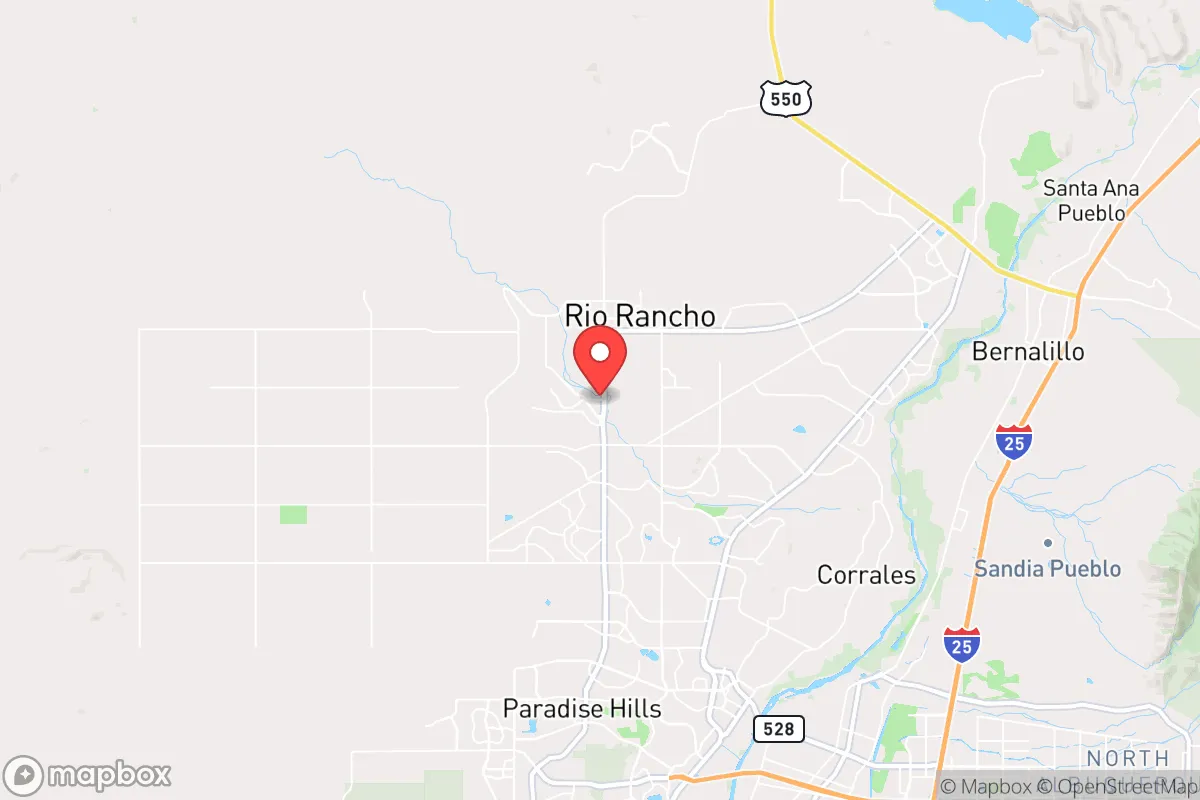
Photo: Wikipedia
Personal Sovereignty in Rio Rancho, NM
Viable for self-reliance. Generally workable, though some barriers may limit total independence.
What does Personal Sovereignty tell us?
Personal Sovereignty measures your capacity for self-reliance and independence with minimal government friction. Higher scores mean fewer barriers between you and the way you want to live... but it assumes you have the space you need and good neighbors.
What does this tell us?
Personal Sovereignty measures your capacity for self-reliance and independence with minimal government friction. Higher scores mean fewer barriers between you and the way you want to live... but it assumes you have the space you need and good neighbors.
State Policy
Energy independence: Net exporter (250% of energy produced in-state)
Personal Liberty
Homesteading

Personal Liberty Analysis
For the liberty-minded individual or family evaluating Rio Rancho, New Mexico, as a potential relocation destination, the city offers a mixed but generally favorable environment for personal sovereignty, particularly when weighed against the increasing regulatory density found in many coastal and urban states. While New Mexico as a whole carries a reputation for progressive governance in certain areas, Rio Rancho’s status as a rapidly growing, master-planned community in Sandoval County provides a distinct buffer from the more restrictive policies of Santa Fe or Albuquerque. The key for a survivalist or prepper mindset is understanding where the state’s overreach is most likely to intrude and where local conditions—from tax policy to land use—allow for a meaningful degree of self-reliance and autonomy.
Tax burden and regulatory posture for individuals and families
New Mexico’s tax structure presents a relatively light burden compared to high-tax states, which is a significant advantage for those seeking to maximize personal financial sovereignty. The state imposes a graduated income tax with a top marginal rate of 5.9%, which is moderate, and there is no state-level estate or inheritance tax. Property taxes in Sandoval County, where Rio Rancho sits, are among the lowest in the nation, with effective rates typically hovering around 0.6% to 0.8% of assessed value. This means a $400,000 home might carry an annual tax bill of roughly $2,800—far less than in Texas or California. The regulatory posture at the state level, however, is a concern. New Mexico has a growing body of environmental and land-use regulations, and the state’s recent push for electric vehicle mandates and renewable energy targets signals a willingness to dictate personal choices. Rio Rancho’s city government, while not aggressively libertarian, has historically been more business-friendly and less inclined toward the kind of zoning overreach seen in Santa Fe. For a prepper, the key takeaway is that the tax burden is low enough to allow for significant savings and investment in self-sufficiency projects, but one must remain vigilant about state-level regulatory creep, particularly around energy and building codes.
Self-defense rights and gun law specifics in New Mexico
For those prioritizing the right to keep and bear arms as a cornerstone of personal sovereignty, New Mexico presents a nuanced landscape. The state is a shall-issue jurisdiction for concealed carry permits, meaning that if you meet the statutory requirements (including a training course and background check), the state must issue the permit. There is no discretionary denial by local officials. However, New Mexico does not have constitutional carry for all adults—a permit is still required to carry a concealed handgun in most public places. Open carry is legal without a permit for individuals 19 and older. A significant point of concern for the liberty-minded is that New Mexico does not have a state-level preemption law for firearms regulation. This means that cities like Albuquerque and Santa Fe have enacted their own local ordinances, including bans on firearms in certain public buildings and parks. Rio Rancho, by contrast, has largely avoided such measures, and the Sandoval County Sheriff’s Office is known for a pro-Second Amendment stance. Magazine capacity restrictions and “assault weapon” bans have been proposed at the state level but have not passed as of 2026. For a prepper, the practical reality is that you can own and carry a wide range of firearms in Rio Rancho, but you must be aware of the patchwork of local rules if you travel into Albuquerque. The lack of state preemption is a vulnerability that could be exploited by future legislatures.
Self-reliance and homesteading viability in Rio Rancho
Rio Rancho’s development pattern is a double-edged sword for those seeking true self-reliance. The city is largely composed of suburban subdivisions with standard lot sizes ranging from one-quarter acre to one-half acre. While this is more space than a typical urban lot, it is far from the acreage needed for serious homesteading or off-grid living. The city’s zoning code generally prohibits livestock like goats, chickens, or pigs on standard residential lots, though some neighborhoods allow hens with restrictions. Water is a critical issue: Rio Rancho relies on groundwater from the Santa Fe Group aquifer, and the city has strict water conservation ordinances, including limits on outdoor watering to specific days and times. This makes large-scale gardening or rainwater harvesting challenging without a dedicated well, which is not feasible on most suburban lots. For a prepper, the viability of true self-reliance within city limits is low. However, the surrounding Sandoval County areas, particularly to the west and north toward Jemez Springs or Cuba, offer rural parcels of 5 to 40 acres with fewer zoning restrictions. These areas allow for wells, septic systems, solar panels, and livestock. The trade-off is a longer commute to Rio Rancho’s amenities and employment centers. The strategic move for a survivalist is to purchase a suburban home in Rio Rancho for daily life and a separate rural parcel for long-term self-sufficiency, leveraging the low property taxes to afford both.
Personal liberties: parental rights, medical autonomy, and property
New Mexico’s record on parental rights and medical autonomy is a significant red flag for conservative families. The state has some of the most permissive laws in the nation regarding medical procedures for minors, including no parental consent requirement for certain reproductive health services. This is a direct erosion of parental sovereignty and a major consideration for families with children. Additionally, New Mexico has a strong “public health” authority that was aggressively used during the pandemic, including mask and vaccine mandates that were enforced more strictly than in neighboring states like Texas or Arizona. On the positive side, property rights are relatively strong. Rio Rancho does not have a rent control ordinance, and there are no state-level laws that restrict the use of private property for short-term rentals or home-based businesses, though city zoning may apply. Free speech protections are standard under the First Amendment, but the state has enacted laws against “hate speech” and online harassment that some legal observers argue could be used to chill political dissent. For a prepper, the medical autonomy and parental rights landscape is the most concerning aspect of New Mexico’s governance. It suggests a state government that views the family as subordinate to the state, which is a fundamental conflict with a sovereignty-focused worldview.
In the final analysis, Rio Rancho offers a workable but imperfect environment for personal sovereignty. The low tax burden, relatively pro-gun local culture, and availability of nearby rural land provide a solid foundation for self-reliance. However, the state-level threats to parental rights, medical autonomy, and the lack of firearm preemption are serious liabilities that require constant vigilance. Compared to states like Idaho, Montana, or Wyoming, New Mexico falls short in constitutional protections and cultural alignment with liberty principles. Compared to California, New York, or Illinois, it is a clear improvement. For the strategic relocator, Rio Rancho represents a compromise location—affordable enough to allow for dual-property ownership (suburban and rural), but one where you must actively engage in local politics and legal advocacy to prevent further erosion of your freedoms. The city itself is not a libertarian haven, but it is a viable base of operations for those willing to navigate the state’s overreach with careful planning and a defensive posture.

* Values derived from national, state, county, city and local statistics and may differ in a specific area. Last updated: 2026-05-01T18:32:10.000Z
Narrative content on this page is AI-generated and may contain mistakes. Verify any details that matter before acting on them.
ReloMaps may earn a commission from affiliate links at no extra cost to you.

