Photo: Wikipedia
Demographics of Ripon, CA
Affluence Level in Ripon, CA
An upper-middle-class area. Household wealth, education levels, and homeownership run ahead of national benchmarks.
People of Ripon, CA
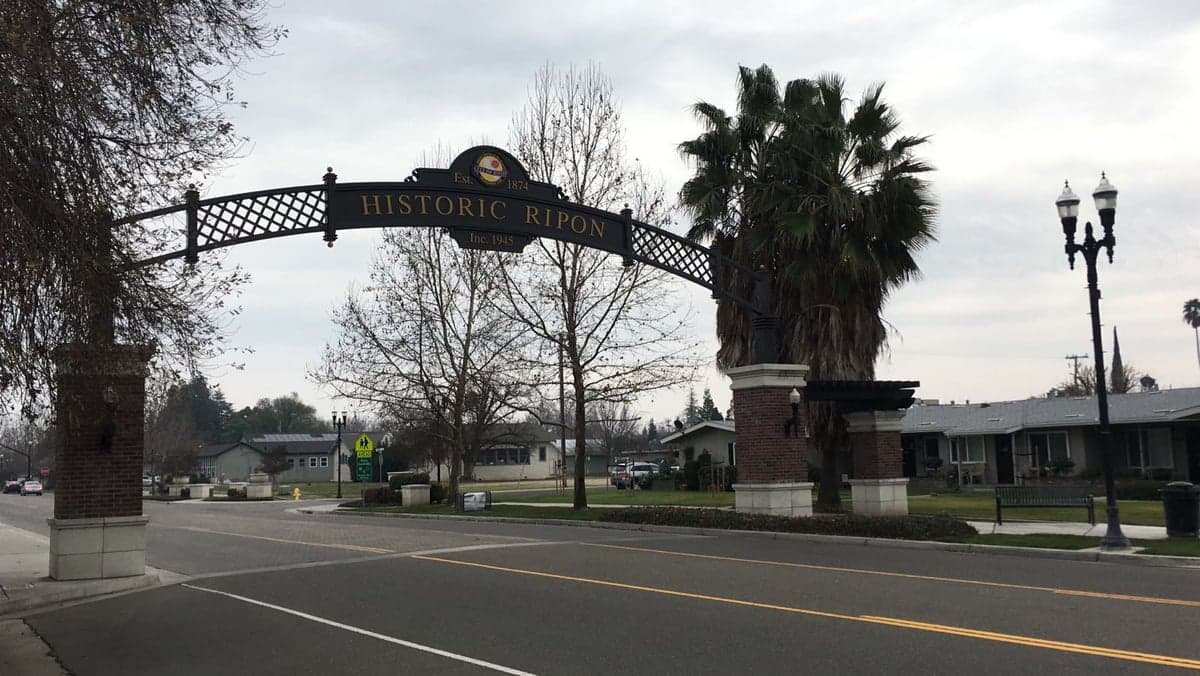
Ripon, California, is a small, family-oriented city of 16,117 residents that retains a distinctly traditional, agricultural-rooted character even as it suburbanizes. The population is notably less diverse than the surrounding San Joaquin Valley, with a White majority of 65.5% and a Hispanic community of 23.1%, while the foreign-born share is a very low 1.3%. The city’s identity is shaped by its history as a tight-knit farming community, and today it is known for its high homeownership rates, low crime, and a civic culture that leans conservative and family-centric.
How the city was settled and grew
Ripon’s human history begins not with Spanish missions or Gold Rush camps, but with a deliberate agricultural colony founded in the late 19th century. The area was originally part of the vast Rancho del Rio Estanislao Mexican land grant, but the city itself was formally established in 1893 by the Ripon Colony Association, a group of investors who subdivided the land into small farms and lots. The first wave of settlers were predominantly White Anglo-Saxon Protestants from the Midwest, drawn by the promise of irrigated farmland along the Stanislaus River. These founding families built the original core of the city in what is now the Downtown Ripon Historic District, centered around Main Street and Stockton Avenue. A second, smaller wave arrived in the early 1900s, composed of Portuguese and Italian immigrants who worked as dairy farmers and vineyard laborers; they settled primarily in the West Ripon area, near the railroad tracks, where modest worker cottages still stand. By 1950, Ripon was a nearly all-white farming town of about 1,500 people, with a social fabric built around the local churches, the volunteer fire department, and the annual Almond Blossom Festival.
Modern era (post-1965)
After the 1965 Immigration and Nationality Act, Ripon did not experience the large-scale immigration that transformed nearby cities like Stockton or Modesto. Instead, the city’s modern growth has been driven primarily by domestic in-migration from the Bay Area and the Central Valley. Starting in the 1980s and accelerating through the 2000s, families seeking larger lots, lower crime, and better schools moved to Ripon, fueling the development of master-planned subdivisions. The Stanislaus River Park neighborhood, built in the 1990s and 2000s, became the primary destination for these White and Asian professional families, offering newer homes and river access. The city’s Hispanic population, which grew from a negligible share to 23.1% by 2020, largely settled in the older, more affordable South Ripon area, south of Highway 99, where multi-generational households and a growing number of small businesses have created a distinct cultural pocket. The East/Southeast Asian community (2.5%) and the Indian-subcontinent community (2.6%) are smaller but visible, concentrated in the newer Mossdale Village and River Islands developments, where tech workers and professionals from the Bay Area have bought homes. Notably, the Black population remains very small at 1.2%, and the city has not seen significant Arab or other immigrant settlement.
The future
Ripon’s population is projected to grow modestly, reaching roughly 20,000 by 2040, driven by continued spillover from the Bay Area and the build-out of the River Islands at Lathrop master plan, which borders Ripon’s southern edge. The city is becoming slightly more diverse, but the pace is slow: the Hispanic share is expected to rise toward 30% as younger families age into homeownership, while the White share will likely decline to around 60%. The East/Southeast Asian and Indian populations are expected to grow incrementally as professionals continue to move into newer subdivisions, but Ripon will remain far less diverse than the surrounding region. The cultural identity is evolving from a purely agricultural community to a bedroom suburb with a conservative, family-first ethos, where newcomers are expected to assimilate into existing norms rather than reshape them. New development is concentrated in the Northwest Ripon area, near the new high school, where large-lot homes are attracting families from both the Bay Area and local farming families looking to upgrade.
For someone moving in now, Ripon offers a stable, low-diversity environment where traditional values, public safety, and school quality are the primary draws. The city is not a melting pot but a community where the population is slowly diversifying through organic growth rather than rapid immigration. New residents will find a place that is becoming more suburban and slightly more varied in background, but that still prizes its agricultural heritage and small-town feel above all else.

* Values derived from national, state, county, city and local statistics and may differ in a specific area. Last updated: 2026-08-23T00:49:21.000Z
Narrative content on this page is AI-generated and may contain mistakes. Verify any details that matter before acting on them.
ReloMaps may earn a commission from affiliate links at no extra cost to you.

