Photo: Wikipedia
Demographics of Ripon, WI
Affluence Level in Ripon, WI
A middle-class area roughly in line with national averages across income, home values, education, and employment.
People of Ripon, WI
Ripon, Wisconsin, is a predominantly white, family-oriented community of 7,803 residents with a notably low foreign-born population of just 0.6%. The city’s character is shaped by its deep-rooted Yankee and German heritage, a strong sense of civic pride tied to its founding of the Republican Party, and a quiet, self-reliant culture typical of small Midwestern manufacturing towns. With a college attainment rate of 24.6% and a population that is 91.7% white, Ripon remains ethnically homogenous compared to state and national averages, though a small but growing Hispanic community (4.1%) is beginning to add new threads to the local fabric.
How the city was settled and grew
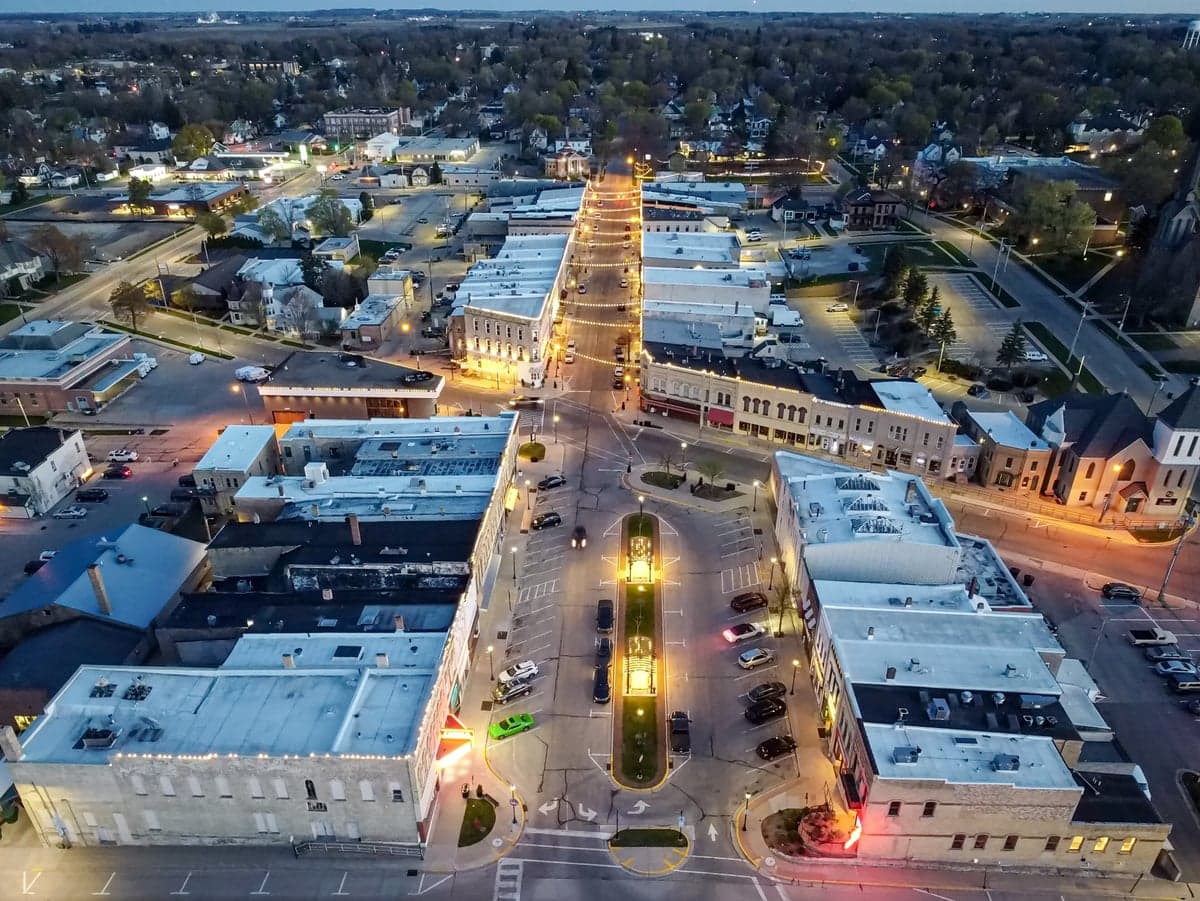
Ripon’s first permanent settlers arrived in the late 1840s, drawn by the promise of fertile farmland and water power along the Fox River. The city was formally platted in 1849 by David P. Mapes and other New Englanders, who named it after Ripon, England. These early Yankees—Congregationalists, abolitionists, and entrepreneurs—established the town’s moral and political tone, famously hosting the 1854 meeting that led to the formation of the Republican Party. The original settlement clustered around what is now the Downtown Historic District, centered on Watson and Blackburn Streets, where many of the founders’ Greek Revival and Italianate homes still stand.
By the 1850s, a second wave of immigrants arrived: German farmers and craftsmen, who were drawn by cheap land and the growing agricultural economy. They settled primarily in the South Side neighborhood, south of the railroad tracks, building St. Peter’s Lutheran Church and establishing a network of family farms that supplied the town’s flour mills and cheese factories. A smaller contingent of Irish immigrants, many fleeing the Potato Famine, took up labor on the railroad and in the early mills, settling in modest homes along the river in what is now the West End area near the old Chicago & North Western depot. By 1900, Ripon was a thriving market town of about 3,000, overwhelmingly native-born white, with a small but visible German-speaking enclave on the South Side.
Modern era (post-1965)
After the 1965 Immigration and Nationality Act, Ripon saw virtually no influx of new immigrant groups. The foreign-born share remained below 1% through the 2020s, a reflection of the city’s limited economic draw for international migrants and its location far from major urban gateways. Instead, the post-1965 period was defined by domestic in-migration: families from rural Wisconsin and the upper Midwest moving to Ripon for jobs at the city’s anchor employers, such as Ripon Foods (a cookie and cracker manufacturer) and Speed Queen (commercial laundry equipment). These new residents, overwhelmingly white and often with some college education, settled in the expanding North Side subdivisions—neighborhoods like Hillside Estates and Fox Ridge, built from the 1970s through the 1990s. The city’s population peaked at around 7,800 in the 2000 census and has since held steady, with growth limited by a tight housing stock and a slow-growing local economy.
The most notable demographic shift since 2000 has been the rise of the Hispanic population, which grew from roughly 1.5% in 2000 to 4.1% by the 2020s. This growth is driven primarily by Mexican-American families moving from larger Wisconsin cities like Milwaukee and Fond du Lac, attracted by lower housing costs and work in agriculture, food processing, and construction. These families have concentrated in the East Side neighborhood, particularly around Scott and Sullivan Streets, where rental housing is more affordable and a small Spanish-language church has taken root. The Black and East/Southeast Asian populations remain negligible (0.4% each), and there is no measurable Indian-subcontinent community.
The future
Ripon’s population is projected to remain stable or decline slightly over the next 10–20 years, mirroring trends across rural Wisconsin. The city’s white population is aging, with a median age of 40.5, and outmigration of young adults to larger job markets is a persistent challenge. The Hispanic share is likely to continue its slow increase, potentially reaching 6–8% by 2040, as families are drawn by affordable housing and entry-level jobs in manufacturing and agriculture. These new residents are expected to continue settling in the East Side and the older South Side neighborhoods, where housing costs are lowest. No significant influx of Asian, Black, or Indian-subcontinent populations is anticipated, given the city’s limited economic diversity and lack of established ethnic communities. The cultural identity of Ripon will likely remain rooted in its Yankee and German heritage, with a gradually expanding Hispanic presence adding modest diversity to local festivals, restaurants, and churches.
For someone moving to Ripon today, the city offers a stable, safe, and historically conscious community where neighbors know each other and civic involvement is high. The population is not diversifying rapidly, but the slow growth of the Hispanic community is beginning to broaden the city’s cultural and culinary landscape. New arrivals should expect a place where tradition matters, where the pace of life is deliberate, and where the biggest changes are incremental rather than transformative.

* Values derived from national, state, county, city and local statistics and may differ in a specific area. Last updated: 2026-08-23T00:49:15.000Z
Narrative content on this page is AI-generated and may contain mistakes. Verify any details that matter before acting on them.
ReloMaps may earn a commission from affiliate links at no extra cost to you.

