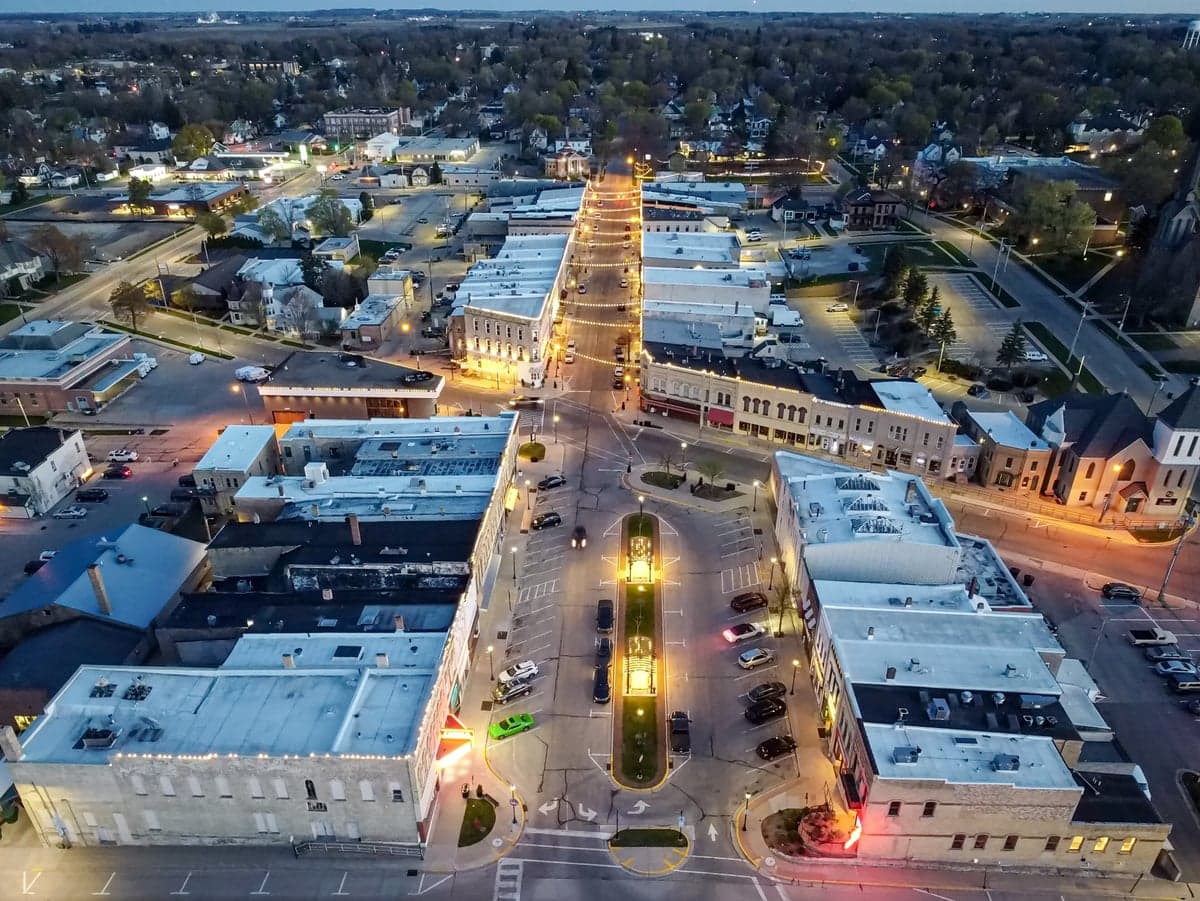
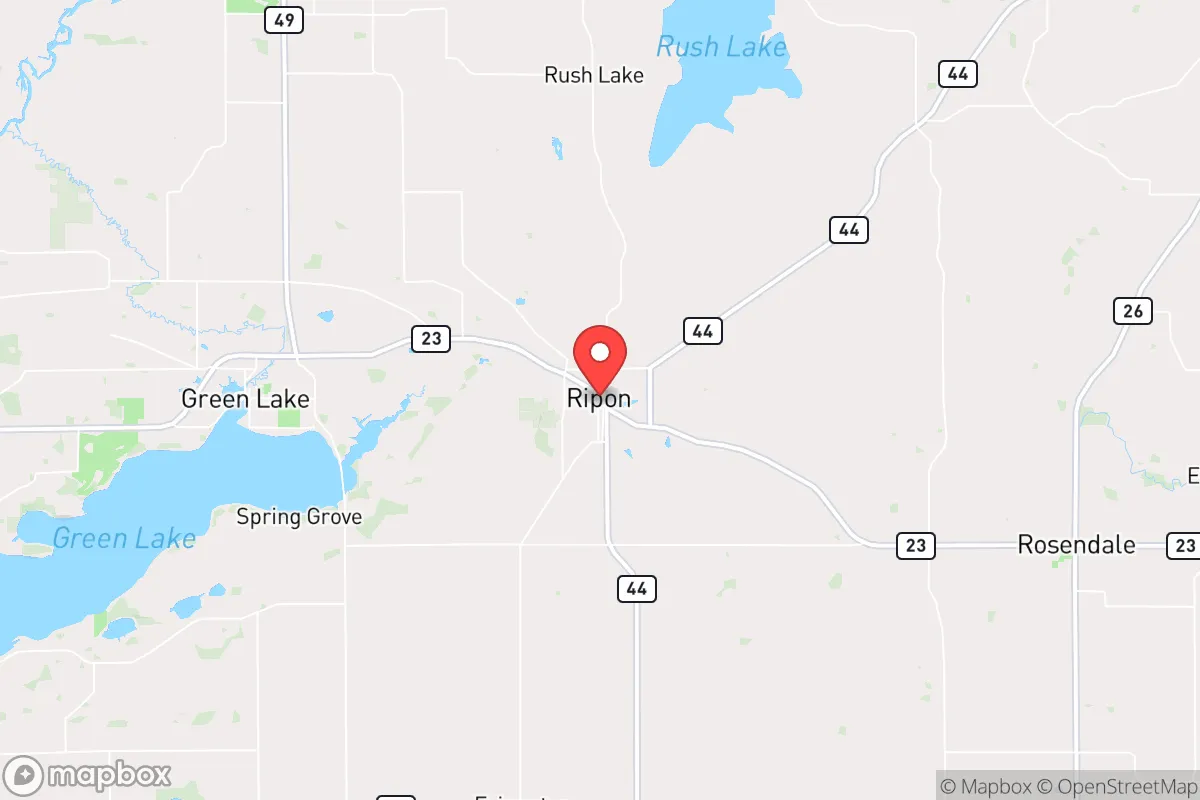
Photo: Wikipedia
Political ClimatePolitical Climate in Ripon, WI
District shown is the primary district for this city’s centroid. Cities may span multiple districts.
Local Political AnalysisPolitical Analysis of Ripon, WI
Ripon, Wisconsin, leans solidly Republican, with a Cook Partisan Voting Index (PVI) of R+8, meaning the area votes about eight points more Republican than the national average. This is a significant contrast to the state of Wisconsin as a whole, which sits at a PVI of EVEN—a perfect swing state. The city itself, often called the "Birthplace of the Republican Party," has a deep-rooted conservative tradition, but the political reality here is more nuanced than the raw numbers suggest. Over the past decade, the rural areas surrounding Ripon have become even more Republican, while the city proper has seen a slight uptick in Democratic votes, mirroring the urban-rural divide seen across the state.
How it compares
To understand Ripon's politics, you have to look at the surrounding landscape. Drive 20 miles south to Fond du Lac, and you'll find a similar R+8 vibe, but head 30 miles east to Oshkosh, and the political mix gets a little more purple, thanks to the university influence. The real contrast is with Madison, about 70 miles south, which is a deep blue island in a red sea. Ripon's R+8 is actually a bit more moderate than some of the neighboring rural townships, where the Republican margin can be 20 points or higher. The city itself, with its liberal arts college (Ripon College) and a small but active arts community, provides a counterbalance to the surrounding farmland. In the 2020 presidential election, the city of Ripon voted about 55% Republican, while the surrounding county (Fond du Lac) went about 60% Republican. That's a noticeable, if not huge, gap.
What this means for residents
For conservative residents, Ripon feels like home. The local government, county board, and school board are reliably Republican. You'll see plenty of "Don't Tread on Me" flags and Trump signs in the yards outside of town. The local GOP chapter is active and well-organized. For liberal residents, it's a different experience. You're in the minority, but you're not isolated. The college provides a small but vocal progressive community, and there are local Democratic groups that meet regularly. You won't feel unsafe expressing your views, but you'll definitely be aware that you're out of step with the majority. The practical effect is that policy debates—whether about school funding, land use, or local taxes—tend to be decided with a conservative tilt. The city council, for example, has a Republican majority, but it's not a rubber stamp; there's genuine debate on issues like downtown development and the city budget.
The cultural and policy distinctions in Ripon are subtle but real. The city has a strong sense of its own history, and that history is explicitly tied to the founding of the Republican Party in 1854. You'll find a small museum dedicated to that legacy. At the same time, Ripon College brings in a more diverse and liberal-leaning population, which keeps the town from becoming a monolith. The local paper, the Ripon Commonwealth Press, covers both sides of the aisle fairly. In terms of policy, you see a pragmatic conservatism: the city is fiscally cautious but has invested in a new library and downtown revitalization. The gun culture is strong, but there's no real push for restrictive local ordinances. The school district is well-regarded, and while there are debates about curriculum, they haven't reached the fever pitch seen in some other parts of the state. Looking ahead, I expect Ripon to stay R+8 or maybe drift a point or two redder as the rural areas grow more conservative, but the city itself will likely remain a stable, slightly-more-purple-than-its-surroundings community. It's a good place to live if you want a small town feel without feeling like you're in a political bubble.

State Political ClimatePolitical Climate in Wisconsin
State Political AnalysisPolitical Environment in the State
Wisconsin is the ultimate swing state, with a Cook PVI of EVEN that perfectly captures its knife-edge balance. Over the past 20 years, it has flipped from reliably blue (voting for Democrats from 1988 to 2012) to a toss-up where margins are measured in thousands of votes—Donald Trump won it by 22,748 in 2016, Joe Biden by 20,682 in 2020, and Trump again by about 29,000 in 2024. The dominant coalitions are a Democratic stronghold in the urban crescent of Milwaukee, Madison, and Kenosha, versus a deeply red rural and exurban expanse everywhere else. The trajectory is a slow, grinding polarization: the suburbs are shifting left, the small towns are shifting right, and the state is stuck in a perpetual political stalemate.
Urban vs. rural divide
The political map of Wisconsin is a story of two states. Milwaukee County, home to the city of Milwaukee, delivers massive Democratic margins—Biden won it by over 200,000 votes in 2020. Dane County, anchored by Madison, is even more lopsided, with Biden winning by nearly 200,000 votes in a county of just 560,000 people. These two counties alone can offset the entire rest of the state. Meanwhile, the rural northwoods and western driftless area—places like Ashland, Bayfield, and Crawford counties—vote Republican by 20-30 points. The WOW counties (Waukesha, Ozaukee, Washington) surrounding Milwaukee are the GOP's suburban fortress, but their margins have been shrinking: Waukesha went from +39 for Romney in 2012 to +25 for Trump in 2024, as college-educated voters drift left. The real battleground is the "Blue Wall" counties along Lake Michigan—Brown (Green Bay), Outagamie (Appleton), and Winnebago (Oshkosh)—which have trended red but remain competitive. Door County, a tourist destination, is a rare rural county that has moved left, flipping from red to blue in presidential races since 2016.
Policy environment
Wisconsin's policy environment is a patchwork of conservative governance in a purple state. The state has a flat income tax of 4.4% (down from 7.65% in 2011), a 5% sales tax (with local options up to 5.6%), and property taxes that are moderate but vary wildly—Milwaukee's effective rate is about 2.3%, while rural Burnett County is around 1.5%. The state is a "right-to-work" state (passed in 2015), and Act 10 (2011) effectively ended collective bargaining for most public employees, a landmark conservative reform that has held up in court. Education policy is a mixed bag: Wisconsin has a robust school choice program (the Milwaukee Parental Choice Program, started in 1990, is the oldest in the nation), but public school funding has been a perennial fight, with per-pupil spending below the national average. Healthcare is dominated by two systems—Aurora Health Care and UW Health—and the state did not expand Medicaid under the Affordable Care Act, leaving about 80,000 people in the coverage gap. Election laws are moderately restrictive: voter ID is required (passed in 2011, upheld in court), and absentee voting was tightened in 2022 with stricter witness signature requirements. The state has no abortion ban after 2023's court ruling, but the issue remains unsettled.
Recent policy direction
The last five years have seen Wisconsin lurch right on some fronts and hold the line on others. In 2023, the Republican legislature passed a flat tax cut and a school choice expansion, signed by Democratic Governor Tony Evers under pressure. On guns, Wisconsin is a "shall-issue" concealed carry state (since 2011) with no permit required for open carry, and in 2024, the legislature passed a bill allowing concealed carry in churches and schools with permission—though Evers vetoed it. Parental rights got a boost in 2023 with a law requiring schools to notify parents if a student requests a name or pronoun change, and a 2024 law banned "critical race theory" and "gender identity" instruction in K-8 schools. On speech, the state has no anti-SLAPP law, which leaves journalists and activists vulnerable to defamation suits. Privacy and surveillance are a mixed bag: Wisconsin has a biometric privacy law (2009) but no comprehensive data privacy law. Medical autonomy is in flux: abortion is legal up to 20 weeks after a 2023 Dane County judge struck down the 1849 ban, but the case is headed to the state supreme court, which flipped to a 4-3 liberal majority in 2023. Property rights are strong—Wisconsin is a "private property rights" state with no statewide rent control. Voting access remains a flashpoint: the 2022 law requiring absentee ballots to be returned in person (not by drop box) was upheld, and the state's bipartisan Elections Commission has been under constant attack from both sides.
Civil unrest & political movements
Wisconsin has been a national flashpoint for political movements. The 2011 Act 10 protests in Madison drew over 100,000 people to the capitol, the largest state-level labor protest in U.S. history. The 2020 Kenosha unrest after the Jacob Blake shooting saw two people killed by Kyle Rittenhouse, who was acquitted in 2021—a case that became a national symbol of self-defense and gun rights. The "People's Flag" movement (a white, blue, and green flag design) has become a symbol of progressive Wisconsin identity, while the "Wisconsin First" movement pushes for state sovereignty on issues like election integrity. Immigration politics are relatively quiet—Wisconsin has no sanctuary cities, and Milwaukee's "welcoming city" ordinance (2017) was repealed in 2023. Election integrity controversies have been intense: the 2020 election saw Trump's campaign file multiple lawsuits in Wisconsin, and a 2022 audit by the nonpartisan Legislative Audit Bureau found no widespread fraud but did identify administrative errors. The "Wisconsin Election Integrity" group continues to push for hand-counting ballots and eliminating drop boxes. Visible flashpoints for a new resident: you'll see "Let's Go Brandon" flags in rural areas and "Black Lives Matter" signs in Madison, but actual political violence is rare—the 2020 unrest was an outlier.
Projection
Over the next 5-10 years, Wisconsin is likely to remain a toss-up, but the demographic trends favor Democrats. The Milwaukee suburbs are getting bluer as college-educated professionals move in, while rural areas are getting redder but losing population. The wild card is the Fox Valley (Green Bay, Appleton, Oshkosh), which is growing but trending red—if those counties flip decisively, the GOP could lock down the state. In-migration is modest—Wisconsin gains about 10,000 net new residents per year, mostly from Illinois—and they tend to be older and more conservative, settling in the Lake Country suburbs west of Milwaukee. The state supreme court will be a battleground: the 2023 election gave liberals a 4-3 majority, but a 2025 election could flip it back. Expect continued fights over abortion, school choice, and election laws. A new resident moving in now should expect a state that is politically exhausting but stable—no one party will dominate, and every election will be a nail-biter. The practical reality is that your vote matters more here than almost anywhere else in the country.
For a new resident, the bottom line is that Wisconsin offers a genuine swing-state experience. If you're conservative, you'll find a state that has passed right-to-work, school choice, and voter ID, but you'll also face a Democratic governor who can veto your priorities. If you're liberal, you'll have strong urban bases in Madison and Milwaukee, but you'll be fighting a Republican legislature that has held a supermajority since 2011. The state's politics are a constant tug-of-war, and your vote truly counts. The practical takeaway: if you want a place where your political engagement can make a difference, Wisconsin is it. Just be prepared for the weather—both the snow and the political storms.
* Values derived from national, state, county, city and local statistics and may differ in a specific area. Last updated: 2026-08-23T00:49:15.000Z
Narrative content on this page is AI-generated and may contain mistakes. Verify any details that matter before acting on them.
ReloMaps may earn a commission from affiliate links at no extra cost to you.

