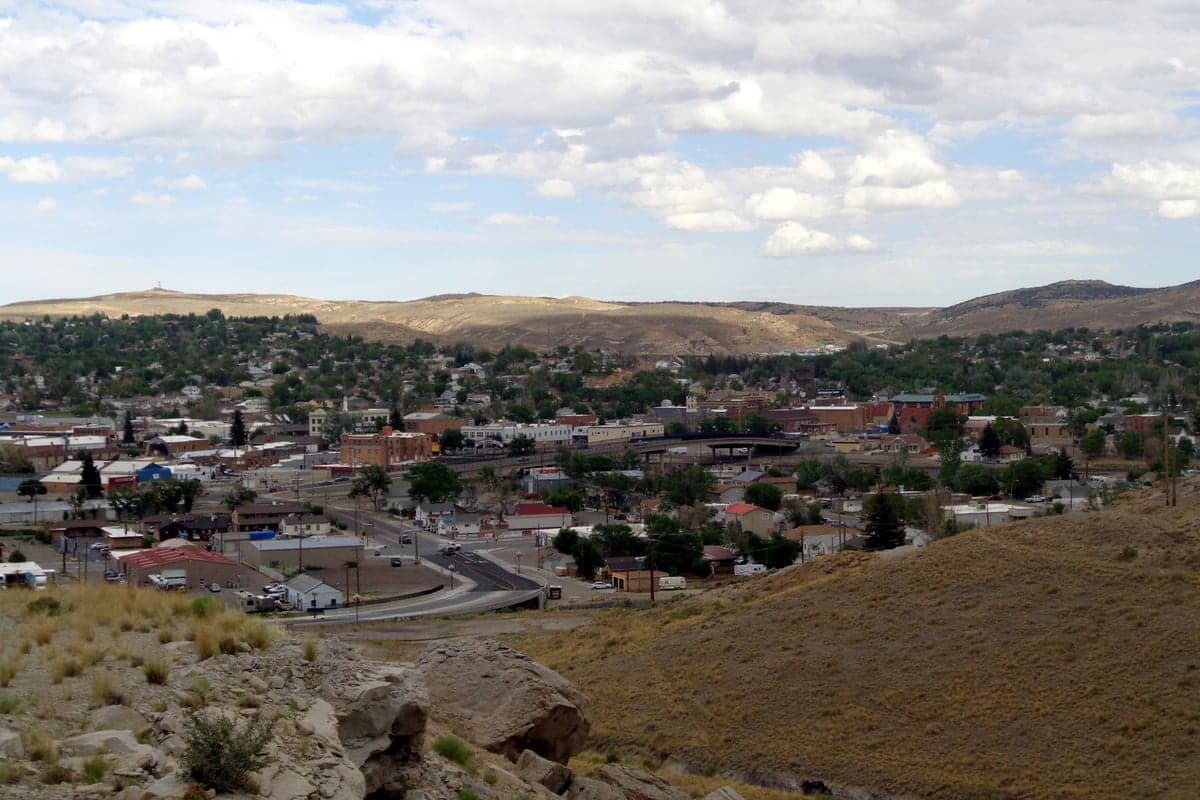
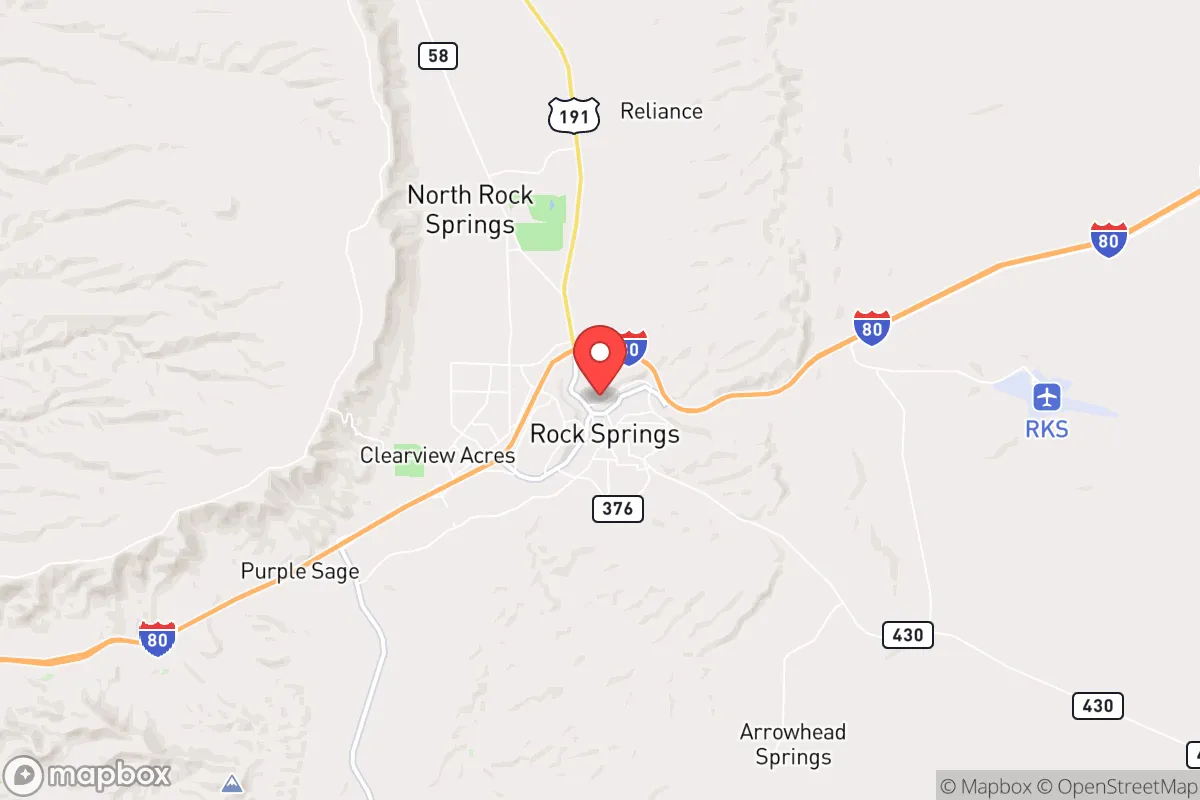
Photo: Wikipedia
Demographics of Rock Springs, WY
Affluence Level in Rock Springs, WY
A below-average socioeconomic profile. Incomes, home values, and educational attainment trail the U.S., with higher poverty and unemployment.
People of Rock Springs, WY
The people of Rock Springs, Wyoming, today number 23,229 and form a community shaped by a century of industrial migration, boom-and-bust cycles, and a recent demographic shift toward Hispanic growth. The city is notably less diverse than the national average, with a foreign-born population of just 3.7%, and remains predominantly white (74.6%) with a significant Hispanic minority (17.4%). Its identity is rooted in a working-class, energy-driven culture, where a college education rate of 21.4% reflects a workforce historically tied to mining, rail, and extraction industries rather than white-collar sectors. For a conservative-leaning individual or family considering relocation, Rock Springs offers a stable, small-city environment where community ties are strong, but economic and demographic change is slowly reshaping the social landscape.
How the city was settled and grew
Rock Springs was not a pioneer farming settlement but a company town born of the transcontinental railroad. The Union Pacific Railroad arrived in 1868, and the discovery of vast coal deposits turned the area into a boomtown almost overnight. The original workforce was a polyglot mix of European immigrants—Irish, Welsh, Finnish, Italian, and Slavic miners—who built the first neighborhoods near the rail yards and mines. The North Side, historically called "Old Town," became the heart of the immigrant working class, with ethnic boarding houses and saloons lining Front Street. By the early 1900s, the city was a notorious "Wild West" coal camp, with a population that fluctuated wildly with coal demand. A second major wave came during and after World War II, when the energy industry expanded to feed national demand. This era brought a new influx of domestic migrants, many from the rural Midwest and South, who settled in the White Mountain area, a neighborhood of modest single-family homes built on the city's western edge. The post-war period also saw the establishment of the East Side, near the current industrial parks, which housed workers for the trona (soda ash) mines that became the city's economic backbone after coal declined. By the 1960s, Rock Springs had a population of roughly 11,000, overwhelmingly white, with a small but established Hispanic community dating to the railroad era.
Modern era (post-1965)
The 1970s energy crisis triggered Rock Springs' most dramatic population surge, as the Carter administration's synthetic fuels program and a boom in trona mining drew thousands of new workers. This period saw the city's population nearly double, peaking at over 25,000 by the early 1980s. The newcomers—largely white domestic migrants from the Rocky Mountain region and the Rust Belt—filled new subdivisions like Meadowbrook and Ridgeview, built on the city's southern and eastern fringes. The Hispanic population, which had been a small but continuous presence since the railroad days, grew more visibly during this era, as families from northern New Mexico and Colorado moved in for mining jobs. Today, the Hispanic community (17.4%) is concentrated in the South Side and parts of the White Mountain area, where older, more affordable housing stock provides entry points for working-class families. The Black population (2.0%) and East/Southeast Asian population (0.8%) remain very small, largely employed in the service and healthcare sectors, with no distinct ethnic enclave. The Indian subcontinent population (0.1%) is negligible. The post-1965 shift under the Hart-Cellar Act had minimal impact on Rock Springs, as the city's remote location and industrial economy did not attract the large-scale immigration seen in coastal or Sun Belt cities. Instead, the city's modern demographic story is one of domestic migration and a gradual, organic growth of its Hispanic minority.
The future
Rock Springs' population is slowly homogenizing in terms of race, but tribalizing along economic lines. The white population, while still the majority (74.6%), is aging, and younger white families are increasingly leaving for college and white-collar jobs in larger Wyoming cities like Laramie or Casper. The Hispanic population is younger and growing, driven by higher birth rates and continued in-migration from the Southwest. This group is not assimilating into a single "melting pot" but is forming a distinct cultural presence, particularly in the South Side and White Mountain neighborhoods, where Spanish-language churches and small businesses are becoming more common. The city's overall population has been flat to slightly declining since the 1980s, and projections suggest a slow decline to around 22,000 by 2035, barring a new energy boom. The next decade will likely see a continued shift: the white share will edge downward, the Hispanic share will rise toward 20-22%, and the city will become more economically stratified, with the energy sector providing stable but fewer jobs. For a newcomer, this means moving into a community that is still predominantly white and conservative, but where the Hispanic presence is becoming more visible and integrated into daily life.
Rock Springs is becoming a more ethnically diverse, but still overwhelmingly white, working-class city where the energy economy dictates the pace of change. The population is not fragmenting into hostile enclaves, but distinct neighborhoods—the older, immigrant-rooted North Side, the newer white subdivisions of Meadowbrook and Ridgeview, and the growing Hispanic South Side—reflect different eras of settlement. For a conservative family or individual, the city offers a stable, low-crime environment with a strong sense of place, but the demographic and economic trends point toward a slower, smaller, and slightly more Hispanic future. Moving in now means joining a community that values self-reliance and tradition, even as its face gradually changes.

* Values derived from national, state, county, city and local statistics and may differ in a specific area. Last updated: 2026-04-21T10:51:06.000Z
Narrative content on this page is AI-generated and may contain mistakes. Verify any details that matter before acting on them.
ReloMaps may earn a commission from affiliate links at no extra cost to you.

