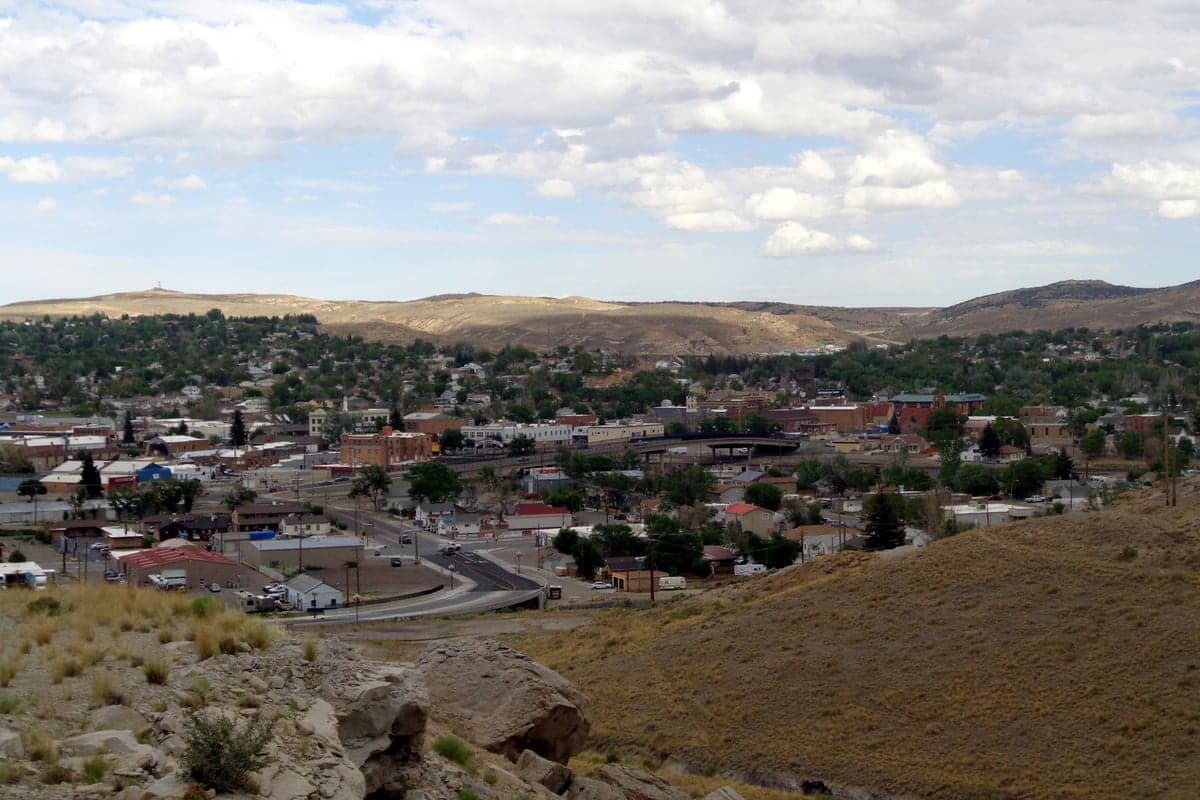
Photo: Wikipedia
Political ClimatePolitical Climate in Rock Springs, WY
District shown is the primary district for this city’s centroid. Cities may span multiple districts.
Inherited from parent state — no local data available.
Local Political AnalysisPolitical Analysis of Rock Springs, WY
Rock Springs has long been a solidly conservative community, and that hasn't changed much despite some national trends. The Cook PVI of R+23 tells you everything you need to know about the political lean here—this is deep red territory, and it's been that way for generations. You'll find most folks around here vote Republican not because they're told to, but because they genuinely believe in limited government, personal responsibility, and keeping the feds out of our business. The trajectory has stayed pretty steady, though you do see a few younger folks moving in from places like Jackson or Laramie who bring some different ideas, but they usually settle in or move on pretty quick.
How it compares
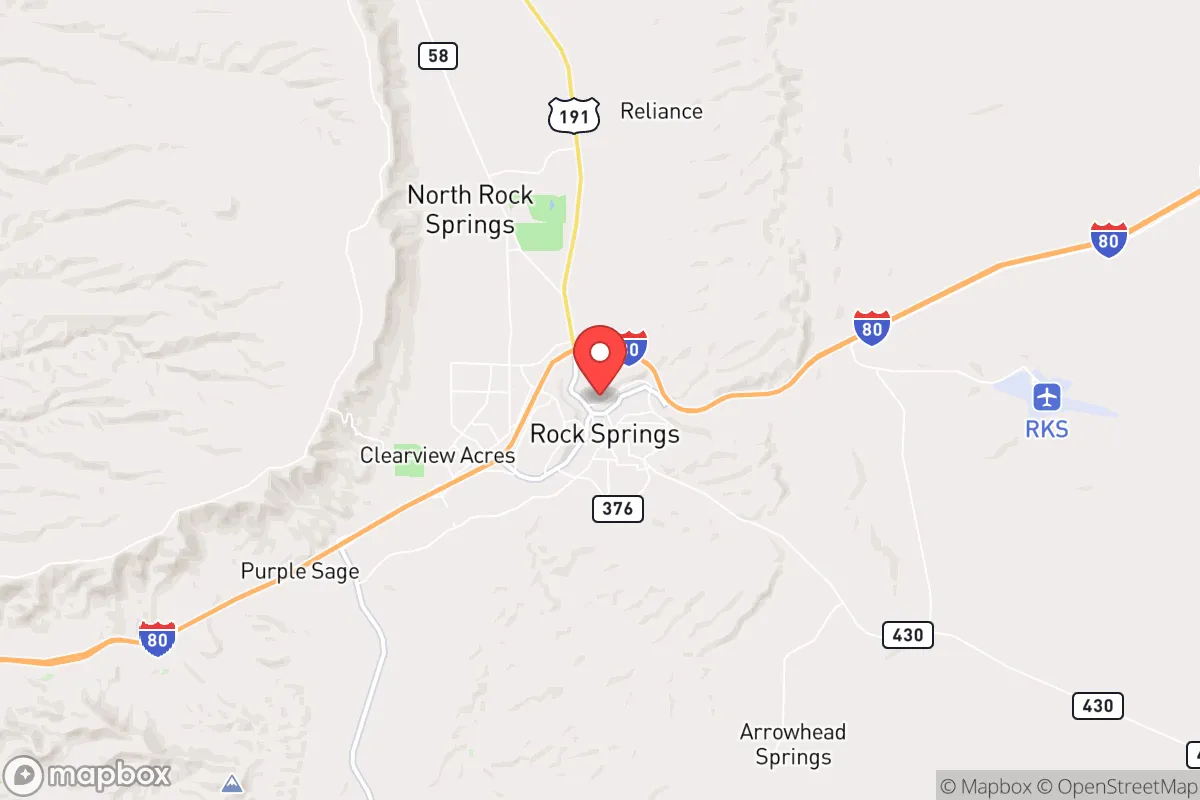
If you look at the surrounding area, Rock Springs is actually a bit of an outlier in its own county. Sweetwater County as a whole leans conservative, but Rock Springs itself has a more working-class, union-influenced history that makes it a little more pragmatic than, say, the ranching communities up in Sublette County or the more libertarian-leaning folks over in Carbon County. Drive an hour east to Rawlins, and you'll find a similar vibe but with a stronger independent streak. Head west to Evanston, and you're getting into more of a Utah-influenced conservative culture. The real contrast is with places like Laramie or Jackson—those are the spots where you see progressive policies creeping in, like higher taxes and more regulations. Rock Springs residents tend to look at those areas and shake their heads, glad we're not dealing with that kind of government overreach here.
What this means for residents
For the people who live here, the political climate means a lot of practical freedoms that are getting harder to find elsewhere. You don't have to worry about the city council telling you what kind of lightbulbs to buy or how to heat your home. Property taxes are reasonable, and there's no state income tax, which is a big deal for families trying to make ends meet. The local government tends to stay out of your personal life, and that's how most folks like it. You'll see a lot of pickup trucks with gun racks and "Don't Tread on Me" stickers, and that's not just for show—it's a genuine attitude. The downside is that if you're looking for a lot of government services or social programs, you won't find much here, but most residents see that as a feature, not a bug.
One thing that sets Rock Springs apart from some other conservative towns is its cultural mix. The energy industry—coal, oil, gas, and now some trona mining—brings in people from all over, so you get a bit of a melting pot feel that you don't see in more homogeneous rural areas. That said, the core values stay the same: hard work, self-reliance, and a healthy skepticism of anyone who wants to tell you how to live your life. If you're thinking about moving here, just know that the local politics are pretty straightforward—you're expected to pull your own weight, and the government is expected to stay out of your way. It's a refreshing change from a lot of places these days, and I hope it stays that way for a long time.

State Political ClimatePolitical Climate in Wyoming
State Political AnalysisPolitical Environment in the State
Wyoming is one of the most reliably conservative states in the Union, with a Republican partisan lean that has only deepened over the past two decades. The state hasn’t voted for a Democratic presidential candidate since 1964, and in 2024, Donald Trump carried it by over 40 points. But the real story isn’t just the raw numbers—it’s the internal tension between a libertarian-leaning, small-government ethos and a growing strain of populist conservatism that’s reshaping local politics from Cheyenne to Cody. Over the last 10-20 years, the GOP has consolidated power to the point where Democrats hold zero statewide elected offices, and the legislature is a supermajority. Yet beneath that red surface, there’s a quiet battle over what “conservative” actually means here.
Urban vs. rural divide
The political map of Wyoming is less about urban vs. rural and more about “less rural” vs. “extremely rural.” The largest city, Cheyenne (pop. ~65,000), leans Republican but is the most moderate part of the state—Laramie County voted about 62% for Trump in 2024, compared to 80%+ in places like Sublette or Niobrara counties. Casper (Natrona County) is a reliable red stronghold, though its energy-industry workforce has made it sensitive to federal land-use policies. The real outlier is Teton County, home to Jackson Hole, which is the only county that consistently votes Democratic—it went for Biden in 2020 and Harris in 2024 by double digits. That’s driven by wealthy out-of-state transplants and a tourism economy that attracts a more progressive crowd. Meanwhile, towns like Gillette (Campbell County) and Rock Springs (Sweetwater County) are deeply conservative, anchored by coal, oil, and gas jobs. The rural-urban divide here is really a “Teton vs. everywhere else” split, with the rest of the state holding firm on gun rights, energy development, and local control.
Policy environment
Wyoming’s policy environment is a dream for limited-government advocates—if you can tolerate the trade-offs. There’s no state income tax, and the sales tax is a low 4% (with local options pushing it to 6% in some towns). Property taxes are among the lowest in the nation, though recent valuation spikes in Teton County have sparked calls for reform. The regulatory posture is aggressively pro-business: no state-level occupational licensing for many trades, minimal environmental review for energy projects, and a right-to-work law that keeps unions weak. Education policy is a mixed bag—the state funds schools well through mineral revenues, but there’s a growing school-choice movement, with a 2023 law allowing Education Savings Accounts for special-needs students. Healthcare is a sore spot: Wyoming is one of the few states that hasn’t expanded Medicaid, and rural hospital closures are a real concern. Election laws are solid—voter ID is required, no-excuse absentee voting is allowed, and the state has resisted mail-in ballot expansions. The legislature passed a law in 2023 banning ranked-choice voting and requiring hand-count audits in some precincts, a nod to election integrity concerns.
Trajectory & freedom
Wyoming is arguably becoming more free in several key areas, but the trajectory is uneven. On gun rights, the state is a national leader: permitless carry has been law since 2011, and in 2023, the legislature passed a “Second Amendment Preservation Act” that prohibits state enforcement of any future federal gun bans. Parental rights got a boost with a 2024 law requiring schools to notify parents of any curriculum involving sexuality or gender identity, and a 2023 law banning transgender athletes from female sports. Medical autonomy is a mixed bag—Wyoming banned nearly all abortions in 2022 via a trigger law, but a court challenge has kept it blocked, leaving the issue unsettled. On property rights, the state passed a law in 2024 limiting county-level zoning authority, a direct response to Teton County’s land-use restrictions. Taxation remains a bright spot: no income tax, and a 2023 law capped property tax increases at 5% annually for homeowners. The biggest threat to freedom here is federal overreach—Wyoming relies heavily on federal mineral royalties and BLM land, so any D.C. push to restrict drilling or mining hits the state hard. The legislature has responded with a “Federal Lands Transfer” resolution demanding the feds hand over 30 million acres to state control, but that’s mostly symbolic for now.
Civil unrest & political movements
Wyoming isn’t known for street protests, but there’s a simmering undercurrent of organized activism. The most visible flashpoint is the “sagebrush rebellion” movement, which has deep roots here—calls for state control of federal lands have been a staple since the 1970s. In 2023, a group called the “Wyoming Liberty Group” pushed for a constitutional convention to limit federal power, though it didn’t gain traction. Immigration politics are muted because the state has a tiny foreign-born population (under 4%), but there’s a 2024 law requiring local law enforcement to cooperate with ICE detainer requests. Election integrity controversies flared in 2022 when a group of activists challenged Dominion voting machines in Laramie County; the state eventually decertified them in favor of hand-counted paper ballots in some precincts. On the left, the only organized movement is in Teton County, where a “Jackson Hole for All” group has pushed for affordable housing mandates and climate resolutions—but those efforts are largely ignored by the rest of the state. You won’t see riots or nightly protests here; the political tension is more about legislative battles and county commission meetings than street confrontations.
Projection
Over the next 5-10 years, Wyoming will likely stay deeply red, but the flavor of that conservatism is shifting. The biggest demographic change is in-migration from blue states—people fleeing Colorado, California, and Oregon for lower taxes and more freedom. That’s already transforming Teton County into a progressive enclave, and it’s starting to nudge places like Laramie (home to the University of Wyoming) slightly leftward. But the vast majority of newcomers are conservatives, many of them remote workers or retirees who want the Wyoming lifestyle without the politics of their old states. That influx is fueling a populist backlash in the legislature—expect more laws targeting “woke” policies in schools, more resistance to federal land control, and possibly a push for a state-level school voucher program. The energy transition is the wild card: as coal declines, towns like Gillette and Rock Springs could see economic pressure that either radicalizes them further right or forces a pragmatic shift toward diversification. The state’s biggest vulnerability is its reliance on federal dollars—if D.C. ever cuts mineral royalties or tightens BLM leasing, the budget will crater, and that could spark a real crisis of governance. For now, expect more of the same: a state that’s conservative, independent, and increasingly skeptical of both national parties.
For a new resident, the bottom line is this: Wyoming offers a level of personal freedom—on taxes, guns, and local control—that’s hard to find anywhere else. But that freedom comes with trade-offs: limited healthcare access, a fragile economy tied to resource extraction, and a political culture that can feel insular. If you’re moving here for the liberty, you’ll find it in spades in places like Cody, Buffalo, or Douglas. If you’re looking for a progressive haven, stick to Jackson—but know you’ll be an island in a red sea. The state’s trajectory is toward more conservative populism, not less, so expect the legislature to keep pushing on parental rights, election integrity, and federal land transfer. Just don’t expect much drama—Wyoming’s politics are as steady and stubborn as the wind that never stops blowing across the high plains.
* Values derived from national, state, county, city and local statistics and may differ in a specific area. Last updated: 2026-04-21T10:51:06.000Z
Narrative content on this page is AI-generated and may contain mistakes. Verify any details that matter before acting on them.
ReloMaps may earn a commission from affiliate links at no extra cost to you.

