Photo: Wikipedia
Demographics of Rockport, TX
Affluence Level in Rockport, TX
A middle-class area roughly in line with national averages across income, home values, education, and employment.
People of Rockport, TX
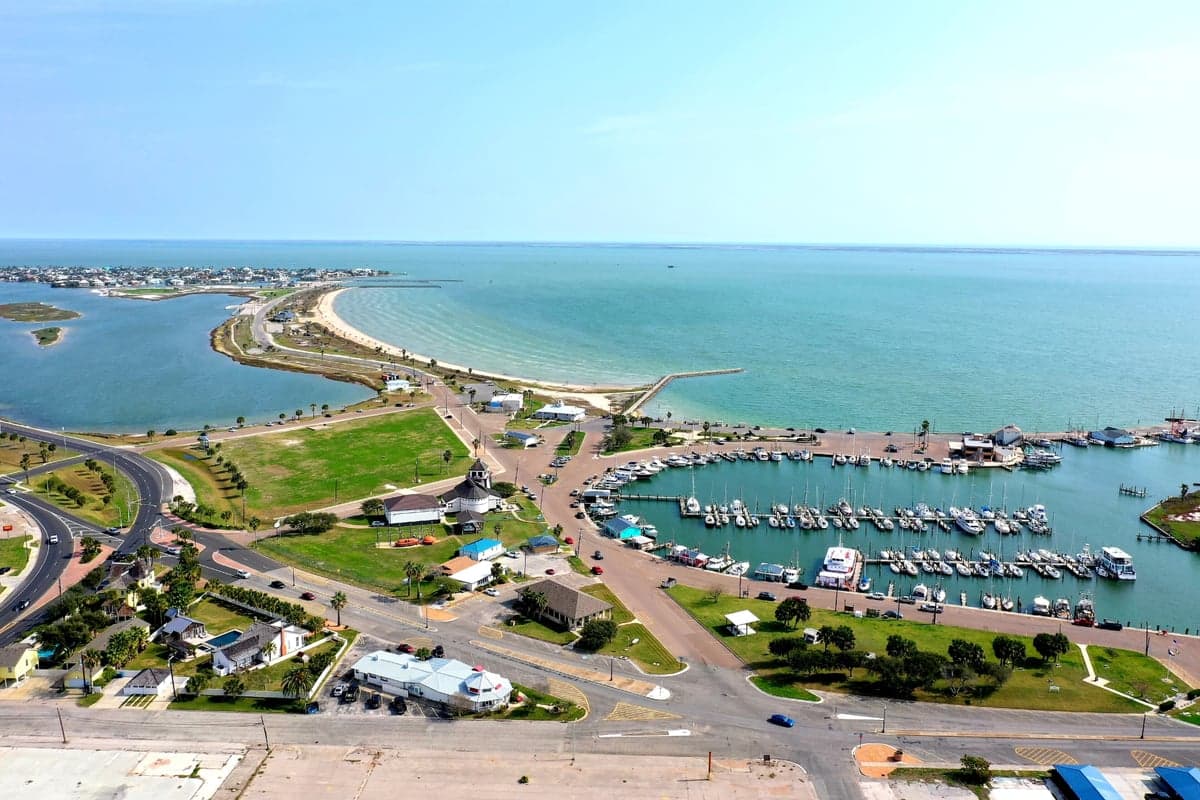
Rockport, Texas, is a small coastal city of 10,449 residents with a distinctly older, predominantly white, and politically conservative character. The population is 72.9% white and 22.1% Hispanic, with negligible foreign-born residents (0.6%) and very small Black (0.6%), East/Southeast Asian (0.5%), and Indian-subcontinent (0.0%) communities. The city’s identity is shaped by its history as a fishing village, a retirement destination, and a hurricane-resilient community that has rebuilt with a strong sense of local tradition.
How the city was settled and grew
Rockport’s original population arrived in the mid-19th century, drawn by the natural deep-water harbor on Aransas Bay. The city was officially founded in 1870 as a port for shipping cotton and cattle, and the first wave of settlers were Anglo-American ranchers and merchants from the Southern states. These families built the Historic Rockport-Fulton area, a waterfront district where many of the original 19th-century homes and commercial buildings still stand. By the early 1900s, the population remained small and overwhelmingly white, with a handful of Mexican-American families working in fishing and agriculture. The Live Oak Peninsula neighborhoods, including Key Allegro and Estes Flats, were developed in the 1920s and 1930s as summer homes for wealthy Texans from San Antonio and Houston, establishing Rockport’s pattern of seasonal and retirement in-migration. The city’s growth was slow through the mid-20th century, with the 1960 census recording just 2,214 residents.
Modern era (post-1965)
After the 1965 Immigration and Nationality Act, Rockport saw almost no change in its foreign-born population—it remains under 1% today—because the city lacked the industrial or agricultural jobs that drew immigrants to other Texas regions. Instead, the post-1965 growth came from domestic in-migration: retirees from the Midwest and Northeast, and second-home buyers from inland Texas. The Aransas Woods and Salt Grass Shores neighborhoods, developed in the 1970s and 1980s, attracted middle-class families and snowbirds seeking waterfront property. The Hispanic population grew gradually, from about 8% in 1980 to 22.1% today, driven by Mexican-American families moving from the Rio Grande Valley for construction and service jobs tied to tourism and the fishing industry. These families concentrated in the Fulton Beach Road corridor and the older South Rockport area, where modest homes and mobile home parks offered affordable housing. The white population, while still the majority, has aged in place: the median age is 56.2, and many younger white residents have left for larger cities, replaced by older retirees. The Black and Asian communities remain tiny, with no distinct ethnic enclaves.
The future
Rockport’s population is heading toward further homogenization and aging. The city lost about 8% of its population after Hurricane Harvey in 2017, and rebuilding has favored higher-value homes, pricing out some lower-income Hispanic families. The Hispanic share is likely to plateau or grow slowly, as the area lacks the job base to attract younger immigrant families. The white population will continue to age, with the 65+ cohort already at 35.4%. No new immigrant communities are emerging; the East/Southeast Asian and Indian-subcontinent populations are essentially static. The city is not tribalizing into distinct ethnic enclaves—rather, it is becoming a more uniformly older, white, and conservative retirement community, with a small Hispanic service-worker population concentrated in older neighborhoods. The next decade will likely see slow population growth (0.5–1% annually) driven by coastal retirees, with little demographic diversification.
For someone moving to Rockport now, the city offers a stable, low-diversity environment where the population is overwhelmingly native-born, English-speaking, and politically conservative. The trade-off is a limited labor market and a social scene geared toward retirees and seasonal residents, with few young families or recent immigrants. It is a place where the past—fishing, ranching, small-town Gulf Coast life—still defines the present, and where the future looks much like the present, only older.

* Values derived from national, state, county, city and local statistics and may differ in a specific area. Last updated: 2026-05-14T18:47:15.000Z
Narrative content on this page is AI-generated and may contain mistakes. Verify any details that matter before acting on them.
ReloMaps may earn a commission from affiliate links at no extra cost to you.

