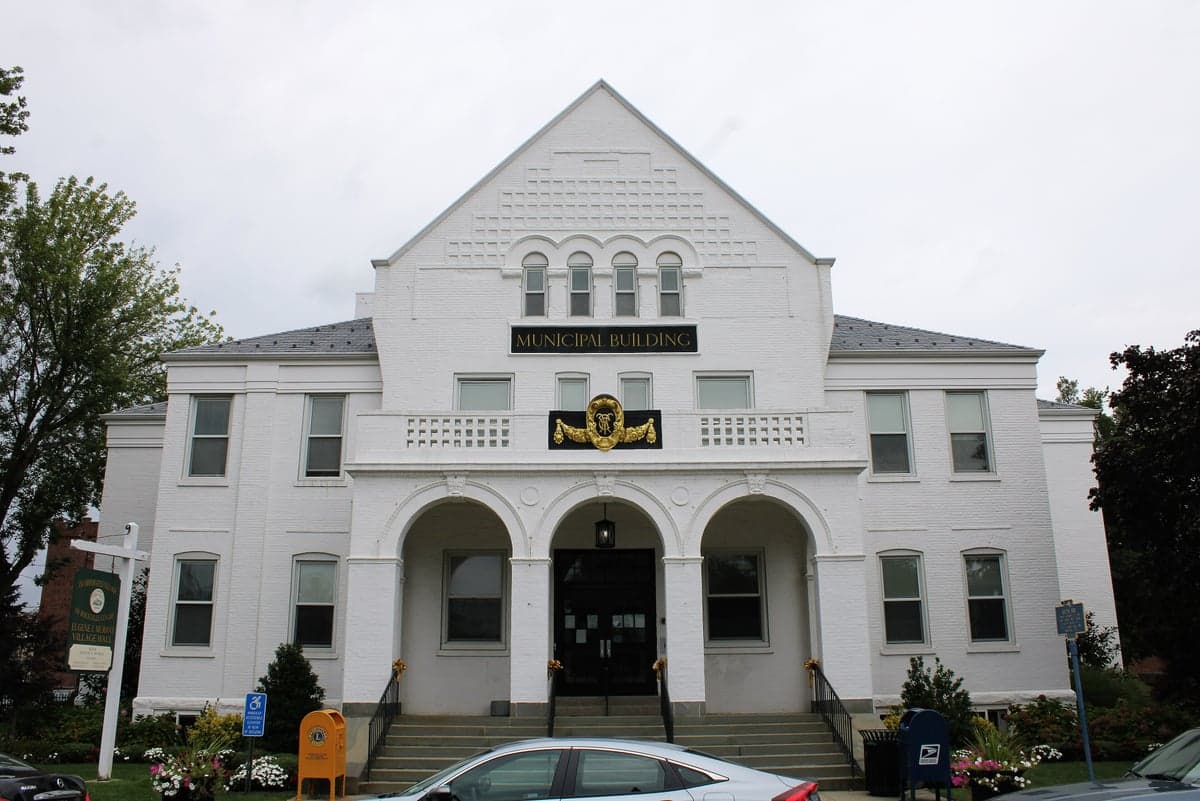
Photo: Wikipedia
Demographics of Rockville Centre, NY
Affluence Level in Rockville Centre, NY
An upper-middle-class area. Household wealth, education levels, and homeownership run ahead of national benchmarks.
People of Rockville Centre, NY
Rockville Centre is a densely settled, majority-white village of 25,770 residents on Long Island’s South Shore, known for its walkable downtown, top-ranked school district, and a population that is 77.2% white, 10.1% Hispanic, 4.0% Black, 4.0% East/Southeast Asian, and 1.5% Indian. The village has a notably high college attainment rate of 62.9%, well above the national average, and a very low foreign-born share of just 3.1%, reflecting a population that is overwhelmingly native-born and multigenerational. Its identity is shaped by a history of successive European ethnic waves, followed by a period of stability and modest diversification since the 1990s. For a conservative-leaning family or individual, Rockville Centre offers a traditional, family-oriented suburb with strong civic institutions and a population that has remained remarkably stable in its core character over the past half-century.
How the city was settled and grew
Rockville Centre’s population history begins with the Meroke Native Americans, who ceded the land to English colonists in the 1640s. The village itself was not formally incorporated until 1893, and its growth was driven almost entirely by the arrival of the Long Island Rail Road in the 1860s. The first major wave of settlers were Protestant Yankees from New England and upstate New York, who built large homes in the North Village area around the train station. By the early 1900s, Irish and German immigrants arrived to work on the railroad and in local trades, settling in the South Side neighborhoods near the tracks. A second major wave of Italian immigrants came in the 1910s–1930s, establishing a strong presence in the Lakeview and Baldwin Harbor border areas, where they built St. Agnes Cathedral and the Italian-American social clubs that remain active today. Jewish families, primarily of German and Eastern European descent, began arriving in the 1920s and 1930s, concentrating in the Hewlett Point and South Park sections, and helped establish the village’s reputation for excellent public schools. By 1950, Rockville Centre was a predominantly white, Catholic and Jewish suburb of 22,000, with a strong middle-class character and virtually no non-white population.
Modern era (post-1965)
The post-1965 period brought only modest demographic change to Rockville Centre compared to many other Long Island suburbs. The 1970s and 1980s saw a small influx of Black families, primarily from Brooklyn and Queens, who settled in the South Side and Lakeview neighborhoods, but the village’s housing costs and zoning laws limited broader integration. The Hispanic population, now 10.1%, began growing in the 1990s, driven by Central American and Puerto Rican families moving into rental units near the Merrick Road corridor. The East/Southeast Asian community, now 4.0%, arrived primarily in the 2000s and 2010s, with Chinese and Korean families drawn to the school district and settling in the North Village and Hewlett Point areas. The Indian population, at 1.5%, is a more recent addition, with professionals moving into single-family homes in the South Park section. Despite these shifts, the village’s white population has remained above 77%, and the foreign-born share of just 3.1% is among the lowest on Long Island, indicating that most growth has come from domestic migration rather than international immigration. The village has not experienced the rapid ethnic succession seen in nearby communities like Hempstead or Uniondale.
The future
Rockville Centre’s population is likely to remain stable in size and character over the next 10–20 years. The village is essentially built out, with limited new housing construction, and its high property values and strict zoning will continue to filter for affluent, college-educated households. The Hispanic and East/Southeast Asian shares are expected to grow slowly, perhaps reaching 12–14% and 5–6% respectively by 2040, as younger families move in from other parts of Nassau County. The Indian population may also increase modestly, but the village’s lack of a large tech or medical employment base limits its appeal to this group compared to nearby Jericho or Great Neck. The white population will likely remain the majority, though it may decline slightly to around 72–74% as older residents age out and are replaced by a more diverse mix. The village is not tribalizing into distinct ethnic enclaves; rather, it is slowly homogenizing into a wealthier, more educated version of itself, with all groups sharing the same schools, parks, and downtown.
For a conservative-leaning family or individual considering a move, Rockville Centre represents a stable, high-opportunity suburb where the population is overwhelmingly native-born, well-educated, and civically engaged. The low foreign-born share and high college attainment rate mean that newcomers will find a community with strong English fluency, high property values, and a shared commitment to local institutions. The village is not becoming a diverse, immigrant-driven hub; it is remaining a traditional, majority-white, family-oriented enclave with gradual, manageable diversification. This makes it a predictable and safe choice for those seeking a long-term home in a community that values continuity over rapid change.

* Values derived from national, state, county, city and local statistics and may differ in a specific area. Last updated: 2026-04-24T12:35:23.000Z
Narrative content on this page is AI-generated and may contain mistakes. Verify any details that matter before acting on them.
ReloMaps may earn a commission from affiliate links at no extra cost to you.

