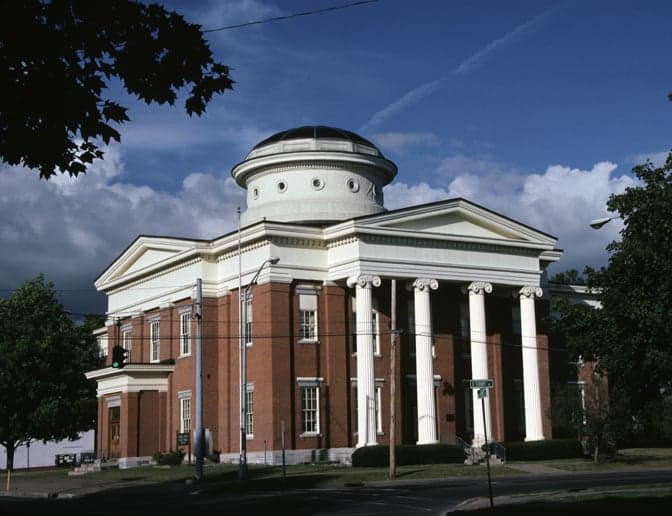
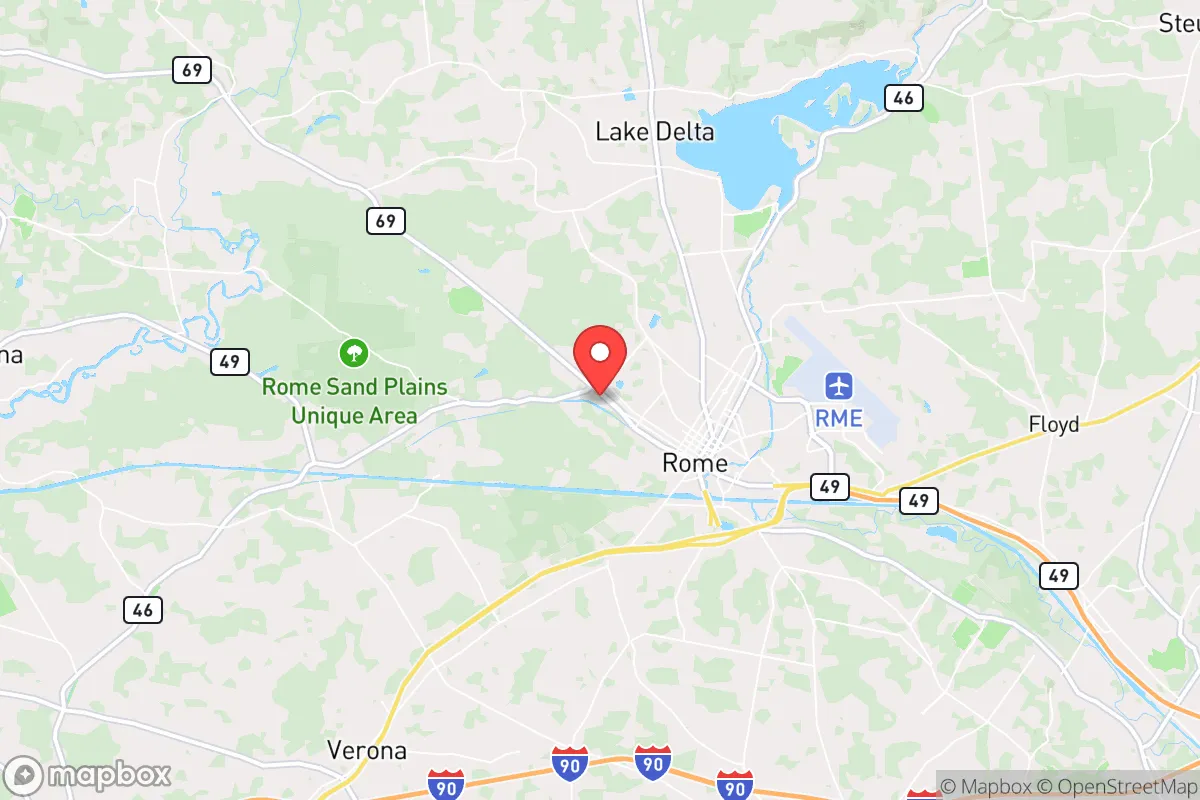
Photo: Wikipedia
Personal Sovereignty in Rome, NY
Moderate friction. Expect trade-offs in some aspect of personal liberty and independence.
What does Personal Sovereignty tell us?
Personal Sovereignty measures your capacity for self-reliance and independence with minimal government friction. Higher scores mean fewer barriers between you and the way you want to live... but it assumes you have the space you need and good neighbors.
What does this tell us?
Personal Sovereignty measures your capacity for self-reliance and independence with minimal government friction. Higher scores mean fewer barriers between you and the way you want to live... but it assumes you have the space you need and good neighbors.
State Policy
Energy independence: Importer (12% of energy produced in-state)
Personal Liberty
Homesteading

Personal Liberty Analysis
Rome, New York, presents a mixed picture for those prioritizing personal sovereignty. While the city itself offers a relatively low cost of living and a quieter pace of life, it sits firmly within a state government that has increasingly centralized authority over local decisions, from gun rights to energy policy. For a survivalist or prepper mindset, the key question isn't just what you can do on your own property, but how much the state will let you do it without interference. The autonomy environment here is best described as "local potential, state constraints"—you can carve out a degree of self-reliance, but you'll be doing so under the shadow of Albany's regulatory reach.
Tax burden and regulatory posture: How New York state policies affect your wallet and freedom
New York's tax burden is among the highest in the nation, and Rome is not exempt. Property taxes in Oneida County are notable, with effective rates often exceeding 2.5% of a home's assessed value. For a $150,000 home—common in Rome—that means annual property taxes around $3,750 to $4,500. This is a significant recurring cost for anyone trying to minimize monthly overhead and build financial resilience. State income taxes are also progressive, topping out at 10.9% for high earners, which can eat into savings for gear, land, or supplies. The regulatory posture is similarly heavy. New York's Climate Leadership and Community Protection Act is phasing out natural gas hookups in new construction, pushing toward electrification. This directly impacts preppers who value off-grid energy independence—installing a backup generator or solar array with battery storage is still legal, but you'll face permitting hurdles and utility interconnection requirements that add cost and time. For those looking to minimize government entanglement, the tax and regulatory climate in Rome is a clear negative, though the lower property values partially offset the high rates.
Self-defense and gun law specifics: What you can and cannot do in Rome, NY
This is the most significant sovereignty concern for conservative-leaning individuals. New York's gun laws are among the most restrictive in the nation, and Rome residents must comply with state-level mandates. The Concealed Carry Improvement Act (CCIA), passed in 2022, requires a "proper cause" showing for a concealed carry permit—essentially a subjective determination by local licensing officials. In practice, Oneida County has been more reasonable than downstate jurisdictions, but the legal landscape remains uncertain. Magazine capacity is capped at 10 rounds, and "assault weapons" are banned by feature, including common semi-automatic rifles like the AR-15. Background checks are required for all firearm transfers, including private sales. For preppers, this means stockpiling standard-capacity magazines or certain rifle configurations is illegal. Castle doctrine exists in New York, but it's not as strong as in stand-your-ground states. You have a duty to retreat if safe to do so before using deadly force, even in your home in some interpretations. Self-defense training and legal insurance (like US LawShield) are strongly advised for anyone living here. The bottom line: if gun rights are a core sovereignty issue, Rome is a compromise location—you can own firearms, but with significant state-imposed limits.
Self-reliance and homesteading viability: Lot sizes, zoning, and off-grid feasibility
Rome's rural character offers genuine opportunities for self-reliance, but zoning and state codes impose limits. Many residential lots in the city proper are small—typically 0.1 to 0.25 acres—making substantial homesteading difficult. However, outlying areas within the Rome city limits and nearby towns like Lee, Western, and Verona offer 1- to 5-acre parcels at affordable prices (often $10,000–$30,000 per acre). Zoning in these areas generally permits keeping chickens, goats, and even a few head of cattle, though you'll need to check specific town ordinances. Off-grid living is legally challenging. New York requires all dwellings to be connected to a septic system or public sewer, and the state building code mandates grid-tied electrical service for new construction. Going fully off-grid with solar and no utility connection is effectively illegal for a primary residence, though you can install a solar system with battery backup as a supplement. Rainwater collection is allowed for non-potable uses like irrigation, but potable water must come from a well or municipal supply. For a prepper, the best strategy is to buy a property with an existing well and septic, then add solar panels and a generator as backup—not as a full replacement. The growing season is short (Zone 5b, roughly 140 frost-free days), limiting year-round food production, but cold frames and hoop houses can extend it.
Personal liberties: Parental rights, medical autonomy, speech, and property
New York's political climate has shifted leftward on several fronts that affect personal sovereignty. Parental rights in education have been eroded by state policies that allow schools to withhold information about a child's gender identity from parents, and by curriculum mandates that some families find objectionable. Rome's school district, while not as progressive as downstate districts, must still comply with state education law. Homeschooling is legal but requires annual notification and submission of an Individualized Home Instruction Plan (IHIP) to the district, along with quarterly reports and annual assessments. Medical autonomy is similarly constrained. New York has broad vaccine mandates for school attendance, and during the COVID-19 pandemic, the state imposed some of the strictest lockdowns and business closures in the country. For those concerned about future public health overreach, this precedent is troubling. Free speech is protected under the First Amendment, but New York has a "hate crimes" law that can enhance penalties for speech perceived as intimidating, which some critics argue chills political discourse. Property rights are relatively strong for existing homeowners, but the state's environmental regulations (e.g., wetland protections, DEC oversight) can limit what you do on your land, especially near water or wooded areas. The overall picture is one of constrained liberty—you have more freedom than in a major city like New York City, but less than in a state like Texas or New Hampshire.
In the broader context of personal sovereignty, Rome, NY, is a location of trade-offs. The low cost of land and housing, combined with a rural feel and a community that leans more conservative than the state average, provides a foundation for self-reliance. However, the heavy hand of New York state government—in taxes, gun control, energy mandates, and education policy—means you cannot fully escape government overreach. For a survivalist or prepper willing to navigate these constraints, Rome offers a viable base of operations, but it is not a sanctuary. Compared to states like Idaho, Montana, or even upstate Pennsylvania, Rome falls short on raw sovereignty metrics. It is best suited for those who have deep roots in the region or who need to stay in New York for family or work reasons, and who are prepared to invest in legal compliance and defensive measures to protect their autonomy.

* Values derived from national, state, county, city and local statistics and may differ in a specific area. Last updated: 2026-05-01T08:45:07.000Z
Narrative content on this page is AI-generated and may contain mistakes. Verify any details that matter before acting on them.
ReloMaps may earn a commission from affiliate links at no extra cost to you.

