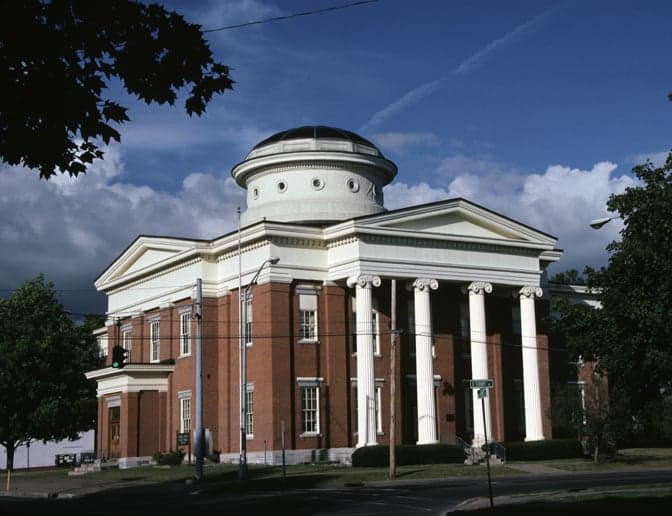
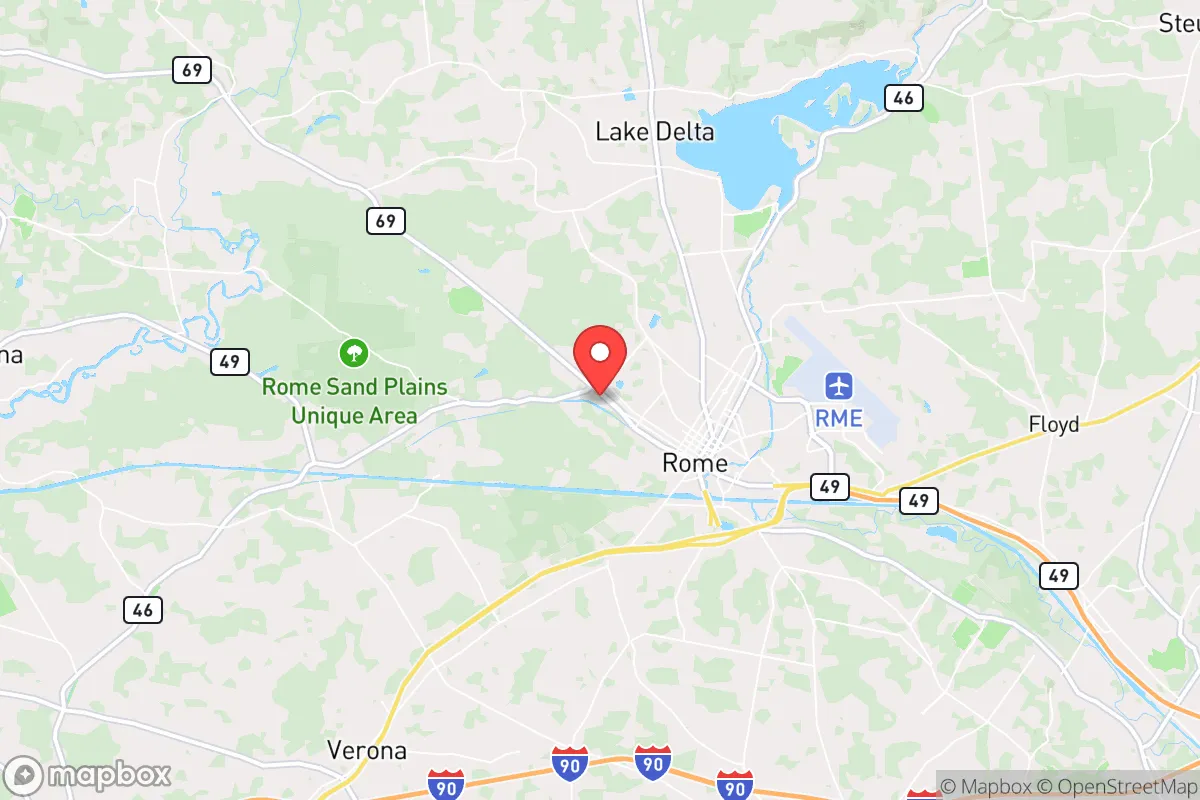
Photo: Wikipedia
Demographics of Rome, NY
Affluence Level in Rome, NY
A below-average socioeconomic profile. Incomes, home values, and educational attainment trail the U.S., with higher poverty and unemployment.
People of Rome, NY
The people of Rome, New York, today number roughly 31,800, forming a predominantly white (81.0%) and older-than-average community with a notably low foreign-born share of just 1.6%. The city’s character is shaped by its history as a manufacturing and military hub, now transitioning toward a more service-oriented economy, and its population density of about 1,200 people per square mile gives it a small-city feel with distinct, historically rooted neighborhoods. A distinctive marker is the strong presence of Italian-American and Polish-American families, whose ancestors arrived in the early 1900s, alongside a smaller but established Black community (4.6%) and a growing Hispanic population (6.9%), concentrated in specific wards and streets.
How the city was settled and grew
Rome’s original population was drawn by its strategic location on the Mohawk River and the historic Oneida Carrying Place, a portage route used by Native Americans and later European settlers. The city was formally incorporated in 1870, but its growth exploded after the Erie Canal opened in 1825, bringing Yankee settlers from New England and later waves of Irish immigrants who dug the canal and built the early infrastructure. These Irish families settled in what is now the East Rome neighborhood, near the canal and rail yards. The next major wave came between 1880 and 1920, when Rome’s copper and brass mills—especially the Rome Brass & Copper Company—drew Italian and Polish immigrants. These groups built tight-knit enclaves in West Rome (around the mills) and the South Rome district, where St. Mary’s and St. Stanislaus churches still anchor the community. A smaller but significant wave of German and French-Canadian families arrived during the same period, settling in the North Rome area near the rail lines. By 1950, Rome’s population peaked at over 41,000, fueled by the expansion of Griffiss Air Force Base, which brought in military families and civilian workers from across the country.
Modern era (post-1965)
After the 1965 Hart-Cellar Act, Rome saw only a modest increase in foreign-born residents, with the current 1.6% share far below the national average. The most significant demographic shift came from domestic in-migration tied to Griffiss Air Force Base, which operated until its realignment in 1995. During the Cold War, the base attracted Black and Hispanic military families, who settled primarily in the Lake Delta area and the Stittville district, where base housing was concentrated. After the base’s closure, many of these families stayed, contributing to the city’s current Black (4.6%) and Hispanic (6.9%) populations. The Hispanic community has grown steadily since 2000, driven by Puerto Rican and Mexican families moving from larger Upstate cities like Utica and Syracuse, and they now form visible clusters in the West Rome and Downtown neighborhoods. The East/Southeast Asian population (1.7%) is small and largely professional, with many families connected to the Mohawk Valley Health System or local colleges, and they are scattered rather than concentrated in a single enclave. The Indian-subcontinent population (0.1%) is negligible, with only a handful of families, mostly in the Lake Delta area. Suburbanization after 1970 hollowed out the core, with white families moving to newer developments in West Rome and Floyd, leaving the older South Rome and East Rome neighborhoods with higher vacancy rates and an aging population.
The future
Rome’s population is projected to continue a slow decline, from 31,795 today toward perhaps 28,000 by 2040, as the city’s median age (around 42) and low birth rates outpace any in-migration. The city is not tribalizing into distinct ethnic enclaves but rather homogenizing as the white population ages and younger families leave for larger metro areas. The Hispanic share is likely to grow modestly, possibly reaching 10-12% by 2040, as families from Utica and Syracuse continue to move in for lower housing costs, but this growth will be gradual and concentrated in West Rome and Downtown. The Black population is stable, with little new in-migration, and the East/Southeast Asian community is plateauing as the health-care sector’s hiring slows. The foreign-born share will likely remain below 3%, as Rome lacks the refugee resettlement programs or large employers that attract immigrants to other Upstate cities. The city is becoming more of a bedroom community for workers commuting to Utica, Syracuse, and the Griffiss Business Park, with a population that is older, whiter, and more rooted than the national average.
For someone moving in now, Rome offers a stable, low-cost environment with a population that is predominantly long-term residents who value community institutions like churches and ethnic clubs. The city is not diversifying rapidly, so newcomers should expect a culturally homogeneous social landscape, especially outside the Hispanic and Black neighborhoods. The key trade-off is affordability and safety versus limited economic dynamism and a shrinking tax base—a reality that will shape the city’s character for the next generation.

* Values derived from national, state, county, city and local statistics and may differ in a specific area. Last updated: 2026-05-01T08:45:07.000Z
Narrative content on this page is AI-generated and may contain mistakes. Verify any details that matter before acting on them.
ReloMaps may earn a commission from affiliate links at no extra cost to you.

