 Popular
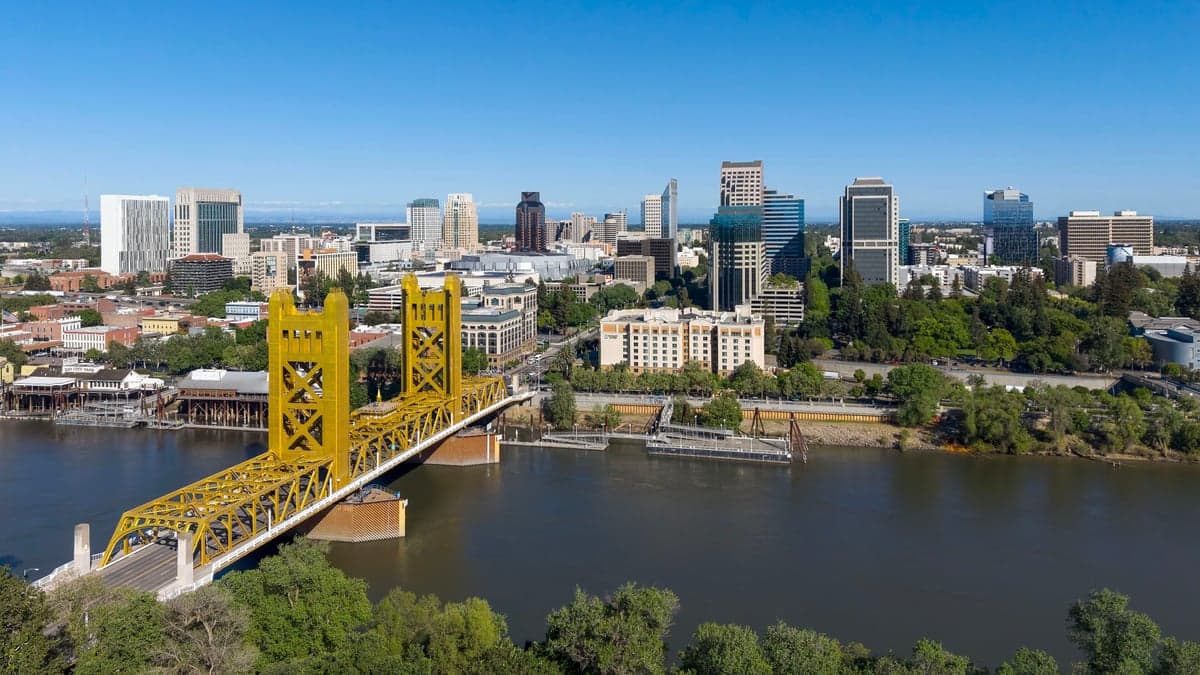
Photo: Wikipedia
Demographics of Sacramento, CA
Affluence Level in Sacramento, CA
A middle-class area roughly in line with national averages across income, home values, education, and employment.
People of Sacramento, CA
Sacramento’s 524,802 residents form one of the most ethnically diverse and politically moderate major cities in California, a place where a plurality-white population (30.2%) coexists with large Hispanic (29.5%), East/Southeast Asian (16.0%), Black (11.7%), and Indian-subcontinent (3.4%) communities. The city is notably less foreign-born (8.5%) than coastal California metros, reflecting a population shaped more by domestic migration than by recent international arrivals. With 36.4% of adults holding a bachelor’s degree, Sacramento strikes a middle ground between blue-collar roots and a growing professional class, anchored by state government, healthcare, and logistics.
How the city was settled and grew
Sacramento was founded in 1849 by John Sutter Jr. as a speculative grid of streets near the confluence of the Sacramento and American Rivers, designed to supply the sudden flood of gold seekers. The 1848 discovery at Sutter’s Mill drew tens of thousands of fortune hunters from the eastern United States, Europe, and China. Chinese laborers, who built the transcontinental railroad through the Sierra Nevada, established Sacramento’s first major ethnic enclave in what is now the Old Sacramento historic district and the adjacent Chinatown (centered on I and 3rd Streets), a neighborhood that remained a commercial and residential hub for East/Southeast Asian immigrants through the 1880s. The completion of the railroad in 1869 and the arrival of the Central Pacific Railroad’s shops turned Sacramento into a rail and agricultural distribution center, drawing waves of European immigrants—Germans, Irish, and Italians—who settled in the Alkali Flat and Mansion Flat neighborhoods north of downtown. By 1900, the city’s population had reached 29,282, with a small but established Black community concentrated in the Oak Park neighborhood east of downtown, a district that would become the heart of Sacramento’s African American life for the next century. The post-World War II boom brought a second major wave: defense-industry workers and military personnel stationed at McClellan Air Force Base and Mather Air Force Base, many of whom settled in the South Sacramento and Meadowview areas, transforming those flatlands into working-class suburbs.
Modern era (post-1965)
The 1965 Hart-Cellar Immigration Act and the end of national-origin quotas reshaped Sacramento’s demographics dramatically. The largest post-1965 influx was from Southeast Asia: Vietnamese, Hmong, and Laotian refugees arrived in the late 1970s and 1980s, clustering in the South Sacramento and Florin neighborhoods, where they established Buddhist temples, grocery stores, and community organizations. Today, Sacramento County has one of the highest concentrations of Hmong Americans in the United States, with Florin Road serving as a commercial spine for East/Southeast Asian businesses. Simultaneously, domestic migration from the Bay Area accelerated after 1990, as higher housing costs pushed working- and middle-class families—disproportionately Black and Hispanic—eastward into Sacramento. The Black population, which peaked at roughly 15% in the 1990s, has since declined to 11.7% as many families moved further to the suburbs of Elk Grove and Roseville. Hispanic growth has been steady, driven by both domestic migration from Southern California and immigration from Mexico and Central America, with the North Sacramento and Del Paso Heights neighborhoods becoming predominantly Hispanic. The Indian-subcontinent community (3.4%) is a more recent arrival, largely tied to the tech and healthcare sectors, and is concentrated in the newer subdivisions of Natomas and the Pocket-Greenhaven areas, where professional-class families have bought homes since the early 2000s.
The future
Sacramento’s population is trending toward a tri-ethnic balance of non-Hispanic white, Hispanic, and East/Southeast Asian residents, with the Black share slowly declining and the Indian-subcontinent share growing modestly. The city is not homogenizing; rather, it is tribalizing into distinct geographic enclaves. Natomas and the Pocket are becoming majority-Asian and Indian-subcontinent professional corridors, while South Sacramento and Florin remain heavily East/Southeast Asian and Hispanic. Oak Park and Del Paso Heights are gentrifying, with white and Asian in-movers gradually displacing longer-term Black and Hispanic renters. The foreign-born share (8.5%) is low by California standards and is projected to remain stable, as Sacramento draws more domestic migrants from the Bay Area than international arrivals. Over the next 10–20 years, the city will likely become slightly more Asian and Hispanic, slightly less Black, and roughly as white as it is now—a slow demographic churn rather than a dramatic shift.
For someone moving to Sacramento today, the city offers a genuinely multiethnic environment without the extreme segregation of older industrial cities, but with clear neighborhood identities that reflect distinct migration histories. The state government and healthcare sectors provide stable employment, while the growing professional class is reshaping formerly working-class districts. It is a city of enclaves, not a melting pot, and newcomers should expect to find a community that matches their background and priorities—whether that means a Hmong grocery in Florin, a tech-adjacent subdivision in Natomas, or a historic bungalow in Oak Park.

* Values derived from national, state, county, city and local statistics and may differ in a specific area. Last updated: 2026-04-21T10:02:47.000Z
Narrative content on this page is AI-generated and may contain mistakes. Verify any details that matter before acting on them.
ReloMaps may earn a commission from affiliate links at no extra cost to you.

