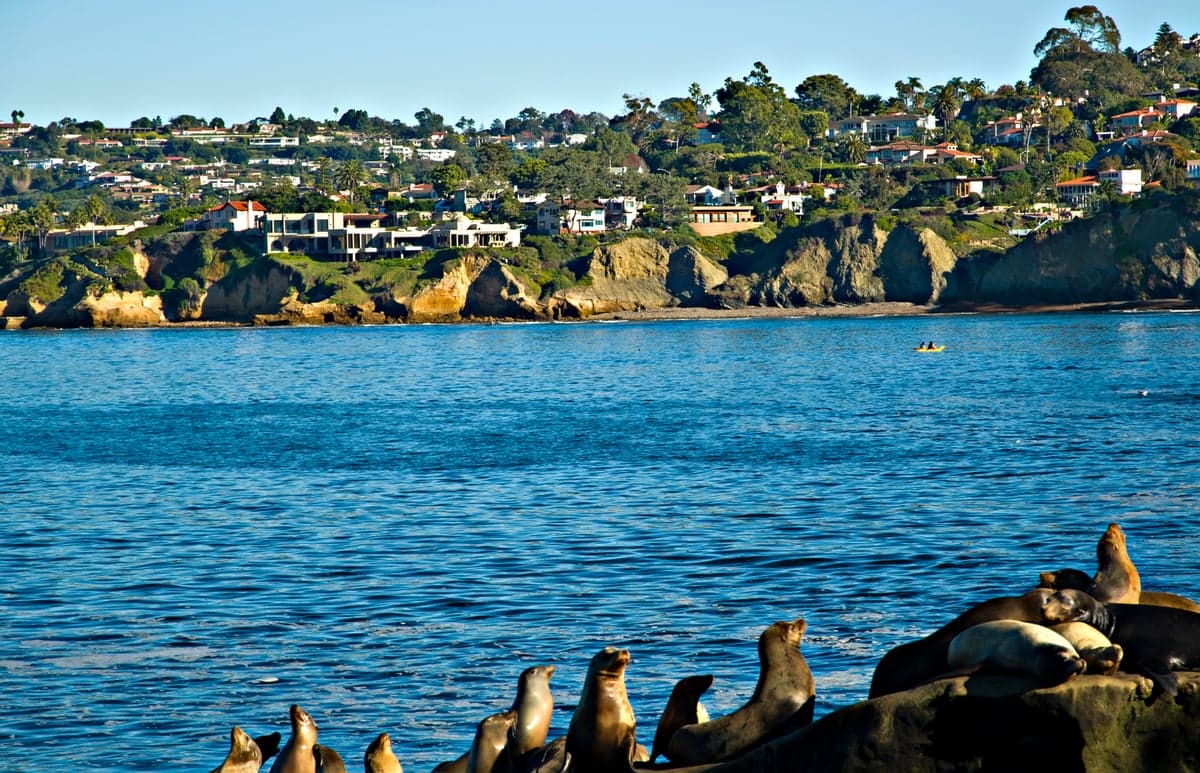
Photo: Wikipedia
Personal Sovereignty in San Diego, CA
Moderate friction. Expect trade-offs in some aspect of personal liberty and independence.
What does Personal Sovereignty tell us?
Personal Sovereignty measures your capacity for self-reliance and independence with minimal government friction. Higher scores mean fewer barriers between you and the way you want to live... but it assumes you have the space you need and good neighbors.
What does this tell us?
Personal Sovereignty measures your capacity for self-reliance and independence with minimal government friction. Higher scores mean fewer barriers between you and the way you want to live... but it assumes you have the space you need and good neighbors.
State Policy
Energy independence: Importer (33% of energy produced in-state)
Personal Liberty
Homesteading

Personal Liberty Analysis
San Diego presents a deeply conflicted environment for personal sovereignty. While its coastal climate and strategic border location offer tangible advantages for self-reliance, the city operates under California’s aggressively expanding regulatory and tax apparatus, which systematically erodes individual autonomy. For a survivalist or prepper evaluating this region, the core tension is clear: you gain access to a robust informal economy and a climate that supports year-round subsistence, but you must navigate one of the most intrusive state governments in the nation, one that actively limits your right to keep what you earn, defend yourself, and make independent medical and educational decisions for your family.
Tax burden and regulatory posture: how California’s system limits your financial autonomy
California’s tax structure is a primary obstacle to personal sovereignty in San Diego. The state imposes a progressive income tax that tops out at 13.3% on high earners, one of the highest rates in the country. Combined with a state sales tax that can exceed 8.75% in San Diego County, and property taxes that, while capped by Proposition 13 at roughly 1% of assessed value, still rise with reassessment upon purchase, the cumulative burden is substantial. For a prepper focused on financial independence, this means a significant portion of your income is forcibly redirected to a state government with a track record of expanding its reach into personal matters. The regulatory posture is equally aggressive: California’s California Environmental Quality Act (CEQA) can be weaponized to delay or block any construction project, including building a personal bunker, installing solar panels, or even constructing a simple shed without permits. The state’s strict building codes and zoning laws make off-grid living nearly impossible within city limits, as any structure must meet energy, water, and waste standards that assume connection to municipal utilities. This regulatory density is a direct assault on the principle that a man should be able to improve his own property without government permission.
Self-defense and gun law specifics: navigating California’s restrictive firearms environment
San Diego’s gun laws are among the most restrictive in the nation, directly impacting your ability to defend your home and family. California operates a may-issue concealed carry system, meaning the San Diego County Sheriff’s Office has broad discretion to deny permits. While recent federal court rulings (like Bruen) have pressured the state, the practical reality is that obtaining a CCW permit in San Diego remains a costly, time-consuming process requiring a "good cause" statement that goes beyond simple self-defense. The state bans so-called "assault weapons" by feature, prohibits magazines holding more than ten rounds, and mandates a ten-day waiting period and a background check for all firearm purchases, including private transfers. For a prepper, this means your defensive capabilities are legally capped: you cannot own standard-capacity magazines, and your rifle options are limited to featureless or fixed-magazine configurations. Open carry of handguns is illegal, and carrying a loaded rifle in public for self-defense is effectively prohibited. The state also has a "red flag" law (Gun Violence Restraining Order) that allows authorities to seize firearms based on a third-party complaint without a criminal conviction, a tool that can be abused by disgruntled neighbors or ex-partners. In a survival scenario, these laws could leave you legally vulnerable for taking the most basic steps to protect your life and property.
Self-reliance and homesteading viability: lot sizes, zoning, and off-grid feasibility
True self-reliance in San Diego is severely constrained by zoning and land-use regulations. Within the city proper, typical residential lot sizes range from 5,000 to 10,000 square feet, with many newer developments on even smaller parcels. Chickens are allowed in most residential zones (with a limit of five hens, no roosters), and beekeeping is permitted with registration, but larger livestock like goats or pigs are prohibited in urban areas. The city’s zoning code requires that all dwellings be connected to the municipal water and sewer system, effectively banning off-grid living. Rainwater catchment is legal but regulated—you can collect up to 5,000 gallons without a permit, but any larger system requires approval. Solar panels are widely permitted, but net metering policies have been weakened, reducing the financial benefit of generating your own power. For a prepper seeking true independence, the only viable option is to look east into the unincorporated county, where lot sizes increase to one acre or more in areas like Alpine, Jamul, or Campo. Even there, however, California’s building codes still apply, and you will face hurdles with septic systems, well permits, and fire clearance requirements. The state’s high water costs and drought restrictions also make large-scale gardening or farming a challenge without significant investment in rainwater storage and greywater systems.
Personal liberties: parental rights, medical autonomy, speech, and property
California’s expansive government reach directly challenges several core personal liberties in San Diego. Parental rights are under consistent pressure: the state mandates comprehensive sexual education in public schools, and parents cannot opt their children out of lessons on gender identity or sexual orientation. The state also has a "gender affirmation" law that can override parental consent for a child’s social transition at school, and it has passed laws allowing minors to consent to certain medical procedures without parental knowledge. On medical autonomy, California’s vaccine mandates for school attendance remain in place, and the state has shown willingness to impose emergency health orders that restrict personal movement and business operations. Free speech is protected by the First Amendment, but California’s "hate speech" laws and workplace harassment statutes can be used to chill political expression, particularly on topics like immigration or gender ideology. Property rights are perhaps the most eroded: the California Coastal Commission has broad authority to restrict development near the coast, and the state’s rent control laws (AB 1482) limit how much landlords can raise rents, which can be seen as a government-imposed cap on the value of your investment. For a prepper, the cumulative effect is a legal environment where the state asserts authority over your children’s education, your medical decisions, and your property’s use, leaving you with fewer options to live according to your own values.
In the broader context of personal sovereignty, San Diego ranks poorly compared to states like Texas, Arizona, or Idaho. The combination of high taxes, restrictive gun laws, aggressive zoning, and encroaching state control over family and medical decisions creates an environment where self-reliance is constantly fighting against regulatory headwinds. For a survivalist willing to live on the urban fringe and invest in legal workarounds—such as forming a trust to hold property, using a private membership association for medical care, or homeschooling under California’s relatively permissive private school affidavit—some autonomy can be preserved. But for those seeking a location where personal sovereignty is the default rather than a constant legal battle, San Diego is a strategic liability. The climate and geography are assets, but the state government is a persistent adversary to the prepper mindset.

* Values derived from national, state, county, city and local statistics and may differ in a specific area. Last updated: 2026-04-24T09:52:25.000Z
Narrative content on this page is AI-generated and may contain mistakes. Verify any details that matter before acting on them.
ReloMaps may earn a commission from affiliate links at no extra cost to you.

