
Photo: Wikipedia
Political ClimatePolitical Climate in San Diego, CA
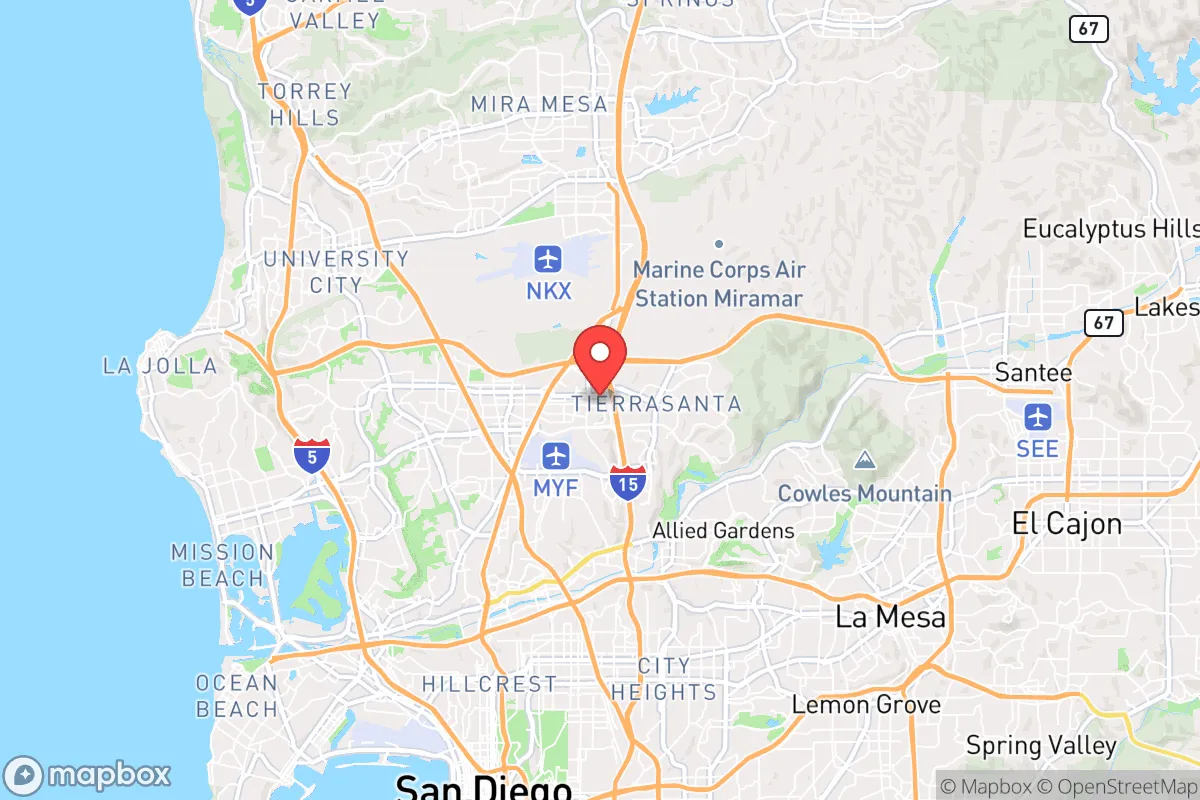
District shown is the primary district for this city’s centroid. Cities may span multiple districts.
Local Political AnalysisPolitical Analysis of San Diego, CA
San Diego’s political climate has shifted hard to the left over the past decade, and if you’ve lived here as long as I have, you’ve felt it in everything from local ordinances to traffic enforcement. The city’s Cook PVI of D+13 tells you the headline—this is a solidly Democratic stronghold—but the real story is how fast the Overton window has moved. In the 2024 presidential race, San Diego County went for Kamala Harris by roughly 20 points, a far cry from the purple swing county it was as recently as 2004, when George W. Bush lost it by just 5 points. The trajectory is unmistakable: the city is trending deeper blue with each cycle, driven by an influx of out-of-state transplants and a local government that seems eager to experiment with progressive policies, often at the expense of personal freedoms.
How it compares
Drive 30 minutes north to Oceanside or Vista, and you’ll find a completely different political reality. Those North County cities lean more conservative, with Oceanside’s city council often split and Vista consistently voting red in local races. Head east to Santee, and you’re in one of the few reliably Republican enclaves in the county—it’s the kind of place where you still see “Don’t Tread on Me” flags on pickup trucks. Even Escondido, just 25 miles north of downtown, has a more balanced electorate, with a Republican mayor and a city council that’s pushed back on some of the county’s more aggressive housing mandates. The contrast is stark: San Diego proper has embraced a one-party rule that feels increasingly disconnected from the values of the surrounding suburbs and rural areas. If you value local control and limited government, you’ll notice the difference the moment you cross the city limits.
What this means for residents
For those of us who remember when San Diego was a more live-and-let-live place, the shift has real consequences. The city council has passed a series of ordinances that feel like government overreach—think mandatory paid sick leave for all workers, a “just cause” eviction law that ties landlords’ hands, and a plastic bag ban that’s been expanded to include most single-use items. More concerning is the trend toward policing by policy: the city has cut its police budget by millions since 2020, even as property crime rates have ticked up in neighborhoods like Hillcrest and North Park. Meanwhile, the school board has embraced critical race theory-inspired curriculum and gender identity policies that allow students to change their names and pronouns without parental consent. For a conservative or even a moderate, it feels like the city government is increasingly comfortable telling you how to run your business, raise your kids, and live your life—all in the name of progress.
Looking ahead, the long-term trend is concerning. San Diego’s housing crisis is driving out middle-class families, many of whom lean conservative, while the city’s tech and biotech sectors attract a younger, more progressive workforce. The 2026 midterms could see a further leftward lurch if the city adopts ranked-choice voting, which some local activists are pushing. If you’re considering a move here, know that your voice on local issues—from property taxes to school choice—will be increasingly drowned out by a political machine that sees personal freedom as an obstacle to its agenda. The beaches are still beautiful, but the political climate is getting harder to ignore.

State Political ClimatePolitical Climate in California
State Political AnalysisPolitical Environment in the State
California is a deep blue state where Democrats hold a supermajority in the legislature and control every statewide office, but the political reality is far more fractured than the registration numbers suggest. Over the last 20 years, the state has lurched hard left on social and economic policy, driven by the massive population centers of Los Angeles, the San Francisco Bay Area, and Sacramento, while vast swaths of the Central Valley, Inland Empire, and far northern counties have become increasingly red. The result is a state where a single-party monopoly governs, but where a growing number of residents feel their votes and values are increasingly irrelevant.
Urban vs. rural divide
The political map of California is a tale of two nations. The coastal metros—San Francisco, Los Angeles, Oakland, and San Jose—generate the overwhelming majority of Democratic votes, with precincts routinely delivering 80-90% margins for the party. These areas are the engine of the state’s progressive policy machine. In contrast, the Central Valley cities like Bakersfield, Fresno, and Visalia are reliably Republican strongholds, with Bakersfield being one of the few major cities in the state where a conservative can feel politically at home. The Inland Empire, including Riverside and San Bernardino, has been a battleground, but recent cycles show it trending redder as exurban voters flee high taxes and crime in coastal counties. The far north, including Redding and Yreka, is deeply conservative, with some counties voting +40 points for Trump in 2024. The divide isn’t just about party—it’s about culture, economics, and a fundamental disagreement over the role of government in daily life.
Policy environment
California’s policy environment is a case study in progressive governance, with consequences that conservatives find alarming. The state has the highest marginal income tax rate in the nation (13.3%), a regressive sales tax that can exceed 10% in some cities, and some of the highest gas taxes in the country. Property taxes are capped by Proposition 13, but the state has found workarounds through parcel taxes and Mello-Roos districts. On education, California has a top-down, union-dominated system where school choice is virtually nonexistent—no vouchers, limited charter expansion, and a curriculum that increasingly emphasizes critical race theory and gender ideology. Healthcare is heavily regulated, with the state moving toward a single-payer model and mandating coverage for abortion and gender transition services. Election laws are among the most permissive in the nation: universal mail-in voting, same-day registration, and no voter ID requirement. For a conservative, the policy environment feels like a slow-motion erosion of local control and individual choice.
Trajectory & freedom
California is becoming less free by almost any measure of personal liberty. On gun rights, the state has passed some of the strictest laws in the country, including an assault weapons ban, a 10-day waiting period, and a “may-issue” concealed carry regime that was only partially loosened after the Supreme Court’s Bruen decision. In 2023, the legislature passed a law allowing private citizens to sue gun manufacturers—a direct end-run around federal protections. On parental rights, California has become a national outlier: schools are prohibited from notifying parents if a child changes their gender identity or pronouns, and the state has declared itself a “sanctuary” for minors seeking gender transition procedures without parental consent. Medical autonomy took a hit with the state’s COVID-19 mandates, which were among the longest-lasting in the nation, and the ongoing push for forced vaccination of schoolchildren. Property rights are under constant assault from rent control expansions, “just cause” eviction laws, and a regulatory environment that makes it nearly impossible to build new housing. The trend is clear: Sacramento trusts itself more than it trusts you.
Civil unrest & political movements
California has been a flashpoint for political unrest, particularly in its major cities. The 2020 George Floyd protests saw widespread looting and arson in Los Angeles, San Francisco, and Oakland, with local prosecutors often declining to charge offenders. The state’s sanctuary law (SB 54) limits cooperation between local law enforcement and federal immigration authorities, creating a de facto safe haven for illegal immigration. The “Recall Newsom” movement in 2021 was the most visible conservative backlash, drawing national attention and nearly succeeding, but it was ultimately defeated by a massive spending advantage and a deeply blue electorate. Secessionist rhetoric, particularly the “Calexit” movement, has faded but not disappeared, while rural counties like Modoc and Siskiyou have floated secession from the state entirely. Election integrity remains a hot-button issue: the state’s universal mail-in voting system, combined with no voter ID, has led to persistent concerns about ballot harvesting and fraud, though no major scandal has been proven. A new resident will notice the visible homelessness crisis, the open-air drug markets, and the sense that law enforcement has largely retreated from quality-of-life enforcement in cities like San Francisco and Los Angeles.
Projection
Over the next 5-10 years, California’s political trajectory is likely to continue its leftward march, but with increasing friction. Demographic shifts are working against the progressive coalition: the state is losing population for the first time in its history, with net out-migration of over 500,000 residents since 2020, many of them middle-class families and young professionals fleeing to Texas, Arizona, and Idaho. The remaining population is older, wealthier, and more polarized. The Central Valley and Inland Empire will continue to grow and become more conservative, but they lack the population density to flip statewide elections. The real wild card is the housing crisis: if the state fails to build enough housing, the cost of living will continue to push out moderate and conservative voters, leaving an even more progressive electorate. However, the growing frustration with crime, homelessness, and failing schools could produce a backlash similar to the 2021 recall attempt, though it’s unlikely to succeed without a major structural change. A new resident moving in now should expect a state where their vote for governor or senator is effectively meaningless, but where local elections—especially in red-leaning counties—still matter.
For a conservative considering a move to California, the bottom line is this: you can find a community that shares your values, particularly in the Central Valley, Inland Empire, or far northern counties, but you will be swimming against a powerful statewide current. Your taxes will be high, your gun rights will be limited, your children’s education will be shaped by Sacramento, and your vote for statewide office will be largely symbolic. If you value local community, outdoor recreation, and a diverse economy, California still offers plenty—but you’ll need to be strategic about where you live and prepared to fight for your freedoms at the local level.
* Values derived from national, state, county, city and local statistics and may differ in a specific area. Last updated: 2026-04-24T09:52:25.000Z
Narrative content on this page is AI-generated and may contain mistakes. Verify any details that matter before acting on them.
ReloMaps may earn a commission from affiliate links at no extra cost to you.

