
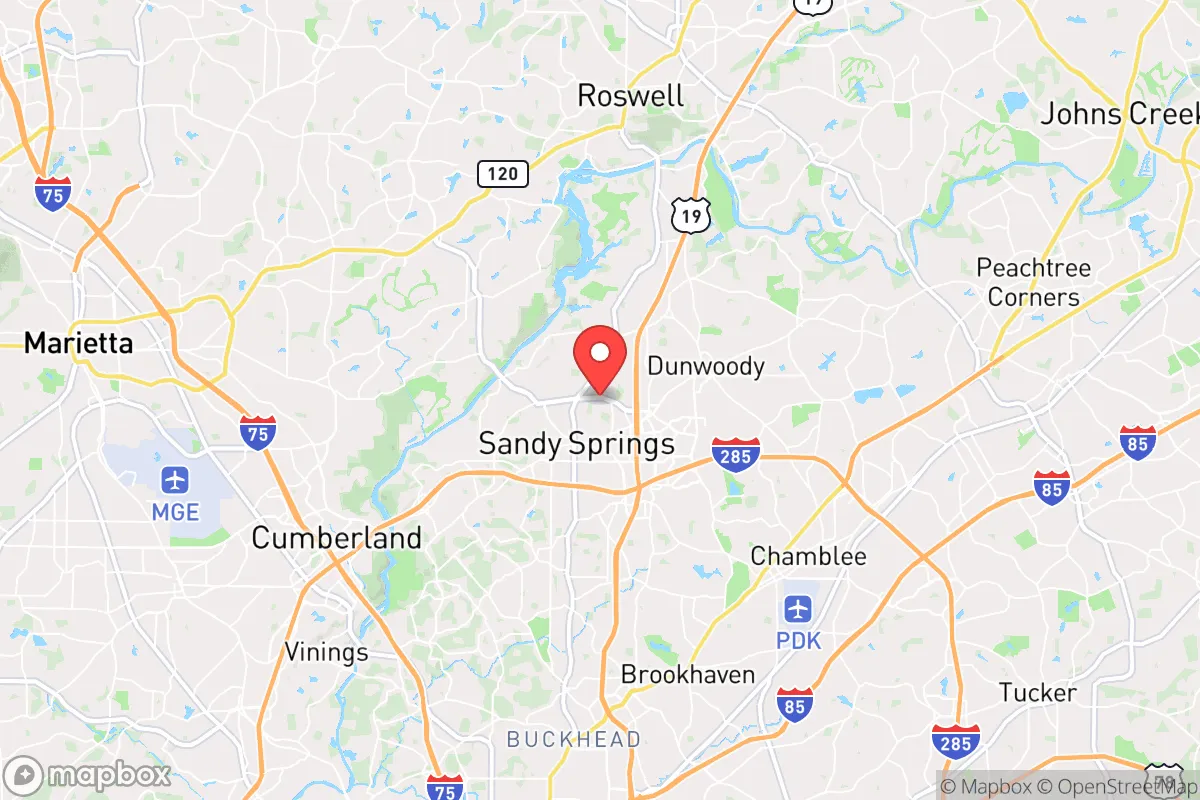
Photo: Wikipedia
Personal Sovereignty in Sandy Springs, GA
Viable for self-reliance. Generally workable, though some barriers may limit total independence.
What does Personal Sovereignty tell us?
Personal Sovereignty measures your capacity for self-reliance and independence with minimal government friction. Higher scores mean fewer barriers between you and the way you want to live... but it assumes you have the space you need and good neighbors.
What does this tell us?
Personal Sovereignty measures your capacity for self-reliance and independence with minimal government friction. Higher scores mean fewer barriers between you and the way you want to live... but it assumes you have the space you need and good neighbors.
State Policy
Energy independence: Importer (12% of energy produced in-state)
Personal Liberty
Homesteading

Personal Liberty Analysis
Sandy Springs offers a notably high degree of personal sovereignty relative to most of the United States, largely because it operates within Georgia’s broader legal framework—a state that consistently ranks among the top for individual liberty, low taxation, and minimal regulatory interference. For the strategic relocator with a survivalist or prepper mindset, this translates into a practical environment where the government is more of a background presence than a daily obstacle. The city’s own governance, a streamlined council-manager system, focuses on core services like public safety and infrastructure rather than social engineering, leaving residents free to manage their own lives, property, and security with a level of autonomy that is increasingly rare in major metro areas. This is not a place where the state inserts itself into your personal decisions; it’s a place where you are expected to handle your own affairs, and the legal system largely backs that expectation.
Tax burden and regulatory posture: how Georgia’s policies keep government off your back
Georgia’s tax structure is a primary pillar of personal sovereignty here. There is no state tax on Social Security benefits, and the state income tax is a flat 5.49%—a rate that has been steadily declining and is scheduled to drop further to 4.99% by 2029. For a prepper or conservative household, this means more of your earned income stays in your control, not funneled into state programs you may not support. Property taxes in Sandy Springs are managed at the county level (Fulton County) and are moderate, with an effective rate around 1.1% of assessed value, though homestead exemptions are available and can reduce the burden for owner-occupied homes. The regulatory environment is equally favorable: Georgia is a right-to-work state, meaning no forced union membership, and occupational licensing requirements are among the least burdensome in the country. There are no state-level rent control laws, no bans on plastic bags or gas stoves, and no aggressive energy mandates that force you to retrofit your home. The city’s zoning code is practical and permissive for most residential uses, with no overreaching “livability” ordinances that dictate what you can plant in your yard or how many vehicles you can park on your property. In short, the tax and regulatory posture here is designed to let you keep your money and run your life without a bureaucrat’s permission slip.
Self-defense and gun law specifics: what you can carry, where, and how to store it
Georgia is a constitutional carry state, meaning that as of 2022, any legal resident 21 or older can carry a handgun openly or concealed without a permit. This is a foundational liberty for anyone serious about self-defense. Sandy Springs itself has no additional local gun restrictions beyond state law—no magazine capacity bans, no “assault weapon” registries, and no red flag laws that allow confiscation without due process. The state’s Stand Your Ground law is unambiguous: you have no duty to retreat before using deadly force if you are lawfully present and reasonably believe it is necessary to prevent death or great bodily harm. For preppers, this extends to vehicle storage: Georgia law explicitly allows you to keep a firearm in your car without a license, even on school parking lots, as long as it is out of sight. The only notable limitation is that carrying in government buildings, courthouses, and certain areas of airports is restricted, but these are standard exceptions. If you are building a home defense plan, you can legally own suppressors, short-barreled rifles, and other NFA items with the proper federal paperwork—Georgia has no state-level ban on any of these. The legal climate here is one of the most supportive in the Southeast for the armed citizen, and Sandy Springs’ police department has a reputation for respecting the Second Amendment rather than harassing lawful carriers.
Self-reliance and homesteading viability: lot sizes, zoning, and off-grid feasibility
For those looking to reduce dependence on the grid, Sandy Springs presents a mixed picture. The city is a dense, affluent suburb of Atlanta, and most residential lots are 0.25 to 0.5 acres, with some larger estate properties in the northern sections near the Chattahoochee River. Zoning is primarily R-1 (single-family residential), which allows for vegetable gardens, small livestock like chickens (hens only, no roosters), and rainwater collection for irrigation—but not for potable use without a permit. Off-grid living in the full sense—solar panels with battery storage, composting toilets, and well water—is technically feasible but constrained by building codes and HOA covenants in many neighborhoods. The city does not have a ban on solar panels, but HOAs can impose aesthetic restrictions, so you need to check your specific subdivision’s rules. Water is supplied by the county, and there is no legal right to drill a well on a standard residential lot unless you have a very large parcel and obtain a permit. For the serious prepper, the best strategy is to look at the unincorporated areas of Fulton County just north of Sandy Springs, where lot sizes increase to 1-5 acres and zoning is looser. Within the city limits, you can achieve a high degree of self-reliance in terms of food production and backup power, but you will still be tied to municipal water and sewer. The trade-off is access to a robust local economy and medical infrastructure, which is a form of resilience in itself.
Personal liberties: parental rights, medical autonomy, speech, and property
Georgia has been a battleground for parental rights, and the current legal landscape is strongly favorable. The state’s Parents’ Bill of Rights, signed into law in 2022, guarantees that parents have the fundamental right to direct the upbringing, education, and healthcare of their children. This means no school can hide medical or mental health information from you, and you have the right to opt your child out of any curriculum you find objectionable. Sandy Springs’ public schools (Fulton County Schools) have generally complied with these laws, though some parents report that enforcement varies by school administration. On medical autonomy, Georgia does not have a state-level vaccine mandate for adults, and COVID-era emergency orders were struck down early. You can refuse any medical treatment for yourself or your child without fear of state intervention, except in extreme cases of imminent harm. Free speech is robustly protected under the Georgia Constitution, which explicitly states that “no law shall be passed to curtail or restrain the freedom of speech.” There are no local hate speech ordinances or “misinformation” boards in Sandy Springs. Property rights are equally strong: Georgia is a “fee simple” state with no state-level inheritance tax, and the eminent domain process is tightly restricted to public use projects like roads and utilities—not private development. The city’s code enforcement is reasonable and complaint-driven; you won’t have inspectors snooping around your property unless a neighbor files a nuisance complaint. Overall, the legal framework here treats you as a sovereign individual, not a subject of the state.
Compared to the rest of the country, Sandy Springs offers a level of personal sovereignty that is difficult to find in any other major metro area. The combination of constitutional carry, low taxes, strong parental rights, and minimal regulatory overreach creates an environment where a survivalist or prepper can live with a high degree of self-determination while still enjoying the economic and logistical benefits of a major city. The main trade-off is density: you won’t have the acreage for a full off-grid homestead, but you will have the legal freedom to arm yourself, educate your children as you see fit, and keep most of your earnings. For someone looking to escape the creeping authoritarianism of blue states without moving to a remote rural area, Sandy Springs is one of the strongest options in the Southeast. It is not a libertarian utopia—no place is—but it is a place where the government largely stays out of your way, and that is increasingly the highest standard a strategic relocator can ask for.

* Values derived from national, state, county, city and local statistics and may differ in a specific area. Last updated: 2026-04-23T05:07:57.000Z
Narrative content on this page is AI-generated and may contain mistakes. Verify any details that matter before acting on them.
ReloMaps may earn a commission from affiliate links at no extra cost to you.

