
Photo: Wikipedia
Political ClimatePolitical Climate in Sandy Springs, GA
District shown is the primary district for this city’s centroid. Cities may span multiple districts.
Local Political AnalysisPolitical Analysis of Sandy Springs, GA
Sandy Springs has long been a reliably conservative stronghold in metro Atlanta, and the numbers back that up with a Cook PVI of R+11. For decades, this was a place where folks minded their own business, kept taxes low, and expected the government to stay out of their lives. But if you’ve been here as long as I have, you’ve noticed the political winds shifting—not dramatically, but enough to raise an eyebrow. The city council and mayor’s office have historically leaned center-right, but recent elections have seen a slow creep of progressive candidates winning seats, often by narrow margins. The trajectory isn’t a hard left turn, but it’s a steady drift away from the hands-off, small-government ethos that built this community.
How it compares
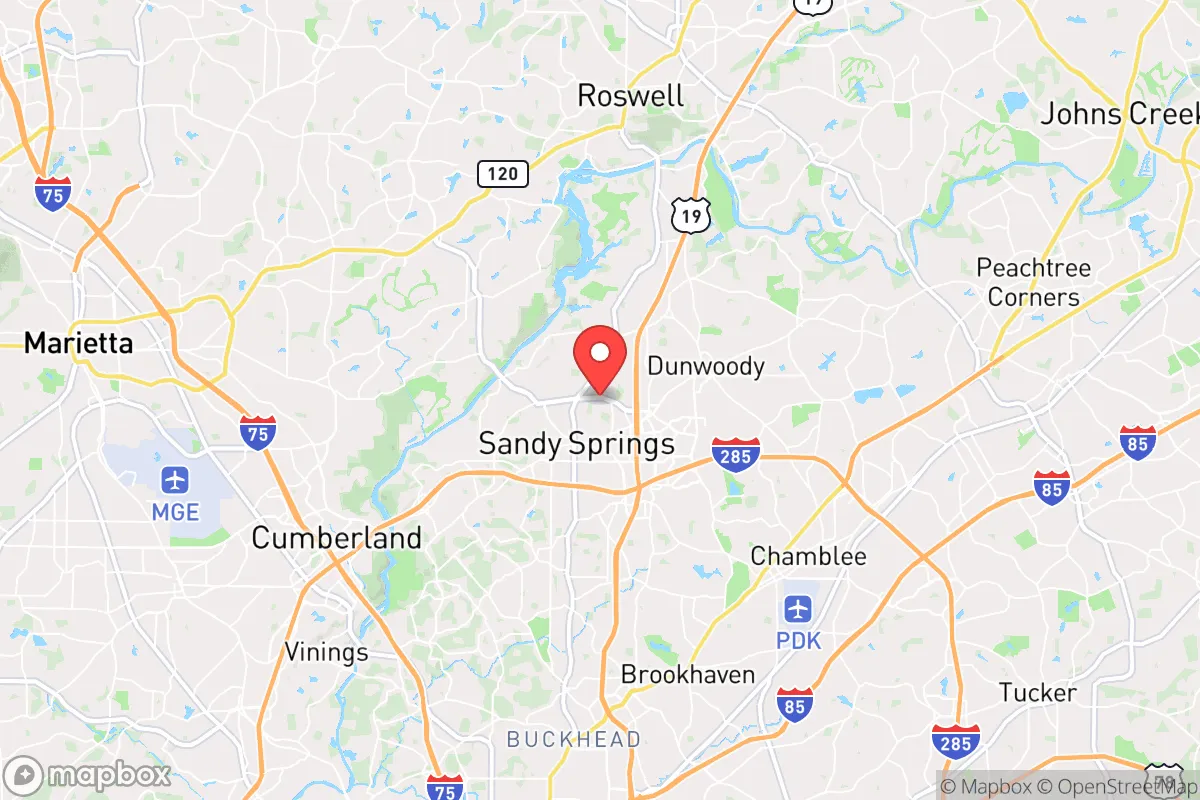
To understand Sandy Springs’ politics, you have to look at its neighbors. Directly to the south, Atlanta is a deep-blue urban core where progressive policies on zoning, policing, and taxes are the norm. Head north to Roswell or Alpharetta, and you’ll find suburbs that still lean Republican, but with a softer edge—more willing to accept higher spending on public transit and social programs. Sandy Springs sits in a kind of buffer zone. It’s more conservative than Buckhead (which is now part of Atlanta proper) and more fiscally disciplined than Dunwoody, which has embraced more municipal spending. The contrast is sharpest when you compare property tax rates: Sandy Springs has kept them relatively low, while nearby cities like Decatur have seen them climb alongside progressive social agendas. That R+11 rating puts Sandy Springs to the right of most of its immediate neighbors, but it’s not as rock-ribbed as, say, Forsyth County to the north, which votes closer to R+30.
What this means for residents
For the average homeowner or small business owner, the political climate here still offers breathing room. Zoning laws remain fairly permissive, and you won’t find the kind of overreaching housing mandates or business regulations that plague cities like Atlanta or Savannah. But the warning signs are there. In the last few years, the city council has debated everything from “equity” task forces to stricter short-term rental rules—the kind of government creep that starts with good intentions and ends with more paperwork and less freedom. If you value being left alone to run your life without a city inspector or a diversity consultant looking over your shoulder, Sandy Springs is still a decent bet, but you need to stay engaged. The school board, for instance, has seen pushes for curriculum changes that mirror national trends, and that’s something parents should watch closely.
Culturally, Sandy Springs has always prided itself on being a place where you can have a nice house, a good job, and not have to deal with city hall unless you want to. That’s still mostly true, but the policy distinctions are getting blurrier. The city has embraced some “livability” initiatives—more bike lanes, more public art, more community events—that sound nice but often come with strings attached, like increased permitting or noise ordinances that didn’t exist ten years ago. The long-term concern is that as Atlanta’s influence spreads north, Sandy Springs could lose its independent, conservative character. For now, it’s still a place where a handshake matters more than a government form, but you’d be wise to keep an eye on the ballot box every election cycle.

State Political ClimatePolitical Climate in Georgia
State Political AnalysisPolitical Environment in the State
Georgia has shifted from a reliably red state to a genuine battleground over the past two decades, with the 2020 presidential election flipping the state blue for the first time since 1992 by a razor-thin margin of just under 12,000 votes. The state’s overall partisan lean is now a near-even split, driven by explosive growth in the Atlanta metro area and a rapidly diversifying electorate, while the rest of the state remains deeply conservative. For a conservative considering relocation, the key takeaway is that Georgia’s political future is being fought over in the suburbs and exurbs, not in the rural counties that still vote 70-80% Republican.
Urban vs. rural divide
The political map of Georgia is a tale of two Georgias. The Atlanta metropolitan area, encompassing Fulton, DeKalb, Cobb, and Gwinnett counties, now accounts for roughly 60% of the state’s population and leans heavily Democratic. Fulton County alone delivered over 250,000 more votes for Joe Biden in 2020 than Donald Trump, effectively canceling out the entire rural vote outside the metro. Meanwhile, the rest of the state—places like Rome in Floyd County, Valdosta in Lowndes County, and Augusta in Richmond County—remains solidly red, with rural counties routinely voting 75-80% Republican. The real battlegrounds are the fast-growing exurbs: Forsyth County (north of Atlanta) voted 65% for Trump in 2020, but its explosive growth is bringing in more moderate voters. Similarly, Columbus in Muscogee County and Savannah in Chatham County are Democratic-leaning cities surrounded by conservative rural areas, creating a patchwork of political islands. The divide isn’t just geographic—it’s cultural, with urban voters prioritizing transit, density, and progressive social policies, while rural voters focus on agriculture, gun rights, and local control.
Policy environment
Georgia’s state-level policy environment is a mixed bag for conservatives. On the positive side, the state has a flat income tax rate of 5.49% (down from 6% in 2022) and a relatively low property tax burden, with median effective rates around 0.87% of home value. The state legislature passed the Georgia Election Integrity Act of 2021 (SB 202), which added voter ID requirements for absentee ballots, limited drop box locations, and restricted third-party ballot collection—moves that drew national criticism but were popular among conservatives who saw them as necessary safeguards. On education, Georgia has a robust school choice program through the Georgia Special Needs Scholarship and the Student Scholarship Organization tax credit program, though universal school choice has not yet passed. The state also has a constitutional carry law (HB 218, signed in 2022), allowing permitless carry of firearms for anyone 21 or older who can legally possess a gun. However, the state’s regulatory environment is increasingly burdensome in the metro area, with Atlanta imposing its own zoning and business regulations that can frustrate small business owners. Healthcare policy remains a flashpoint: Georgia did not expand Medicaid under the Affordable Care Act, but the state’s Pathways to Coverage program (launched in 2023) requires work or community engagement for eligibility, a conservative alternative that has enrolled far fewer people than traditional expansion.
Trajectory & freedom
Georgia’s trajectory on personal freedom is a tug-of-war between conservative legislative gains and progressive local overreach. On the freedom side, the state has expanded gun rights significantly: HB 218 (2022) made Georgia the 25th constitutional carry state, and SB 319 (2024) strengthened the “stand your ground” law by removing the duty to retreat in any place where a person is lawfully present. Parental rights saw a win with HB 1178 (2022), which allows parents to opt their children out of school mask mandates and requires schools to notify parents of any “sexually explicit” instructional materials. However, the state has also seen concerning expansions of government power. The Georgia Hate Crimes Act (2020) was signed into law after the Ahmaud Arbery case, adding enhanced penalties for crimes motivated by bias—a move that some conservatives view as a slippery slope toward thought policing. More troubling for property rights, the state’s Georgia Environmental Protection Division has aggressively enforced the Georgia Water Quality Control Act, leading to costly compliance burdens for farmers and developers, particularly in the Altamaha River basin. On medical freedom, Georgia has not banned gender transition procedures for minors (unlike Florida or Alabama), though a bill (SB 140) did pass in 2023 banning such procedures for minors, only to be vetoed by Governor Brian Kemp—a decision that angered many conservatives. The state’s tax burden is relatively low, but local governments in metro Atlanta have been raising property taxes to fund transit and affordable housing initiatives, eroding the state-level gains.
Civil unrest & political movements
Georgia has been a flashpoint for political movements on both sides. The Stop Cop City movement in Atlanta—opposing the construction of a police training facility in DeKalb County—has drawn national attention, with activists occupying the site and clashing with law enforcement. In 2023, a state trooper was shot during a protest, and the state legislature responded with HB 147 (2024), which expanded penalties for rioting and blocking highways. On the right, the Georgia Republican Assembly and Georgia Carry are active, pushing for further gun rights and election integrity measures. Immigration politics are heated: Georgia has a sanctuary city ban (HB 87, 2011) that prohibits local governments from adopting policies that limit cooperation with federal immigration enforcement, but some metro Atlanta counties—particularly DeKalb and Clayton—have been accused of noncompliance. The 2020 election aftermath saw massive protests in Atlanta, with claims of voter fraud (unsubstantiated in court) leading to a special grand jury investigation into Trump’s attempts to overturn the election, which resulted in a 2023 indictment. This has polarized the state further, with many rural conservatives viewing the prosecution as political persecution. A new resident would notice the stark contrast: in Macon or Albany, you’ll see Trump flags and “Don’t Tread on Me” decals; in Atlanta’s intown neighborhoods, you’ll see “Defund the Police” yard signs and pride flags.
Projection
Over the next 5-10 years, Georgia is likely to become more competitive, not less, as in-migration from blue states (particularly California, New York, and Illinois) continues to reshape the electorate. The Atlanta metro is projected to add another 1.5 million people by 2035, and these newcomers tend to be younger, more diverse, and more progressive—especially in the core counties. However, the exurbs like Forsyth, Paulding, and Barrow are also growing fast, and these areas are attracting families fleeing high taxes and crime in blue states, potentially reinforcing the conservative vote. The state legislature is likely to remain under Republican control through at least 2030 due to gerrymandering, but the governor’s race and presidential elections will be toss-ups. Expect more fights over election laws, with Republicans pushing for stricter voter ID and ballot security, while Democrats push for automatic voter registration and mail-in voting expansion. On personal freedom, the trend is mixed: the state will likely pass a school choice expansion (education savings accounts) and further gun rights (maybe permitless carry for 18-year-olds), but local governments in metro Atlanta will continue to push progressive policies on housing, zoning, and policing that may conflict with state preemption laws. The biggest wildcard is the 2026 governor’s race: if a Democrat wins, expect a rapid shift toward Medicaid expansion, higher taxes, and more regulation.
For a conservative moving to Georgia, the bottom line is this: the state still offers a relatively low tax burden, strong gun rights, and a business-friendly environment, but you need to choose your county carefully. If you move to Forsyth County or Oconee County (outside Athens), you’ll find a community that shares your values and votes accordingly. If you land in Decatur or Brookhaven, you’ll be surrounded by progressive activism and higher taxes. The state’s political future is uncertain, but for now, Georgia remains a place where a conservative can live freely—provided you’re willing to drive past the Atlanta city limits to do it.
* Values derived from national, state, county, city and local statistics and may differ in a specific area. Last updated: 2026-04-23T05:07:57.000Z
Narrative content on this page is AI-generated and may contain mistakes. Verify any details that matter before acting on them.
ReloMaps may earn a commission from affiliate links at no extra cost to you.

