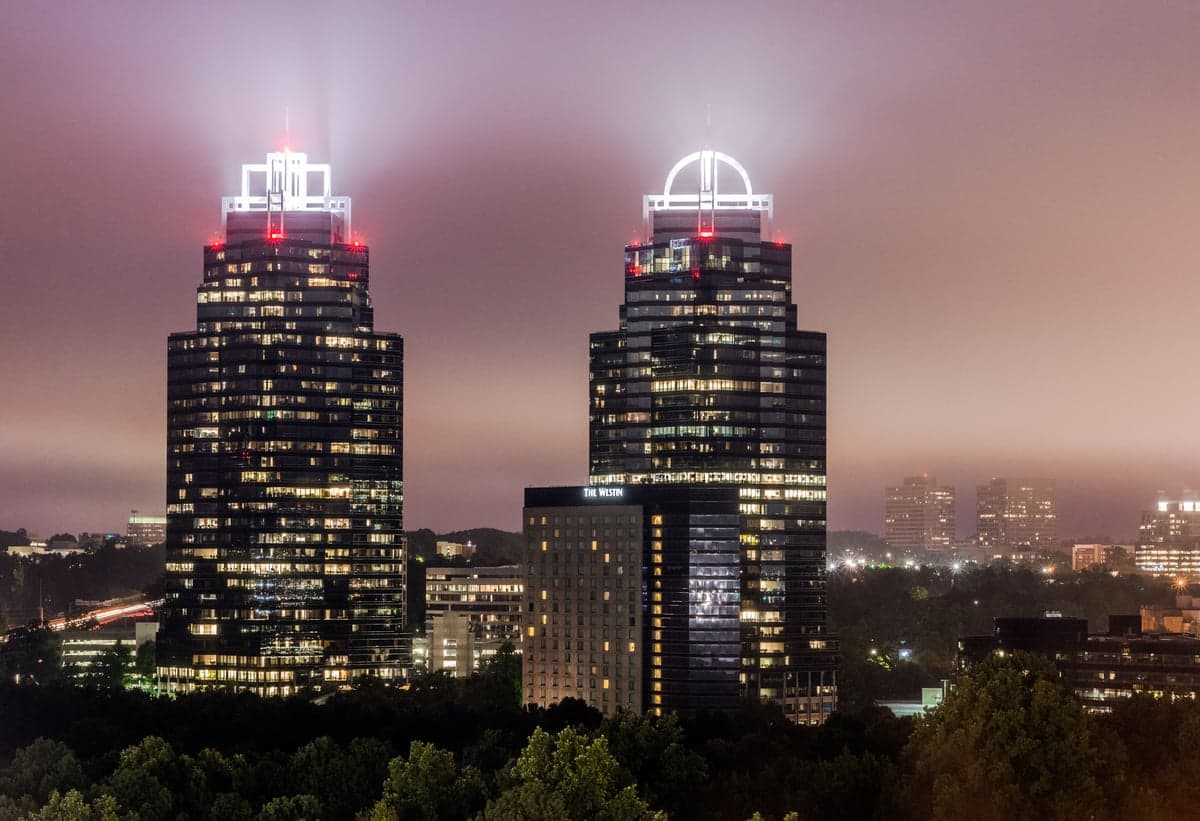
Photo: Wikipedia
Demographics of Sandy Springs, GA
Affluence Level in Sandy Springs, GA
An upper-middle-class area. Household wealth, education levels, and homeownership run ahead of national benchmarks.
People of Sandy Springs, GA
Sandy Springs, Georgia, is home to 107,198 residents who form one of the most educated and economically dynamic populations in metro Atlanta, with 69.9% holding a college degree. The city is predominantly white (56.4%) but has a substantial Black population (19.5%), a growing Hispanic community (11.4%), and distinct Indian-subcontinent (4.3%) and East/Southeast Asian (3.3%) enclaves. Its character is that of a high-income, professional-class suburb that has matured into a self-governing city, attracting families and singles who prioritize schools, proximity to Atlanta’s job centers, and a suburban lifestyle with urban amenities.
How the city was settled and grew
Sandy Springs was not a colonial-era settlement; its development began in earnest after the Civil War, driven by railroad access and the establishment of the Chattahoochee River as a regional water source. The area’s original population consisted of white farmers and small landowners who worked cotton and timber lands. The arrival of the Atlanta and Chattanooga Railroad in the 1880s spurred the first real growth, with a depot near what is now the Hammond Drive corridor. The historic Mount Vernon neighborhood, centered on the Mount Vernon Presbyterian Church (founded 1866), became the social and civic hub for these early families. By the early 20th century, Sandy Springs remained a sparsely populated crossroads, with a few general stores and a post office serving a rural white population. The first significant non-white presence came during the Great Migration, when Black families settled in the Riverside area along the Chattahoochee, working as domestic laborers and farmhands for white landowners. This pattern of racial separation—white families in the central and northern parts, Black families in the river-bottom areas—persisted through the 1950s.
Modern era (post-1965)
The post-1965 era transformed Sandy Springs from a rural crossroads into a dense, affluent suburb. The 1964 opening of Interstate 285 (the Perimeter) and the 1970s construction of Georgia 400 made the area a prime location for corporate relocations and white-collar commuters. White families from inside the Perimeter moved north, settling in subdivisions like Highland Lake and North Springs, drawn by good schools and large lots. The 1980s and 1990s saw an influx of Jewish families, particularly from the Buckhead area, who established a strong community around the Ahavath Achim synagogue and the Dunwoody Springs neighborhood. The Hart-Cellar Act’s impact arrived later here than in Atlanta proper. By the 2000s, Indian-subcontinent professionals—engineers, doctors, IT managers—began settling in the Concord Mills and Hammond Hills areas, drawn by the nearby Perimeter business district and top-rated schools like Riverwood International Charter. East/Southeast Asian families, primarily Korean and Chinese, concentrated in the Mount Vernon and Northridge neighborhoods, often running small businesses or working in tech. The Black population, which had been small and concentrated in Riverside, grew significantly after 2000 as middle-class Black families moved into previously white subdivisions like Highland Lake and Spalding Woods. The Hispanic population, now 11.4%, is largely concentrated in the Riverside and Hammond Drive corridors, working in construction, landscaping, and service industries. Sandy Springs incorporated as a city in 2005, driven by a desire for local control over zoning and services—a move that was overwhelmingly supported by white homeowners and opposed by many Black and Hispanic residents who feared higher taxes and reduced representation.
The future
The population of Sandy Springs is likely to continue its trajectory toward greater diversity, but with distinct enclaves rather than full integration. The white share (56.4%) is slowly declining as older homeowners age in place and younger, more diverse families move in. The Indian-subcontinent community (4.3%) is growing rapidly, driven by continued tech-sector hiring in the Perimeter and Alpharetta, and is likely to surpass the East/Southeast Asian share (3.3%) within a decade. The Black population (19.5%) is stable but may plateau as housing prices push lower-income families to more affordable suburbs like Mableton or Stone Mountain. The Hispanic population (11.4%) is growing steadily, particularly in the Riverside area, where new apartment complexes are absorbing immigrant families. The city’s high cost of housing—median home values above $600,000—will continue to filter for high-income residents, meaning the population will remain heavily college-educated and professional. The key demographic tension will be between the older, white, homeowner base and the younger, more diverse, renter-heavy population in the Hammond Drive and Riverside corridors. Sandy Springs is not homogenizing; it is tribalizing into income- and ethnicity-based neighborhoods, with the Mount Vernon and Highland Lake areas remaining predominantly white and affluent, while Riverside and Hammond Drive become more Hispanic and working-class.
For a conservative-leaning individual or family moving to Sandy Springs today, the city offers a stable, high-amenity environment with strong schools and low crime, but it is a place where demographic change is real and visible. The city’s politics have shifted from solidly Republican to a more competitive mix, with the 2020 presidential election seeing Joe Biden win the city by a narrow margin. The future points toward a more diverse, more Democratic-leaning Sandy Springs, but one where the core institutions—schools, parks, and city government—remain high-quality and oriented toward family life. The bottom line: Sandy Springs is becoming a multiethnic, upper-middle-class suburb where newcomers will find a well-run city, but should expect to live in a neighborhood that reflects their income bracket and ethnic background rather than a fully integrated community.

* Values derived from national, state, county, city and local statistics and may differ in a specific area. Last updated: 2026-04-23T05:07:57.000Z
Narrative content on this page is AI-generated and may contain mistakes. Verify any details that matter before acting on them.
ReloMaps may earn a commission from affiliate links at no extra cost to you.

