Photo: Wikipedia
Demographics of Sanford, ME
Affluence Level in Sanford, ME
A below-average socioeconomic profile. Incomes, home values, and educational attainment trail the U.S., with higher poverty and unemployment.
People of Sanford, ME
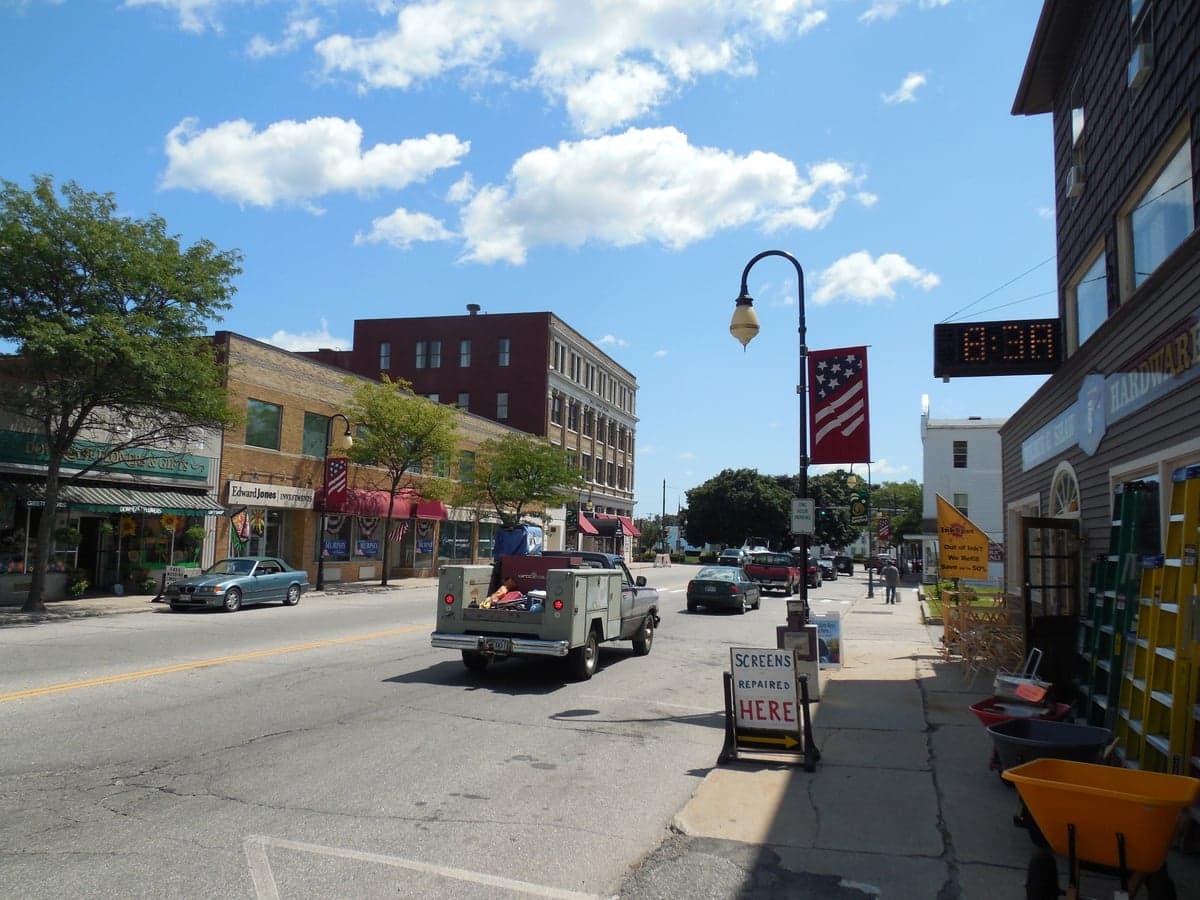
The people of Sanford, Maine, today number 22,095, forming a predominantly white (88.1%) and working-class community with a low foreign-born share of just 1.6%. The city’s identity is rooted in its industrial past and recent efforts to revitalize a downtown that once bustled with mill workers. With only 23.6% holding a college degree, Sanford remains a place where manufacturing and trades still anchor the local economy, though the population is slowly diversifying with small but growing Hispanic (2.5%), East/Southeast Asian (1.9%), and Black (1.7%) communities.
How the city was settled and grew
Sanford’s human history begins with the Massabesic people, but the city’s modern population stems from European settlement in the 1770s, when families from Massachusetts and New Hampshire took up land grants along the Mousam River. The real population boom came in the 19th century with the rise of textile mills. Irish immigrants arrived first in the 1840s and 1850s, settling in the Mill Yard neighborhood near the factories. French Canadians followed from Quebec after the Civil War, drawn by mill jobs, and established a dense community in Springvale, the village at Sanford’s northern edge. By 1900, the city was a patchwork of ethnic enclaves: the Irish in Mill Yard, French Canadians in Springvale, and smaller groups of English and Scottish workers scattered along Main Street. The mills peaked in the 1920s, employing thousands, and the population held steady through the mid-20th century as the children of these immigrants stayed in the area.
Modern era (post-1965)
After the last major mill closed in the 1950s, Sanford’s population stagnated and then declined, losing about 10% of its residents between 1960 and 1980. The post-1965 immigration reforms had little immediate effect here—Sanford’s foreign-born share remains far below the national average. Instead, the modern era saw domestic in-migration from other parts of Maine and New England, with families seeking affordable housing. The South Sanford neighborhood, near the New Hampshire border, absorbed many of these newcomers, growing as a suburban-style area of single-family homes. The small Hispanic population (2.5%) began arriving in the 2000s, primarily from Mexico and Central America, working in construction and food processing; they are concentrated in the Downtown district around Main Street. The East/Southeast Asian community (1.9%) includes a mix of Vietnamese and Chinese families, many of whom opened restaurants and small businesses in Springvale. The Black population (1.7%) is largely African American, with some families moving from southern Maine for lower housing costs, settling in the West Side neighborhood near the old mill complex. The Indian-subcontinent population remains negligible at 0.2%.
The future
Sanford’s population is slowly diversifying, but the pace is modest. The white share has dropped from over 95% in 2000 to 88.1% today, driven by the growth of Hispanic and East/Southeast Asian communities. These groups are not forming isolated enclaves but are integrating into existing neighborhoods—Hispanic families in Downtown, Asian families in Springvale—while the broader population remains overwhelmingly white and native-born. The city’s low college attainment rate (23.6%) and limited high-wage job base suggest that future growth will depend on attracting new industries; the recent opening of a biomanufacturing facility and the expansion of the Sanford Seacoast Regional Airport offer potential. Over the next 10–20 years, Sanford is likely to see continued slow diversification, with the Hispanic share possibly reaching 5–6% and the East/Southeast Asian share rising to 3–4%, but the city will remain a predominantly white, working-class community. The foreign-born share may climb to 3–4% but will stay well below the national average.
For someone moving in now, Sanford is a place where the population is stable and slowly becoming more diverse, but the core character remains that of a former mill town with a strong local identity. The city offers affordable housing and a tight-knit feel, but newcomers should expect a community where change comes gradually and where the population’s roots in French Canadian and Irish heritage still shape daily life. The neighborhoods of Springvale, Mill Yard, and South Sanford each retain distinct histories, making Sanford a city of small, recognizable communities rather than a homogenized suburb.

* Values derived from national, state, county, city and local statistics and may differ in a specific area. Last updated: 2026-04-19T06:21:20.000Z
Narrative content on this page is AI-generated and may contain mistakes. Verify any details that matter before acting on them.
ReloMaps may earn a commission from affiliate links at no extra cost to you.

