 Popular

Photo: Wikipedia
Demographics of Scarsdale, NY
Affluence Level in Scarsdale, NY
An elite concentration of wealth — high incomes, strong home values, advanced degrees, and minimal poverty signal a top-tier socioeconomic profile.
Census doesn't track above $250K
People of Scarsdale, NY
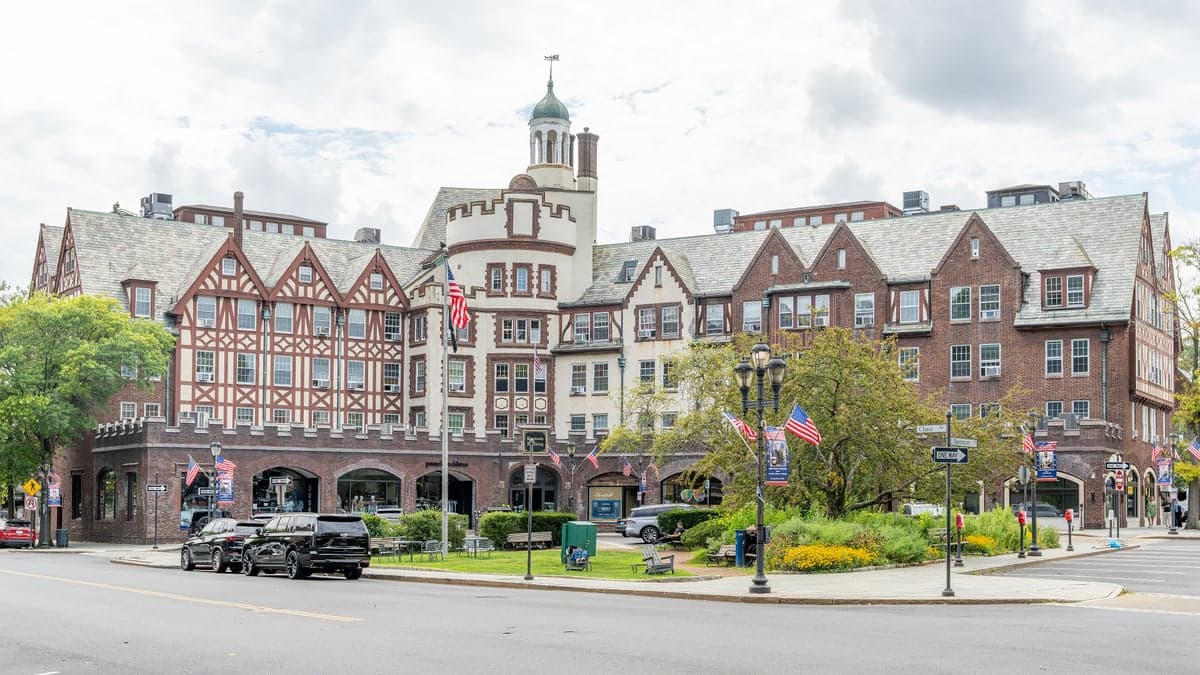
Scarsdale, New York, is a village of 18,005 residents defined by exceptional educational attainment—90.7% hold a college degree—and a population that is 66.7% white, with significant East/Southeast Asian (12.6%) and Indian subcontinent (6.1%) communities. The foreign-born share stands at 12.0%, reflecting a steady, selective immigration pattern rather than a broad gateway dynamic. The village’s identity is shaped by its role as a top-tier commuter suburb for Manhattan professionals, with a density of 2,800 people per square mile and a housing stock dominated by large single-family homes on generous lots.
How the city was settled and grew
Scarsdale was originally part of a 1661 land grant to John Richbell, but significant settlement did not begin until the mid-19th century. The arrival of the New York and Harlem Railroad in 1846 transformed the area from scattered farms into a commuter suburb. The first wave of residents were wealthy New York City merchants and financiers who built country estates in what is now the Heathcote neighborhood, named after the Heathcote family’s 18th-century holdings. By the 1890s, the village incorporated to control development, and the Scarsdale Estates section—centered on the Scarsdale Golf Club—became the preferred enclave for Protestant Anglo-Saxon families from Manhattan’s upper classes. A second wave arrived in the 1920s and 1930s, when Jewish families, many of German and Eastern European descent, began moving into the Greenacres neighborhood, drawn by the village’s excellent schools and restrictive covenants that were gradually challenged. The post-World War II boom brought a third wave: middle- and upper-middle-class families, predominantly white and Christian, who filled the Fox Meadow and Edgewood sections with colonial revival and Tudor homes. By 1960, Scarsdale was 98% white, with a small number of Black domestic workers living in the Garth Road area near the village’s commercial center.
Modern era (post-1965)
The Hart-Cellar Immigration Act of 1965 opened the door for a new wave of residents. The first significant non-white arrivals were East/Southeast Asian families—primarily Chinese and Korean—who began moving into Heathcote and Fox Meadow in the 1980s, attracted by the Scarsdale school district’s reputation for academic rigor. By 2000, the Asian share had reached 8%, concentrated in the Quaker Ridge neighborhood, where newer, larger homes were built on former estate lots. The Indian subcontinent community grew later, accelerating after 2010, and now makes up 6.1% of the population. These families have clustered in Edgewood and the newer developments off Mamaroneck Road, drawn by the same school system and the presence of a growing Indian professional network in Westchester County. The Hispanic population, at 5.7%, is more dispersed but has a visible presence in the Garth Road corridor, where some service workers and small business owners have settled. The Black population remains small at 1.6%, largely concentrated in the Garth Road area and the few rental properties near the village line. The white share has declined from 90% in 1990 to 66.7% today, but this shift reflects selective replacement—incoming Asian and Indian families have similar or higher income and education levels, preserving the village’s socioeconomic character even as its ethnic composition changes.
The future
Scarsdale’s population is likely to continue its gradual diversification, but within a narrow band. The foreign-born share of 12.0% is stable, suggesting that immigration is not accelerating but rather maintaining a steady flow of highly educated professionals. The East/Southeast Asian and Indian communities are not forming distinct ethnic enclaves; instead, they are assimilating into the existing neighborhoods—Heathcote and Fox Meadow for Asian families, Edgewood for Indian families—while participating fully in village civic life. The white population will likely continue its slow decline, but the village’s housing costs (median home value above $1.5 million) and zoning laws (minimum lot sizes of one-half acre) act as a demographic filter, ensuring that newcomers, regardless of ethnicity, are overwhelmingly college-educated and high-income. The Hispanic and Black populations are not projected to grow significantly, as affordable housing options remain scarce. Over the next 10-20 years, Scarsdale will likely become slightly more Asian and Indian, slightly less white, but remain a high-education, high-income, politically moderate-to-conservative village where the primary identity is not ethnic but socioeconomic: a place for families who prioritize elite public schools and a short commute to Manhattan.
For a conservative-leaning individual or parent considering relocation, Scarsdale offers a stable, low-crime environment with a population that values educational achievement and property investment. The demographic changes underway are not disruptive—they are replacing one group of high-achieving professionals with another. The village is becoming more diverse in ancestry but not in class, and the neighborhoods that defined Scarsdale a century ago—Heathcote, Greenacres, Fox Meadow, Edgewood—remain the anchors of its identity. Moving in now means joining a community where the central question is not who you are but what school your children attend.

* Values derived from national, state, county, city and local statistics and may differ in a specific area. Last updated: 2026-04-23T02:50:47.000Z
Narrative content on this page is AI-generated and may contain mistakes. Verify any details that matter before acting on them.
ReloMaps may earn a commission from affiliate links at no extra cost to you.

