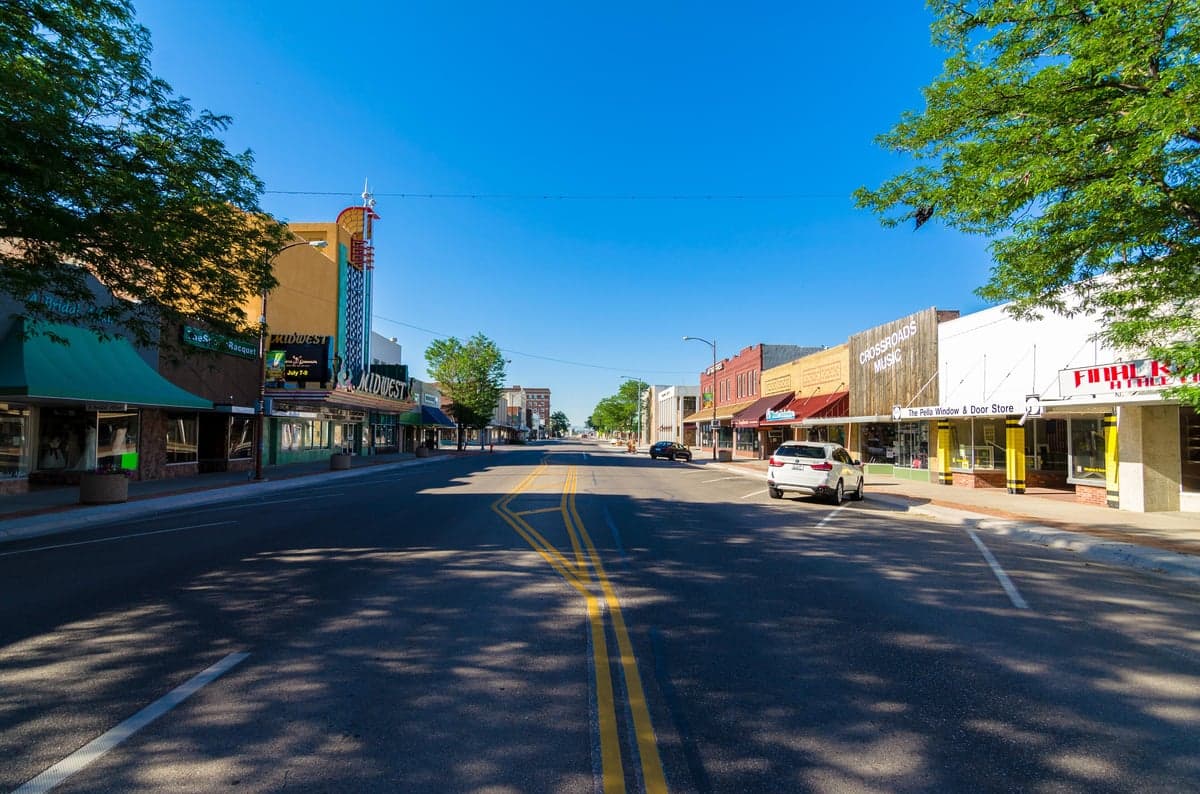
Photo: Wikipedia
Political ClimatePolitical Climate in Scottsbluff, NE
District shown is the primary district for this city’s centroid. Cities may span multiple districts.
Local Political AnalysisPolitical Analysis of Scottsbluff, NE
Scottsbluff leans heavily Republican, with a Cook PVI of R+27 that places it among the most conservative small cities in Nebraska. The local political climate has remained remarkably stable over the past two decades, with registered Republicans outnumbering Democrats by roughly a 3-to-1 margin in Scotts Bluff County. While the city itself has seen a modest uptick in Democratic votes in recent presidential cycles—about 2-3 percentage points since 2016—the surrounding rural precincts have actually trended further right, keeping the overall district firmly in conservative hands.
How it compares
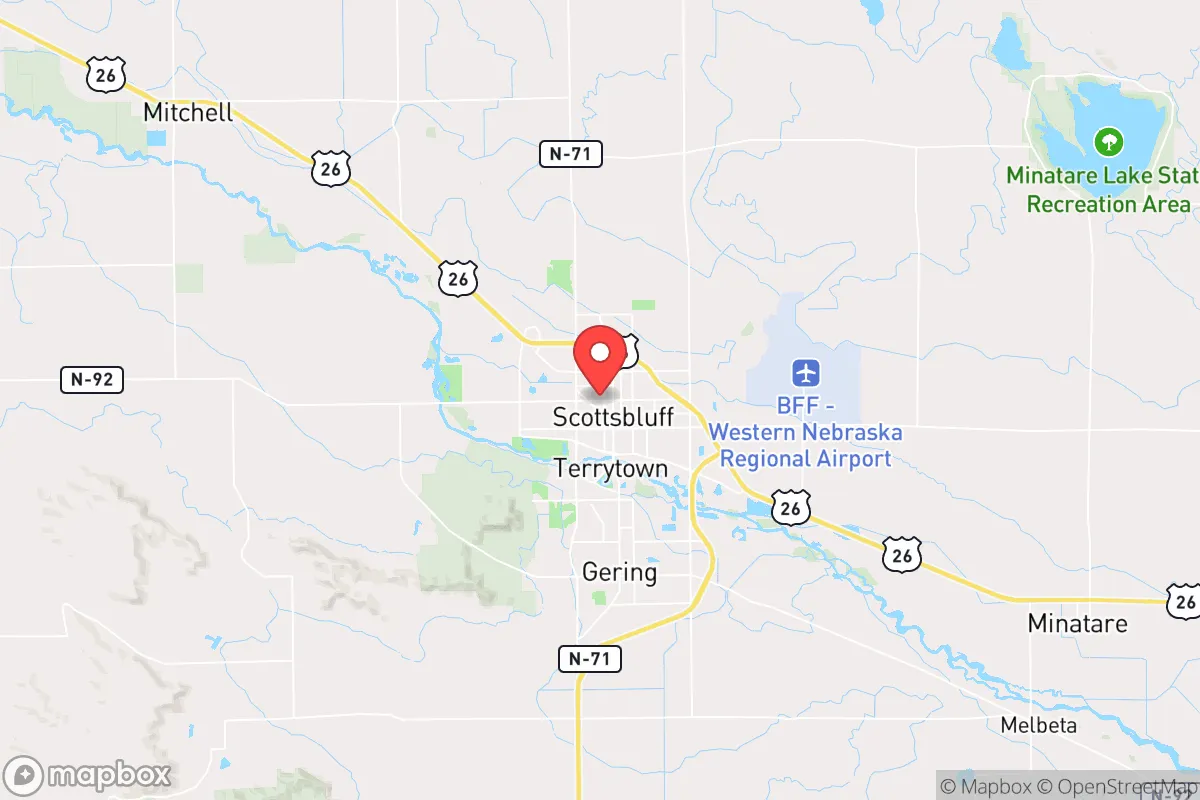
Drive 20 miles east to Gering, and you'll find a similar political profile, though slightly more moderate on local issues like zoning and school funding. The real contrast comes when you head 90 miles south to Cheyenne, Wyoming, or 120 miles east to North Platte—both of which have R+12 to R+15 PVIs, meaning Scottsbluff is nearly twice as conservative as those regional hubs. The biggest political shock comes from Lincoln, 300 miles east, where the Cook PVI flips to D+14. That distance isn't just miles—it's a cultural chasm. Scottsbluff residents tend to view Lincoln's progressive policies on land use, taxation, and education as cautionary tales of government overreach into personal freedoms. The local sentiment is that what works in a college town doesn't translate to the High Plains, where self-reliance and limited government are still the operating principles.
What this means for residents
For daily life, the R+27 lean translates into low taxes and minimal regulatory friction. Property taxes in Scotts Bluff County run about 1.2% of assessed value, well below the state average, and there's no city income tax. The city council has consistently rejected proposals for inclusionary zoning or rent control, arguing those are government oversteps into private property rights. School board elections tend to focus on local control and parental rights, with candidates who emphasize keeping curriculum decisions close to home rather than deferring to state or federal mandates. The biggest concern I hear from longtime neighbors is that as Scottsbluff grows—and it is growing, slowly—there's pressure from outside groups to adopt policies that worked in Omaha or Denver but would choke our way of life here. The 2024 election saw a local ballot measure to create a community oversight board for police fail by a 62-38 margin, with opponents framing it as an unnecessary layer of bureaucracy that would undermine the sheriff's authority.
Culturally, Scottsbluff remains a place where the Second Amendment is a given—open carry is common, and the local gun show at the county fairgrounds draws from three states. The city's annual Oregon Trail Days celebration leans heavily into pioneer heritage and self-sufficiency themes. There's a quiet but real wariness of any shift toward progressive ideology, whether it's statewide pushes for carbon-neutral building codes or federal environmental regulations that could impact the area's agribusiness backbone. The long-term trajectory depends on who moves here. If the new arrivals are retirees from Denver or remote workers from the coasts, the political balance could shift a few points left over the next decade. But for now, Scottsbluff is still a place where a Republican primary is the real election, and the general election is just a formality. That's not likely to change until the city's population doubles, and even then, it'll be a slow, grudging shift—if it happens at all.

State Political ClimatePolitical Climate in Nebraska
State Political AnalysisPolitical Environment in the State
Nebraska has been a reliably red state for decades, but it’s not the deep-red monolith outsiders assume. The state’s overall partisan lean is solidly Republican — Donald Trump won it by 19 points in 2024 — but the political landscape is far more nuanced than a single number suggests. Over the last 10-20 years, the dominant coalition has been a mix of rural conservatives, agricultural interests, and a growing suburban base, while the state’s two major population centers — Omaha and Lincoln — have drifted leftward, creating a sharp urban-rural divide that defines every election cycle.
Urban vs. rural divide
The political map of Nebraska is a textbook case of geographic polarization. The eastern third of the state, anchored by Omaha (Douglas County) and Lincoln (Lancaster County), is where Democrats have their strongest foothold. Douglas County voted for Joe Biden in 2020 and has been trending blue for a decade, driven by a growing professional class, younger voters, and a significant Hispanic population. Lincoln, home to the University of Nebraska, is similarly competitive — Lancaster County went for Biden by a narrow margin in 2020, though it flipped back to Trump in 2024. Meanwhile, the rest of the state is overwhelmingly Republican. Counties like Scotts Bluff in the Panhandle, Buffalo County (Kearney), and Hall County (Grand Island) routinely deliver 70-80% of their votes to GOP candidates. The rural-urban split is so pronounced that Nebraska is one of only two states (Maine is the other) that splits its electoral votes by congressional district. The 2nd District, which covers Omaha and its suburbs, is a genuine swing district — it went for Obama in 2008, Trump in 2016 and 2020, and then flipped back to Biden in 2020 before returning to Trump in 2024. That volatility makes it a national bellwether.
Policy environment
Nebraska’s policy environment is broadly conservative, but with some notable exceptions that matter to families and individuals. The state has no income tax on Social Security benefits and a flat state income tax rate that was cut from 6.84% to 5.84% in 2023, with further reductions scheduled to bring it to 4.99% by 2027. Property taxes remain a sore spot — they’re high relative to the region, and the state’s reliance on local levies for school funding means homeowners in growing suburbs like Papillion or Gretna can face significant bills. On education, Nebraska has a robust school choice movement: the state passed a tax-credit scholarship program in 2023 (LB 753) that allows donors to receive credits for funding private school scholarships, though it faced a referendum challenge in 2024. The state’s approach to healthcare is mixed — Nebraska expanded Medicaid under the Affordable Care Act in 2020 via a ballot initiative, but the legislature has resisted further expansion of government-run programs. Election laws are generally secure: Nebraska requires voter ID (enacted in 2023), has no same-day registration, and conducts regular voter roll maintenance. The state’s unicameral, nonpartisan legislature is unique — while most members are Republicans, the absence of party labels on the ballot can produce unpredictable coalitions, especially on fiscal issues.
Trajectory & freedom
On the freedom front, Nebraska has been moving in a decidedly positive direction over the last five years, particularly on gun rights and parental rights. In 2023, the legislature passed a constitutional carry law (LB 77), allowing law-abiding citizens to carry concealed firearms without a permit — a major win for Second Amendment advocates. The same bill also preempted local governments from enacting their own gun restrictions, preventing cities like Omaha from imposing stricter rules. On parental rights, Nebraska passed the “Parents’ Bill of Rights” (LB 1084) in 2024, which requires schools to notify parents of any changes to a student’s mental, emotional, or physical health and prohibits instruction on gender identity or sexual orientation in grades K-5. This law has been a flashpoint, with the ACLU filing a lawsuit, but it remains in effect. On medical autonomy, Nebraska banned abortion after 12 weeks in 2023 (LB 574), with exceptions for rape, incest, and medical emergencies — a significant restriction that aligns with the state’s conservative values. The state also passed a law in 2023 prohibiting gender-affirming care for minors (LB 574 as well, bundled with the abortion ban), making Nebraska one of the most restrictive states on this issue. Property rights are generally strong, though eminent domain battles occasionally arise around pipeline projects like the Keystone XL, which was ultimately canceled in 2021. Taxation remains a concern — while income tax cuts are welcome, property tax relief has been slow, and the state’s reliance on sales tax (currently 5.5%) means low-income families bear a disproportionate burden.
Civil unrest & political movements
Nebraska has not seen the kind of large-scale civil unrest that has rocked coastal cities, but there have been notable flashpoints. In the summer of 2020, Omaha experienced several nights of protests and some property damage following the death of George Floyd, with tensions flaring over police reform and racial justice. More recently, the debate over transgender rights has galvanized both sides. In 2023, hundreds of protesters on both sides of the issue descended on the state capitol in Lincoln during the debate on LB 574, with conservative parents’ groups and religious organizations turning out in force. Immigration politics are less volatile here than in border states, but the issue is simmering. Schuyler and Lexington, small towns in eastern Nebraska, have seen significant Hispanic population growth driven by meatpacking plants, and local tensions occasionally surface over housing and schools. There is no sanctuary city policy in Nebraska — state law (LB 403, passed in 2023) requires law enforcement to cooperate with federal immigration authorities. Election integrity controversies have been minimal compared to other states, though the 2020 and 2024 cycles saw some grassroots activism around voter roll accuracy and mail-in ballot procedures. The state’s Republican Party has been internally divided between establishment conservatives and more populist, Trump-aligned factions, but this has not yet produced the kind of open warfare seen in states like Arizona or Michigan.
Projection
Looking ahead 5-10 years, Nebraska’s political trajectory is likely to remain conservative, but with increasing tension between the growing urban centers and the rural base. The Omaha metro area, particularly suburbs like Elkhorn and Bennington, is experiencing rapid population growth driven by families fleeing higher-cost states like California and Colorado. These newcomers tend to be more moderate — they support lower taxes and school choice but are less enthusiastic about social issues like abortion restrictions. This could shift the 2nd Congressional District into a permanent swing seat, and if the trend continues, it might eventually put pressure on statewide races. However, the rural vote is not shrinking fast enough to flip the state blue — the Panhandle, central Nebraska, and the Sandhills remain deeply Republican, and the state’s population growth is still modest compared to the Sun Belt. The biggest wildcard is the legislature’s ability to pass property tax reform — if relief doesn’t materialize, it could fuel a populist backlash that reshapes the GOP primary landscape. For now, expect Nebraska to remain a reliably red state with a purple stripe through its eastern edge.
For a conservative family or individual considering a move here, the bottom line is this: Nebraska offers a policy environment that respects gun rights, parental authority, and limited government, with a tax structure that is improving but still has work to do on property taxes. The state is not immune to progressive activism, particularly in Omaha and Lincoln, but the legislature has shown a willingness to push back. If you value a place where your vote counts in a meaningful way — especially in the 2nd District — and where your children’s education is not subject to ideological experimentation, Nebraska is a solid bet. Just be prepared for cold winters and a property tax bill that might make you wince.
* Values derived from national, state, county, city and local statistics and may differ in a specific area. Last updated: 2026-05-03T20:32:02.000Z
Narrative content on this page is AI-generated and may contain mistakes. Verify any details that matter before acting on them.
ReloMaps may earn a commission from affiliate links at no extra cost to you.

