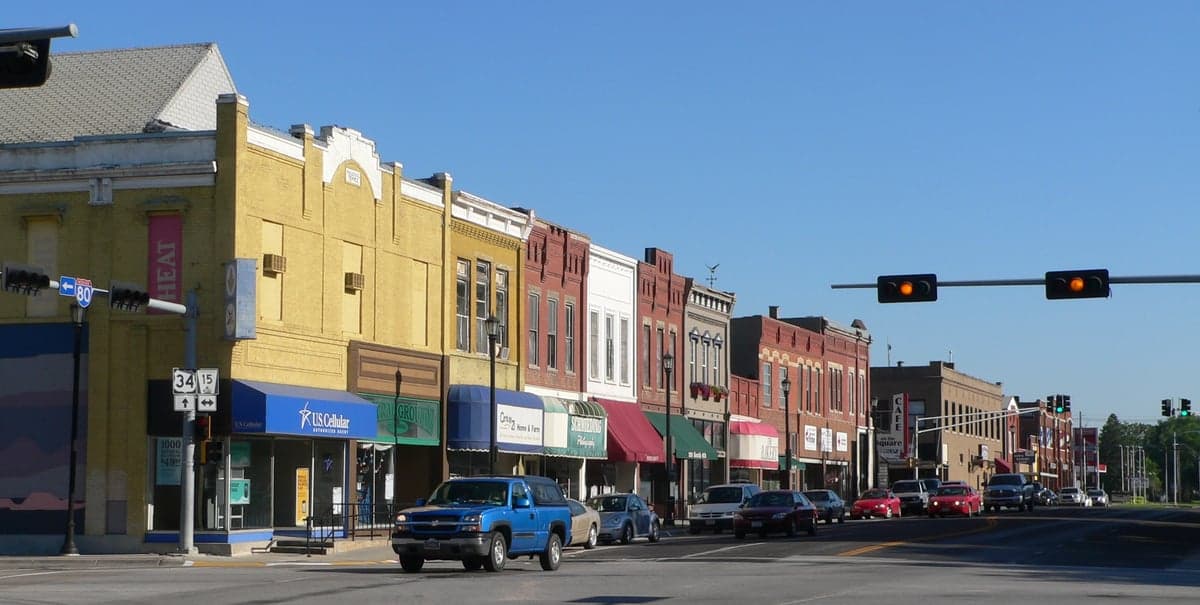
Photo: Wikipedia
Personal Sovereignty in Seward, NE
Viable for self-reliance. Generally workable, though some barriers may limit total independence.
What does Personal Sovereignty tell us?
Personal Sovereignty measures your capacity for self-reliance and independence with minimal government friction. Higher scores mean fewer barriers between you and the way you want to live... but it assumes you have the space you need and good neighbors.
What does this tell us?
Personal Sovereignty measures your capacity for self-reliance and independence with minimal government friction. Higher scores mean fewer barriers between you and the way you want to live... but it assumes you have the space you need and good neighbors.
State Policy
Energy independence: Importer (35% of energy produced in-state)
Personal Liberty
Homesteading

Personal Liberty Analysis
Seward, Nebraska, offers a notably high degree of personal sovereignty that stands out in the Great Plains, largely because the state’s constitutional and statutory framework actively limits government overreach into daily life. For those approaching relocation from a survivalist or prepper mindset, the town’s combination of a low-tax, low-regulation environment, strong Second Amendment protections, and a deeply ingrained culture of self-reliance creates a strategic base of operations. While no location is a fortress against federal overreach, Seward’s local governance and Nebraska’s state-level policies provide a buffer that is increasingly rare in coastal or urban-dominated states. The key is understanding how these layers of autonomy actually function on the ground for a single individual or a family preparing for systemic instability.
Tax burden and regulatory posture: how Nebraska compares to surrounding states
Nebraska’s tax structure is a mixed bag, but for a conservative audience, the overall burden is manageable and the regulatory posture is light. The state has a progressive income tax with rates from 2.46% to 6.64% (as of 2025), which is moderate compared to high-tax states like California or New York, but higher than neighboring South Dakota or Wyoming, which have no income tax. However, Seward County’s property tax rates are a critical factor: the effective rate hovers around 1.5% of assessed value, which is on par with the national average but higher than some Texas counties. The trade-off is that Nebraska has no state sales tax on groceries or prescription drugs, and the state sales tax is a flat 5.5% (with local options adding up to 1.5% in Seward). For a prepper, the real win is the regulatory environment: Nebraska is a right-to-work state, has minimal occupational licensing burdens compared to coastal states, and its state-level environmental and building codes are less restrictive than those in the Pacific Northwest or Northeast. Seward’s city council has historically resisted adopting overly burdensome zoning overlays, meaning you can operate a home-based business, keep livestock, or store supplies without excessive permitting. The state’s constitutional spending limit also restrains government growth, which translates to fewer new taxes and fees over time.
Self-defense and gun law specifics: what the Second Amendment actually looks like here
Nebraska is a shall-issue state for concealed carry permits, and as of 2023, it became a constitutional carry state, meaning law-abiding adults 21 and older can carry a concealed handgun without a permit. This is a major plus for those who view self-defense as a non-negotiable right. Seward itself is in Seward County, which has a sheriff’s office that is generally pro-Second Amendment and does not engage in “red flag” enforcement beyond what state law mandates—Nebraska does have a red flag law (enacted in 2020), but it requires a court order based on specific threats, and local judges in Seward County are conservative and skeptical of overbroad applications. The state also preempts local gun ordinances, so Seward’s city council cannot ban firearms in most public places. For long guns, there are no state-level restrictions on AR-15s or standard-capacity magazines, and the state does not require registration of any firearm. Stand your ground is not explicitly codified in Nebraska statute, but the state’s self-defense law is based on the “castle doctrine” and does not impose a duty to retreat in one’s home or vehicle. For a prepper, this means you can legally defend your property and family without fear of prosecution for using force, provided the threat is imminent and unlawful. The only notable restriction is a 48-hour waiting period for handgun purchases from licensed dealers, but private sales between individuals are unregulated.
Self-reliance and homesteading viability: lot sizes, zoning, and off-grid feasibility
Seward’s zoning code is a critical factor for anyone wanting to live off-grid or with significant self-sufficiency. Within the city limits, most residential lots are standard suburban sizes (6,000 to 10,000 square feet), which allows for substantial vegetable gardens, small orchards, and even a few chickens (hens only, no roosters) without a special permit. However, rainwater collection is legal in Nebraska, and Seward does not prohibit it, though you must ensure it doesn’t create a nuisance for neighbors. For those wanting larger acreage, the unincorporated areas of Seward County are where the real opportunity lies. Zoning in the county is minimal—there is no county-wide building code for agricultural or rural residential parcels, meaning you can build a pole barn, install solar panels, or dig a well without the bureaucratic hurdles common in more regulated states. Off-grid living is feasible if you own at least 5 acres outside city limits, as Nebraska has no state law requiring connection to the electrical grid. The county allows composting toilets and greywater systems, though you’ll need to comply with Nebraska’s Department of Environment and Energy rules for septic systems. The biggest practical consideration is water: Seward sits atop the Ogallala Aquifer, and private wells are common in rural areas, with typical depths of 100-200 feet yielding good quality water. For a prepper, this means you can secure a independent water source, grow your own food, and generate your own power without the county or state interfering, as long as you’re not creating a public health hazard.
Personal liberties: parental rights, medical autonomy, speech, and property
Nebraska has a strong track record on parental rights, which is a cornerstone of personal sovereignty for families. The state’s Parental Bill of Rights (LB 1076, passed in 2022) explicitly affirms that parents have the fundamental right to direct the upbringing, education, and healthcare of their minor children. This means Seward Public Schools cannot hide curriculum or medical decisions from parents, and there is no state-level mandate for comprehensive sex education that overrides parental opt-outs. On medical autonomy, Nebraska does not have a state-level vaccine mandate for adults, and while schools require standard childhood immunizations for attendance, religious and medical exemptions are available and have been upheld by the state’s conservative courts. The COVID-era emergency powers were rolled back by the legislature in 2021, limiting the governor’s ability to impose lockdowns or mask mandates without legislative approval. For speech, Nebraska is not a standout—it has no state-level shield law for journalists, and local ordinances in Seward are typical for a small town—but there are no “hate speech” laws that criminalize political or religious expression. Property rights are robust: Nebraska is a “Dillon’s Rule” state for municipalities, meaning cities like Seward only have powers explicitly granted by the state, which limits their ability to impose rent control, inclusionary zoning, or other property-use restrictions. Eminent domain for private economic development is restricted by state law, so your land is relatively safe from corporate takings.
Overall, Seward offers a sovereignty profile that is strong for the Midwest but not as extreme as states like Idaho or Montana. The trade-off is that Nebraska’s income tax and property tax are higher than some libertarian-leaning states, but the regulatory climate, gun laws, and parental rights are solidly pro-freedom. For a single individual or family looking to ride out national instability, Seward’s combination of a conservative local culture, a state government that respects the Second Amendment and parental authority, and a rural environment that permits genuine self-reliance makes it a viable strategic relocation target. The key is to buy land outside city limits to maximize autonomy, and to understand that while Nebraska is not a free state in the absolute sense, it is far more sovereign-friendly than the vast majority of the country.

* Values derived from national, state, county, city and local statistics and may differ in a specific area. Last updated: 2026-09-21T19:02:24.000Z
Narrative content on this page is AI-generated and may contain mistakes. Verify any details that matter before acting on them.
ReloMaps may earn a commission from affiliate links at no extra cost to you.

