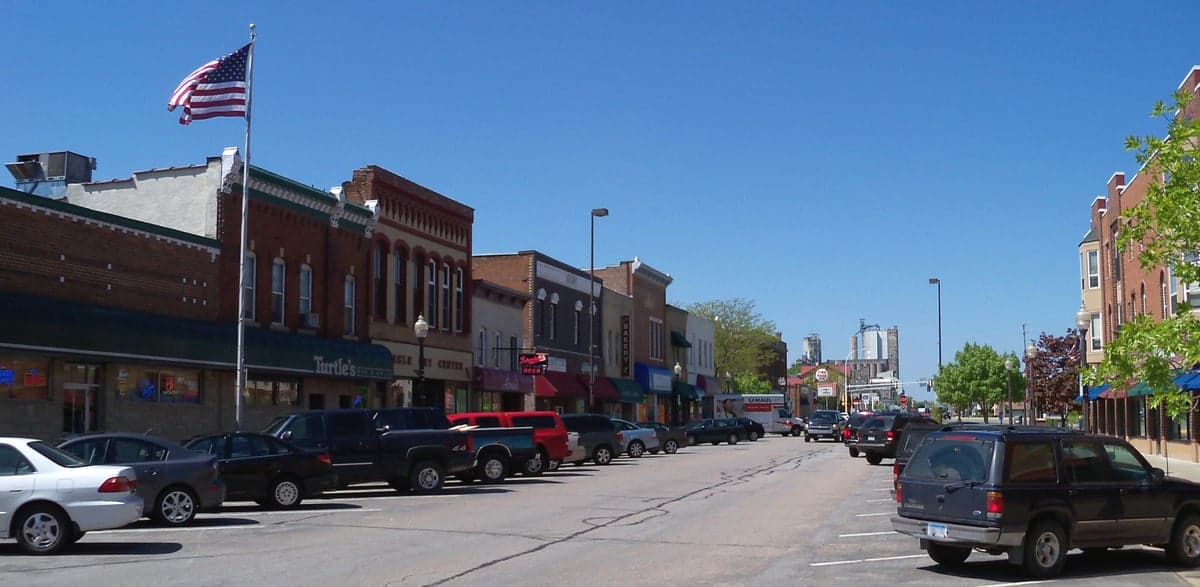
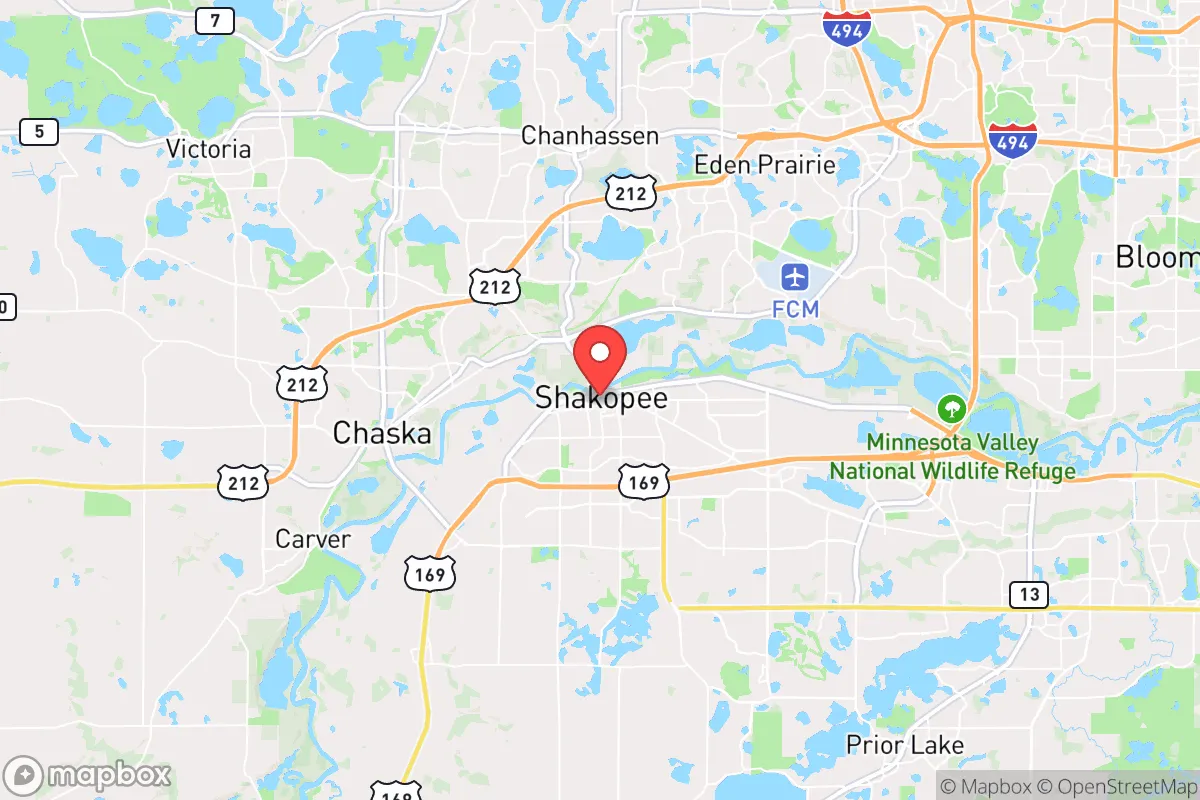
Photo: Wikipedia
Demographics of Shakopee, MN
Affluence Level in Shakopee, MN
An upper-middle-class area. Household wealth, education levels, and homeownership run ahead of national benchmarks.
People of Shakopee, MN
Shakopee, Minnesota, today is a rapidly diversifying suburban city of 45,002 residents, where a historically white, working-class population is giving way to a more multi-ethnic mix. The city’s character is defined by its blend of older riverfront neighborhoods, newer master-planned subdivisions, and a growing industrial base anchored by the massive Amazon fulfillment center and Canterbury Park. With a foreign-born population of 6.2% and a college-educated rate of 39.9%, Shakopee is neither a wealthy exurb nor a struggling inner-ring suburb, but a pragmatic, family-oriented community where affordability and job access drive in-migration. Distinct identity markers include a strong local sports culture, a visible Hmong and Hispanic presence in specific neighborhoods, and a political tilt that leans conservative relative to the Twin Cities metro.
How the city was settled and grew
Shakopee’s original population was Dakota Sioux, who called the area Te Tanka (Big Village) before European settlement. The first white settlers arrived in the 1850s, drawn by the Minnesota River’s water power and fertile bottomlands. German and Irish immigrants formed the early core, building the Downtown Shakopee historic district along First Avenue and Holmes Street, where many of their original limestone and brick commercial buildings still stand. The arrival of the Minneapolis, St. Paul and Sault Ste. Marie Railroad in the 1880s spurred a second wave of Scandinavian immigrants—Swedes and Norwegians—who settled in the Southbridge area near the river, working in the flour mills and later the Minnesota Valley Canning Company (later Green Giant). By 1900, Shakopee was a small, ethnically homogeneous farming and milling town of about 1,500, with distinct German and Scandinavian enclaves still visible in the street names and church congregations of the West Side neighborhood. The mid-20th century brought little change; the population hovered around 5,000 through the 1960s, with most residents commuting to jobs in the Twin Cities or working at the local gravel pits and the Shakopee Correctional Facility (opened 1986).
Modern era (post-1965)
The 1965 Hart-Cellar Immigration Act opened the door for Shakopee’s first significant non-European population. The largest early wave came from Southeast Asia after the Vietnam War: Hmong refugees began arriving in the 1980s, drawn by low housing costs and entry-level manufacturing jobs at companies like ADC Telecommunications (now CommScope) and the Shakopee-based Canterbury Park racetrack. These families concentrated in the Jackson Street corridor and the Eagle Creek neighborhood, where Hmong-owned businesses and the Hmong Baptist Church now anchor a visible community. A second wave of Hispanic immigration—primarily Mexican and Central American—accelerated in the 2000s, driven by construction and food-processing jobs. Hispanic residents (9.8% of the population) are most concentrated in the Southbridge and West Side neighborhoods, where bilingual signage and taquerias are common. The most recent shift is the arrival of East/Southeast Asian (7.8%) and Indian-subcontinent (3.0%) professionals, who have moved into newer subdivisions like Deans Lake and Woodland Hills since 2010, drawn by tech and logistics jobs at Amazon, Shutterfly, and the nearby Mystic Lake Casino complex. Black residents (8.1%) are more dispersed but have a visible presence in the Eagle Creek and Downtown rental stock. The white share has dropped from over 90% in 1990 to 63.6% today, with the most rapid diversification occurring in the last decade.
The future
Shakopee’s population is heading toward a more pluralistic, but not fully integrated, future. The city is not homogenizing; rather, distinct ethnic enclaves are solidifying: Hmong families in Eagle Creek, Hispanic families in Southbridge, and white and Asian professionals in Deans Lake. The immigrant communities—particularly Hmong and Hispanic—are growing through both natural increase and continued chain migration, while the Indian and East/Southeast Asian populations are plateauing as housing prices rise. The next 10-20 years will likely see the white share fall below 50% by 2040, driven by out-migration of younger white families to cheaper exurbs and continued minority in-migration. Shakopee is becoming a majority-minority suburb, but one where ethnic groups remain geographically and socially distinct rather than blending into a single melting pot. The school district (Shakopee Public Schools) is already majority non-white, which will accelerate this trend.
For a conservative-leaning individual or family moving to Shakopee now, the city offers a stable, job-rich environment with a still-strong white cultural base in the older neighborhoods, but the demographic trajectory is clear: Shakopee is becoming a multi-ethnic, working-to-middle-class suburb where newcomers will find distinct ethnic communities rather than a uniform suburban experience. The key decision is which neighborhood—and which demographic future—aligns with your priorities.

* Values derived from national, state, county, city and local statistics and may differ in a specific area. Last updated: 2026-04-20T16:24:45.000Z
Narrative content on this page is AI-generated and may contain mistakes. Verify any details that matter before acting on them.
ReloMaps may earn a commission from affiliate links at no extra cost to you.

