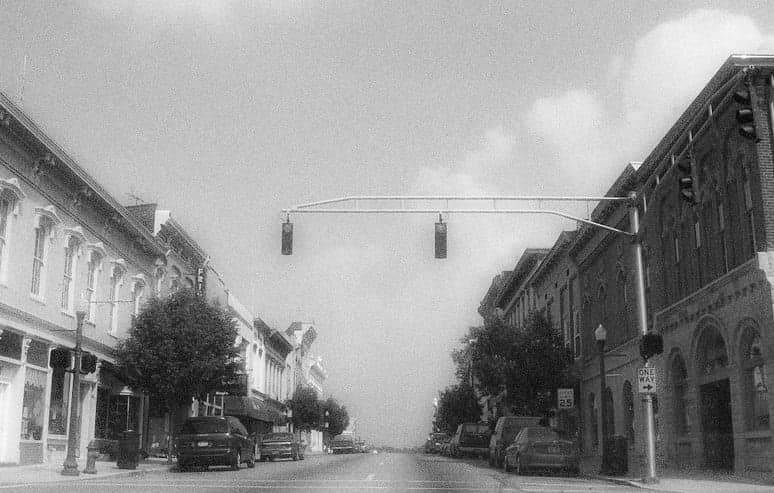
Photo: Wikipedia
Demographics of Shelbyville, KY
Affluence Level in Shelbyville, KY
A middle-class area roughly in line with national averages across income, home values, education, and employment.
People of Shelbyville, KY
Shelbyville, Kentucky, is a city of 17,436 residents where the population is becoming more diverse while retaining a distinctly small-town, family-oriented character. The city is 64.8% White, 20.1% Hispanic, 8.4% Black, and 6.6% foreign-born, a composition that reflects layered waves of migration over two centuries. With 25.3% of adults holding a college degree, Shelbyville is a working-class and middle-class community where manufacturing and logistics anchor the economy, and where the population is gradually shifting from a historically biracial (White and Black) makeup to a tri-ethnic one with a growing Hispanic presence.
How the city was settled and grew
Shelbyville was founded in 1792 as the seat of Shelby County, named for Revolutionary War hero Isaac Shelby. The original population was almost entirely of English, Scots-Irish, and German stock, drawn by land grants awarded to veterans of the American Revolution and the War of 1812. These early settlers established farms and small businesses along the Clear Creek valley, and the town grew slowly as a market center for the surrounding agricultural region. By the mid-19th century, a small free Black population had emerged, concentrated in the West End neighborhood near the railroad tracks, where many worked as laborers, domestics, and artisans. The arrival of the Louisville and Nashville Railroad in the 1850s spurred modest industrial growth, but Shelbyville remained overwhelmingly rural and White through the early 1900s. The Great Migration brought a notable wave of Black families from the Deep South between 1910 and 1950, settling primarily in the Southside and East Shelbyville neighborhoods, where they built churches, schools, and a tight-knit community around the historic Lincoln Institute (a segregated boarding school founded in 1912). By 1960, Shelbyville was roughly 85% White and 15% Black, with negligible other groups.
Modern era (post-1965)
The post-1965 era reshaped Shelbyville’s demographics in two major phases. First, the Immigration and Nationality Act of 1965 opened doors for new arrivals, but Shelbyville saw little immediate change—its foreign-born share remained below 2% through the 1980s. The real transformation began in the 1990s, when the JBS Swift pork processing plant (now a major employer) and several logistics centers expanded, creating a demand for low-skill labor that drew Hispanic migrants from Mexico and Central America. This wave settled heavily in the Northside and Midtown areas, where affordable housing and proximity to industrial jobs made the neighborhoods entry points. By 2020, the Hispanic share had risen to over 20%, making Shelbyville one of the most Hispanic cities in Kentucky outside of Louisville. The Black population, meanwhile, has remained stable at roughly 8-9%, with many families now living in the Southside and newer subdivisions like Briarwood and Clear Creek Estates. The East/Southeast Asian population is tiny at 0.6%, and the Indian-subcontinent population is effectively zero—a reflection of the city’s lack of professional-sector jobs that typically attract those groups. Domestic in-migration has been modest, with most new White residents coming from other parts of Kentucky or the Midwest, drawn by lower housing costs and the expanding logistics sector.
The future
Shelbyville’s population is heading toward greater Hispanic growth and gradual diversification, but not toward the kind of hyper-diversity seen in larger metros. The Hispanic share is likely to continue rising, driven by both immigration and higher birth rates, potentially reaching 25-30% by 2040. This group is not tribalizing into isolated enclaves; rather, second-generation Hispanic residents are increasingly moving into the Briarwood and Clear Creek Estates subdivisions alongside White and Black families, suggesting assimilation into the broader community. The Black population is projected to remain stable or grow slightly, while the White share will continue to decline as a percentage, though Whites will remain the majority for the foreseeable future. The East/Southeast Asian and Indian populations are unlikely to grow significantly unless Shelbyville attracts a major tech or healthcare employer—something not currently on the horizon. The city is homogenizing in the sense that English remains the dominant language and cultural norms are broadly Midwestern-Southern, but it is also becoming more ethnically layered, with distinct Hispanic cultural institutions (bakeries, churches, soccer leagues) now woven into the fabric of the Northside and Midtown neighborhoods.
For someone moving to Shelbyville now, the city offers a stable, family-oriented environment where the population is becoming more Hispanic but remains predominantly White and English-speaking. The community is not experiencing the rapid demographic churn of a Sun Belt boomtown, but rather a gradual, organic shift that has so far been absorbed without major social friction. New residents—whether single individuals or parents—will find a place where neighborhoods are still defined more by income and housing stock than by ethnicity, and where the main story is the quiet expansion of a working-class Hispanic population alongside a long-established Black community and a still-dominant White majority.

* Values derived from national, state, county, city and local statistics and may differ in a specific area. Last updated: 2026-05-03T20:24:19.000Z
Narrative content on this page is AI-generated and may contain mistakes. Verify any details that matter before acting on them.
ReloMaps may earn a commission from affiliate links at no extra cost to you.

