
Photo: Wikipedia
Political ClimatePolitical Climate in Shelton, CT
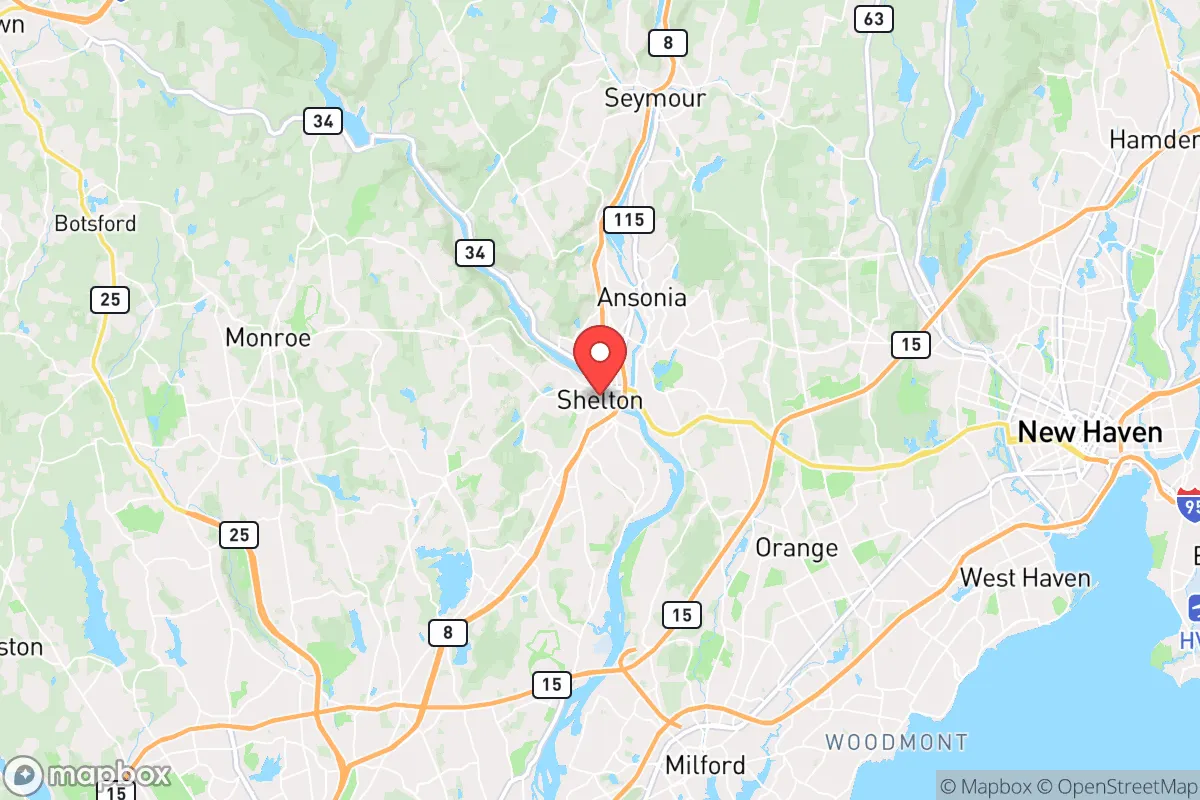
District shown is the primary district for this city’s centroid. Cities may span multiple districts.
Local Political AnalysisPolitical Analysis of Shelton, CT
Shelton, Connecticut, leans reliably Democratic, carrying a Cook PVI of D+8, but that number tells only part of the story. For decades, this was a blue-collar, independent-minded town where folks voted their conscience, not a party line. You’d see as many “Don’t Tread on Me” flags as campaign signs. Lately, though, the political winds have shifted noticeably leftward, driven by an influx of commuters from New York and Fairfield County who bring bigger-government sensibilities with them. The old Shelton—pragmatic, fiscally conservative, and wary of overreach—is still here, but it’s increasingly a minority voice in its own hometown.
How it compares
Drive ten minutes north to Monroe or Trumbull, and you’ll feel the difference immediately. Those towns lean more Republican, with Monroe voting +12 R in recent state races. Head south into Stratford or Bridgeport, and you’re in deep-blue territory where progressive policies are the norm. Shelton sits right in the middle, but the D+8 rating means it’s now closer to Stratford than to Monroe. The city council and school board have tilted left over the past two cycles, and you see it in the votes: higher spending proposals pass more easily, zoning rules get tighter, and there’s a growing appetite for state-level mandates that used to be met with skepticism. The surrounding towns like Oxford and Seymour still hold the line, but Shelton’s trajectory is a warning sign for anyone who values local control over personal freedoms.
What this means for residents
For the average homeowner or small business owner, the shift means more than just bumper stickers. Property taxes have crept up as the town takes on new social programs and infrastructure projects that feel more like state priorities than local needs. The school curriculum has seen quiet changes too—more emphasis on equity initiatives, less on traditional academics. If you value the right to make your own choices about your property, your children’s education, or your business operations, you’ll find yourself increasingly at odds with the town’s direction. The local Republican committee is still active, but they’re fighting an uphill battle against a demographic tide that sees government as a solution, not a threat. Long-term, if the trend holds, Shelton could become a mirror of Westport or Darien—prosperous, but with a heavy hand in your daily life.
Culturally, Shelton still has its old-school charm: the Shelton Farmers Market and the Housatonic River are gathering spots where politics takes a back seat. But the policy distinctions are real. The town has embraced state-mandated affordable housing quotas under 8-30g, which is reshaping neighborhoods in ways that worry longtime residents about property values and community character. There’s also been a push for electric vehicle mandates and energy efficiency codes that add red tape for homeowners. If you’re looking for a place where you can live and let live, Shelton still offers that in pockets—but the window is closing. Keep an eye on the next few municipal elections; they’ll tell you whether Shelton stays a place for independent thinkers or becomes just another suburb of the state capital’s agenda.

State Political ClimatePolitical Climate in Connecticut
State Political AnalysisPolitical Environment in the State
Connecticut has shifted from a classic swing state to a reliably blue stronghold over the past two decades, with Democrats now holding every statewide office and supermajorities in both legislative chambers. The state’s overall partisan lean is roughly D+10 to D+12 in presidential elections, a stark contrast from the 1990s when it voted for both Bill Clinton and George W. Bush. This leftward drift has accelerated since 2016, driven by the consolidation of wealthy, educated suburbs around New York City and the near-total collapse of the GOP in Fairfield County’s commuter towns.
Urban vs. rural divide
The political map of Connecticut is a tale of three distinct regions. The southwestern corner—Fairfield County, including towns like Greenwich, Stamford, and Westport—is the engine of Democratic dominance. These affluent, highly educated suburbs have moved sharply left since 2016, with many precincts now voting 65-75% Democratic. The state’s three largest cities—Hartford, New Haven, and Bridgeport—are deep blue strongholds, delivering margins of 80% or more for Democrats. In contrast, the eastern half of the state, particularly the “Quiet Corner” around Windham County and the rural towns of Litchfield County in the northwest, remain reliably Republican. The town of Litchfield itself, for example, voted for Trump in both 2016 and 2020, a rare holdout in a state that went for Biden by 20 points. The divide isn’t just urban vs. rural; it’s also a cultural and economic split between the New York City orbit and the rest of the state, with the I-84 corridor acting as a rough political boundary.
Policy environment
Connecticut’s policy environment is among the most progressive in the Northeast, with a tax burden that consistently ranks in the top five nationally. The state has a progressive income tax with a top marginal rate of 6.99%, a high property tax burden, and a recently enacted paid family and medical leave program funded by a payroll tax. On education, the state has some of the nation’s strongest teacher unions and a school choice system that is limited compared to neighboring states, though there are a handful of magnet schools and charter schools in Hartford and New Haven. Healthcare is heavily regulated, with a state-run health insurance exchange and strict mandates. Election laws are among the most liberal in the country: Connecticut has no-excuse absentee voting, early voting (enacted in 2023), and same-day voter registration. The state also passed a “safe harbor” law in 2022 protecting out-of-state abortion providers and patients from legal action, signaling a willingness to use state power to shield progressive policies from federal or interstate challenges.
Trajectory & freedom
Over the past five years, Connecticut has moved decisively toward more government control over personal choices. The most significant expansion of state power came with the 2023 passage of HB 6667, which banned the sale of “assault weapons” and high-capacity magazines, and raised the minimum purchase age for all firearms to 21. This followed a 2013 law that already had some of the strictest gun regulations in the country. On medical freedom, the state’s COVID-19 response was among the most aggressive in the nation, with prolonged school closures and a vaccine mandate for healthcare workers that remained in place well after other states had dropped them. Parental rights have been a flashpoint: in 2021, the state passed a law requiring schools to adopt policies that affirm a student’s gender identity without parental notification, effectively overriding parental authority in schools. Property rights are also constrained by the state’s affordable housing statute (8-30g), which allows developers to bypass local zoning in towns that don’t meet a 10% affordable housing threshold, a law that has sparked fierce resistance in towns like Fairfield and Westport. The overall trajectory is one of expanding state authority into areas of personal and family life.
Civil unrest & political movements
Connecticut has seen relatively low levels of civil unrest compared to larger states, but there have been notable flashpoints. The 2020 Black Lives Matter protests in New Haven and Hartford were large but mostly peaceful, though they did lead to the removal of a Christopher Columbus statue in New Haven. On the right, the state has a small but active Second Amendment movement, with regular rallies at the state capitol in Hartford, particularly during the 2023 gun bill debate. Immigration politics are a simmering issue: Connecticut is a sanctuary state, with a 2013 law (the “Trust Act”) limiting local police cooperation with federal immigration authorities. In 2024, the state expanded protections by barring the use of state resources for immigration enforcement, a move that drew sharp criticism from conservative towns. Election integrity has been a recurring concern among conservatives, particularly after the 2020 election saw widespread use of no-excuse absentee ballots, though no major fraud was documented. The most visible political movement in recent years has been the “Save Our Schools” coalition, which mobilized parents in Greenwich and Darien against critical race theory and gender identity curricula, though these efforts have had limited legislative success.
Projection
Looking ahead five to ten years, Connecticut is likely to become even more solidly Democratic. In-migration patterns are working against conservatives: the state is losing population overall, but the people moving in tend to be younger, more diverse, and more liberal, while those leaving are often older, more conservative residents heading to Florida or the Carolinas. The state’s high cost of living and tax burden are accelerating this trend, with the 2020 Census showing Connecticut losing a congressional seat for the first time in decades. The GOP’s base in the rural east and northwest is shrinking, and the party has shown little ability to compete in the suburbs. The most likely scenario is a continued leftward drift on policy, with potential new gun restrictions, a push for single-payer healthcare, and further erosion of local zoning control. A conservative moving to Connecticut today should expect to live in a state where their political views are in the minority, where state policy will frequently conflict with their values, and where the political climate will only become more challenging over time.
For a conservative individual or family considering a move to Connecticut, the bottom line is this: you will be living in a state where your vote for statewide office will have little impact, where your tax dollars will fund policies you likely oppose, and where your children’s schools may operate under rules that conflict with your values. The state’s natural beauty, excellent schools in certain districts, and proximity to New York City are real draws, but they come with a heavy price—both financially and in terms of personal freedom. If you value low taxes, gun rights, parental authority in education, and a government that stays out of your life, Connecticut is likely not the right fit. If you can tolerate a high-cost, high-regulation environment and are willing to fight for your values at the local level, towns like Litchfield or Woodbury in the northwest offer a more conservative enclave, but the statewide tide is not in your favor.
* Values derived from national, state, county, city and local statistics and may differ in a specific area. Last updated: 2026-04-19T09:30:31.000Z
Narrative content on this page is AI-generated and may contain mistakes. Verify any details that matter before acting on them.
ReloMaps may earn a commission from affiliate links at no extra cost to you.

