Photo: Wikipedia
Demographics of Shepherdstown, WV
Affluence Level in Shepherdstown, WV
A middle-class area roughly in line with national averages across income, home values, education, and employment.
People of Shepherdstown, WV
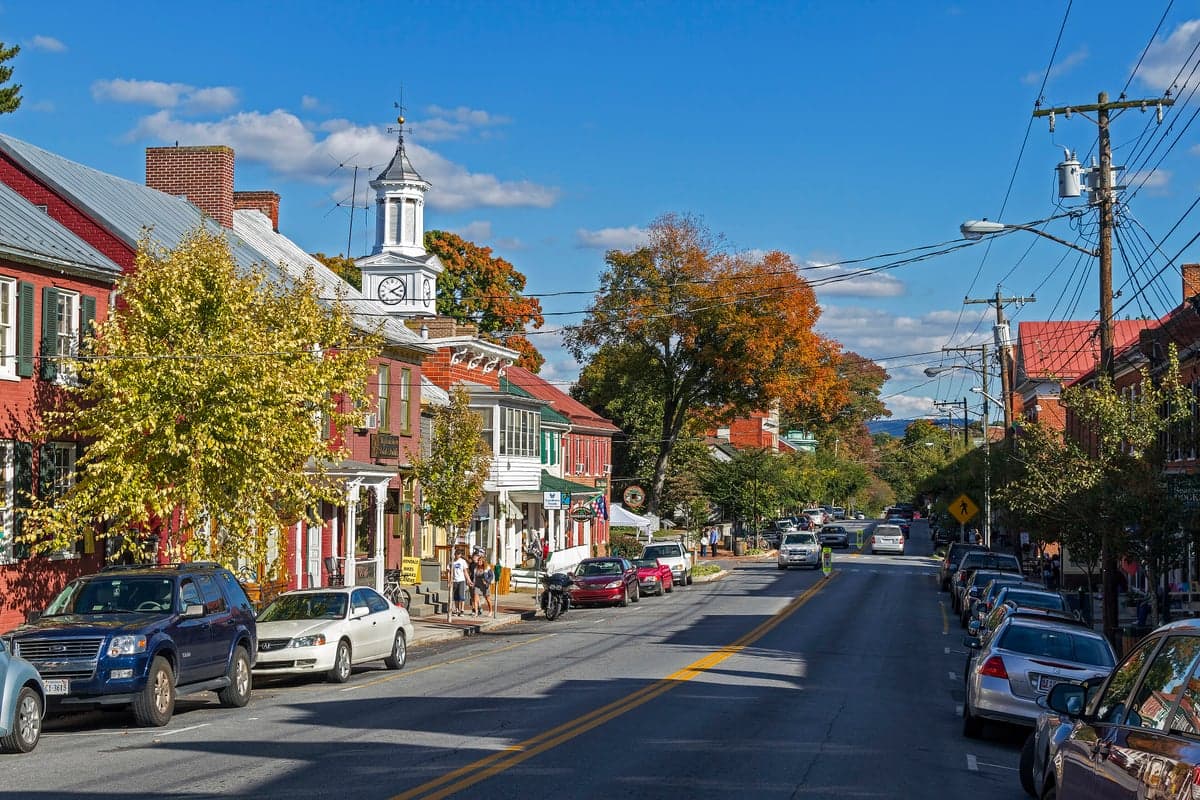
Shepherdstown, West Virginia, is a small, historically rooted college town of 1,399 residents, defined by its overwhelmingly white (84.4%) and highly educated (71.4% college degree) population. The city’s character is shaped by Shepherd University, which anchors a walkable historic core and draws a mix of faculty, students, and retirees seeking a quiet, culturally engaged community. With a foreign-born share of just 3.5% and a Black population of 11.4%, Shepherdstown is more diverse than much of rural West Virginia, yet remains a predominantly white, liberal-leaning enclave in an otherwise conservative state.
How the city was settled and grew
Shepherdstown was founded in 1762 by Thomas Shepherd, who received a land grant along the Potomac River. The original settlers were primarily English, Scots-Irish, and German farmers, drawn by fertile bottomlands and the river’s milling potential. The town’s historic core, German Street, was the commercial and social spine, lined with stone and brick buildings built by these early families. During the 19th century, the town remained a small agricultural and milling center, with a significant enslaved Black population working on surrounding plantations. After the Civil War, freedmen established a small community in the East End neighborhood, near the railroad tracks, where a few Black families remained through the Jim Crow era. The arrival of Shepherd College (now Shepherd University) in 1871 brought a new wave of faculty and students, many from the Mid-Atlantic, and spurred modest growth in the University District around the campus. By 1950, the population was still under 1,000, almost entirely white, with a tiny Black minority concentrated in the East End.
Modern era (post-1965)
The post-1965 period saw Shepherdstown’s population stabilize and then slowly diversify, driven primarily by the university’s expansion. The 1970s and 1980s brought an influx of out-of-state faculty and students, many from the Northeast and Mid-Atlantic, who settled in the Rumsey Ridge and Morgan’s Grove subdivisions—newer, car-dependent neighborhoods on the town’s periphery. These newcomers were overwhelmingly white and college-educated, reinforcing the town’s liberal, academic character. The Black population, which had been as high as 15% in the 19th century, declined to 11.4% by 2020, with most Black residents now living in the East End or in scattered rental units near campus. The Hispanic share (1.2%) and Indian-subcontinent share (1.1%) are very small, with Indian residents typically being university faculty or medical professionals living in the University District or Rumsey Ridge. East/Southeast Asian residents are essentially absent (0.0%). The foreign-born share (3.5%) is slightly below the national average, reflecting limited immigration to this inland town. The dominant demographic trend since 1965 has been the replacement of older, locally born white residents with younger, highly educated white transplants from outside West Virginia.
The future
Shepherdstown’s population is likely to remain small and stable, with slow growth driven by university enrollment and retirement migration. The town is not homogenizing into a single enclave but rather tribalizing into distinct zones: the historic core (German Street) attracts tourists and long-term residents; the University District is transient and student-heavy; and the peripheral subdivisions (Rumsey Ridge, Morgan’s Grove) house faculty and professionals. The Black population is aging and not being replaced by younger Black families, so its share may decline further. The Hispanic and Indian communities are too small to drive significant change, and East/Southeast Asian immigration is negligible. The most likely scenario is that Shepherdstown becomes whiter and more educated over the next decade, as the university continues to attract out-of-state students and faculty while local working-class families move to more affordable areas like Martinsburg or Charles Town. The town’s liberal political culture will likely persist, but its demographic profile will remain a narrow slice of the broader American population.
For someone moving in now, Shepherdstown offers a highly educated, culturally engaged community in a historic setting, but with very limited racial or ethnic diversity. The population is stable and aging, with little influx of young families or immigrants. The town is becoming a more exclusive enclave for white, college-educated professionals and retirees, while the surrounding county remains more conservative and working-class. If demographic diversity or a growing population is a priority, Shepherdstown may not be the right fit. If a quiet, walkable college town with a strong sense of place is the goal, it remains one of West Virginia’s most distinctive small cities.

* Values derived from national, state, county, city and local statistics and may differ in a specific area. Last updated: 2026-10-10T16:28:57.000Z
Narrative content on this page is AI-generated and may contain mistakes. Verify any details that matter before acting on them.
ReloMaps may earn a commission from affiliate links at no extra cost to you.

