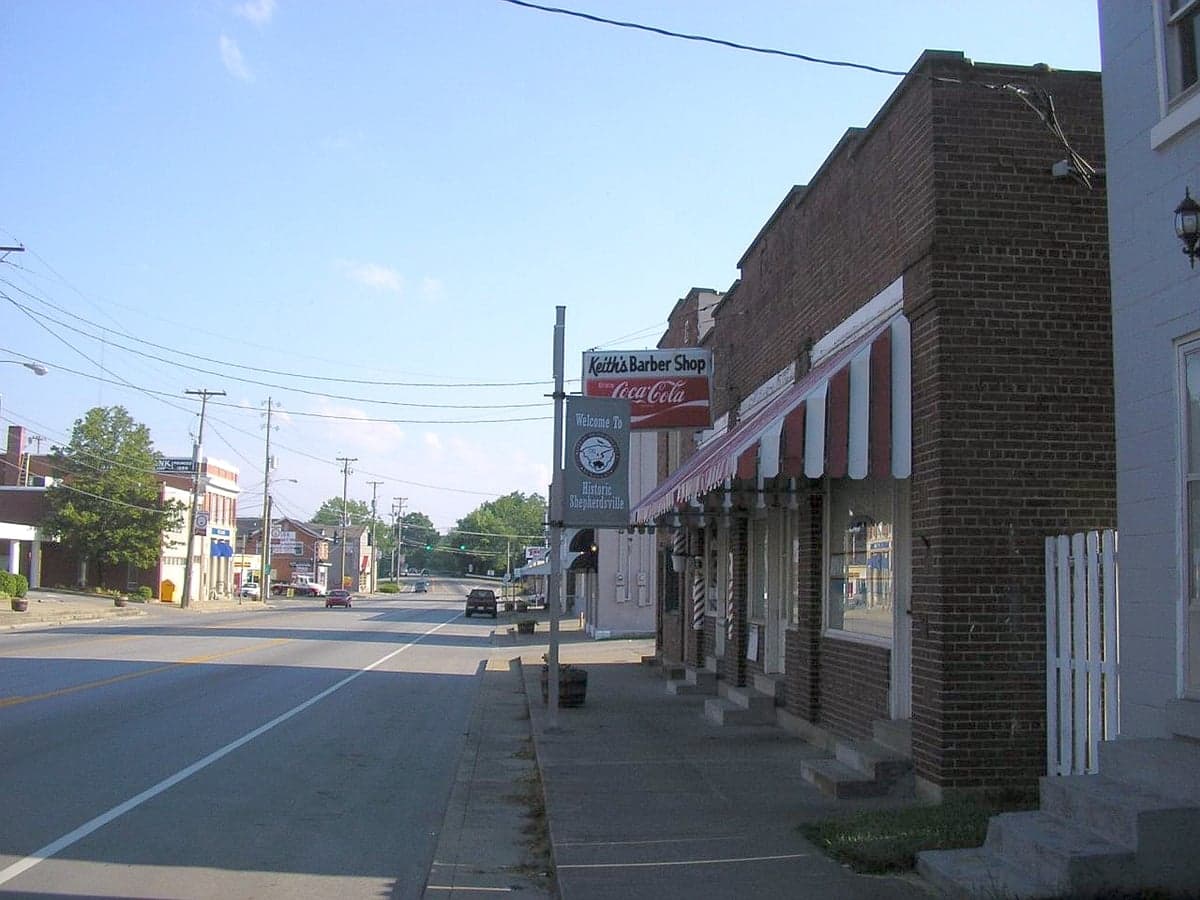
Photo: Wikipedia
Demographics of Shepherdsville, KY
Affluence Level in Shepherdsville, KY
A below-average socioeconomic profile. Incomes, home values, and educational attainment trail the U.S., with higher poverty and unemployment.
People of Shepherdsville, KY
The people of Shepherdsville, Kentucky, today form a predominantly white, working-class community of 14,351 residents, marked by a strong local identity rooted in small-town values and a low 0.8% foreign-born population. With a 92.2% white demographic and a 17.2% college-educated rate, the city is notably homogeneous compared to national averages, reflecting a population that has remained stable in composition even as the broader Louisville metro area has diversified. The city’s character is defined by its role as a bedroom community for Louisville (20 miles north) and its concentration of logistics and manufacturing jobs, with residents often describing it as a place where "everyone knows everyone" and where family ties run deep.
How the city was settled and grew
Shepherdsville was founded in 1793 as the seat of Bullitt County, drawing its first settlers—primarily of English, Scots-Irish, and German descent—who arrived via the Wilderness Road and Ohio River tributaries. These early families were attracted by land grants offered to veterans of the Revolutionary War and the fertile bottomlands along the Salt River. The original settlement clustered around the courthouse square in what is now Downtown Shepherdsville, where log cabins and later brick homes housed merchants, millers, and farmers. By the mid-19th century, the arrival of the Louisville and Nashville Railroad spurred a second wave of growth, bringing Irish and German laborers who built homes in the Railroad District along the tracks, a neighborhood still identifiable by its narrow lots and older frame houses. The 20th century saw little new immigration; instead, the population grew through natural increase and domestic migration from surrounding rural counties, with families settling in the Pioneer Village area (annexed in the 1960s) and the Cedar Grove subdivision, which was developed for workers at the nearby Fort Knox military base.
Modern era (post-1965)
After the 1965 Hart-Cellar Act, Shepherdsville experienced virtually no influx of foreign-born residents—the foreign-born share today is just 0.8%, far below Kentucky’s 4.2% average. Instead, the post-1965 period was defined by domestic in-migration from rural Kentucky and Appalachia, as families moved to the city for jobs at the expanding Zappos.com fulfillment center and the GE Appliances plant in nearby Louisville. These new residents concentrated in the Brookside and Fox Chase subdivisions, which were built out in the 1970s and 1980s as affordable single-family housing. The Hispanic population, now at 2.7%, began to grow slowly after 2000, largely driven by workers in the logistics and warehousing sectors, and is most visible in the Southside area near the I-65 interchange. The Black population, at 2.0%, has remained small and is dispersed rather than concentrated in any single neighborhood, reflecting the city’s lack of a historic African American district. The Asian population is effectively zero (0.0%), and the Indian subcontinent population is also zero (0.0%), making Shepherdsville one of the least ethnically diverse cities of its size in Kentucky.
The future
Demographic projections suggest Shepherdsville will remain overwhelmingly white and native-born for the foreseeable future, with the Hispanic share likely rising slowly to 4-5% by 2035 as logistics-sector employment grows. The city is not tribalizing into distinct ethnic enclaves—its small minority populations are too few to form concentrated neighborhoods—but it is homogenizing in the sense that new housing developments, such as the Lakeview Estates subdivision, are attracting the same demographic profile: white, working-class families from within a 50-mile radius. The college-educated share (17.2%) is unlikely to rise sharply, as the city lacks a university or major white-collar employment base, and the population is aging slightly as younger adults move to Louisville for professional careers. The next decade will likely see continued slow growth (1-2% annually) driven by affordable housing prices and proximity to Louisville, but without significant diversification.
For someone moving in now, Shepherdsville offers a stable, low-crime, and culturally cohesive environment where the population is overwhelmingly native-born, English-speaking, and family-oriented. The city is not becoming a melting pot or a tribalized patchwork—it is a place where demographic continuity is the defining trend, and where newcomers who share the community’s existing values and lifestyle will find a welcoming, if homogeneous, social landscape.

* Values derived from national, state, county, city and local statistics and may differ in a specific area. Last updated: 2026-04-21T11:15:08.000Z
Narrative content on this page is AI-generated and may contain mistakes. Verify any details that matter before acting on them.
ReloMaps may earn a commission from affiliate links at no extra cost to you.

