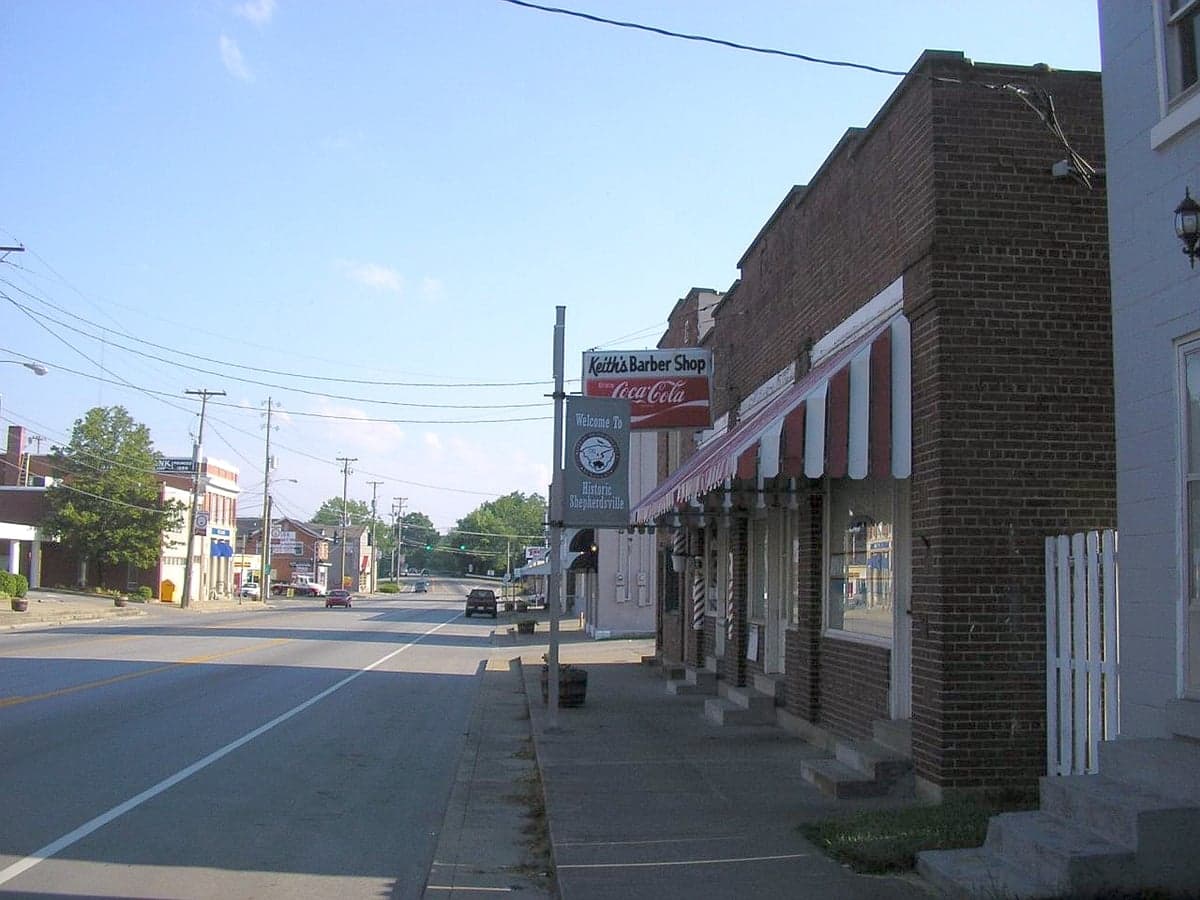

Photo: Wikipedia
Political ClimatePolitical Climate in Shepherdsville, KY
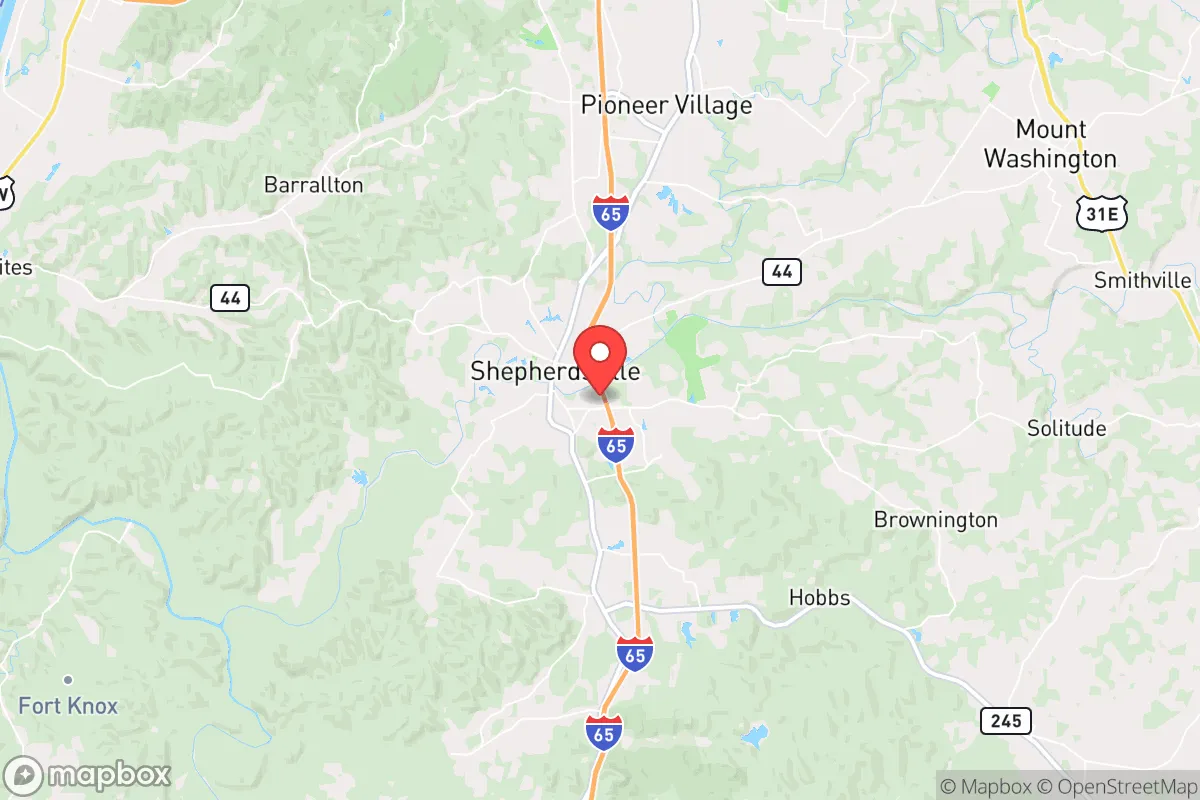
District shown is the primary district for this city’s centroid. Cities may span multiple districts.
Local Political AnalysisPolitical Analysis of Shepherdsville, KY
Shepherdsville is about as solidly conservative as it gets in Kentucky, and that's been the case for as long as anyone around here can remember. The Cook PVI sits at R+20, which means the area votes about 20 points more Republican than the national average, and that number has held steady even as some other parts of the state have started to wobble. You don't see much hand-wringing over politics here—people know what they believe, and they vote accordingly, with most local races being decided in the Republican primary rather than the general election.
How it compares
Drive 20 minutes north to Louisville, and you're in a completely different world—Jefferson County leans Democratic, with a Cook PVI of D+8, and the contrast is stark. While Louisville has seen a push for progressive policies on everything from policing to zoning, Shepherdsville has stayed the course. Bullitt County as a whole has trended even redder in recent cycles, with Trump winning by over 40 points in 2020. The nearby towns of Mount Washington and Lebanon Junction are cut from the same cloth, but places like Bardstown to the east have started to show a slight purple tint as more people move in from out of state. That hasn't happened here yet, and most folks hope it never does.
What this means for residents
For the people who live here, the conservative tilt isn't just about who gets elected—it shapes daily life in real ways. Property taxes are low, the county government is lean, and there's a general distrust of any new regulation that sounds like it might come from Frankfort or Washington. The local school board has pushed back hard on curriculum mandates that feel like indoctrination, and the sheriff's office has made it clear they won't enforce any gun laws they consider unconstitutional. That kind of local control is exactly why a lot of families moved here from more restrictive areas. The downside is that some services can feel thin—there's not much public transit, and the road maintenance budget gets stretched—but most residents would rather patch a pothole themselves than trade freedom for a smoother ride.
There's a quiet concern, though, that the political winds could shift if the county keeps growing. New subdivisions are popping up along the I-65 corridor, and some of the newcomers are coming from places like Louisville or even out of state. They bring different expectations, and you can already see it in small ways—a few more Harris signs in yards during the last election, some chatter about adding bike lanes or more affordable housing mandates. So far, the old guard has held the line, but the 2028 election cycle will be a real test. If Shepherdsville starts to drift even a little toward the center, it'll be because the people who moved here for the quiet and the low taxes forgot why they came in the first place.

State Political ClimatePolitical Climate in Kentucky
State Political AnalysisPolitical Environment in the State
Kentucky has long been a reliably red state in federal elections, but its political climate is far more nuanced than a simple partisan label suggests. The state leans solidly Republican at the presidential level, with Donald Trump winning by over 25 points in both 2016 and 2020, and the GOP now holds supermajorities in both chambers of the state legislature. However, this dominance is a relatively recent development — as recently as the early 2000s, Kentucky was a competitive swing state with a strong Democratic tradition at the local level, particularly in the eastern coalfields and the urban core of Louisville. Over the past two decades, a dramatic realignment has occurred: culturally conservative, working-class voters in rural areas have shifted en masse to the GOP, while the state’s few urban centers have become increasingly Democratic. The result is a state that votes overwhelmingly Republican statewide but contains sharp internal divisions that any new resident should understand.
Urban vs. rural divide
The political map of Kentucky is a textbook example of the urban-rural split that defines American politics today. The two major population centers — Louisville (Jefferson County) and Lexington (Fayette County) — are the state’s Democratic strongholds. Jefferson County voted for Joe Biden by about 15 points in 2020, and Fayette County by about 18 points. These cities are home to the state’s major universities (University of Louisville, University of Kentucky), a growing professional class, and a more diverse population. Outside these islands, the rest of the state is deeply red. The eastern coalfields, once a Democratic bastion due to union loyalty, have flipped hard: counties like Pike, Perry, and Harlan now vote Republican by margins of 60-70 points. The same is true for the western part of the state, including the Jackson Purchase region around Paducah and the Pennyrile area around Hopkinsville. A notable exception is Bowling Green (Warren County), which is a fast-growing, moderately conservative city that still leans Republican but is becoming more competitive as it attracts younger, more educated transplants. The suburban ring around Louisville — places like Oldham County and Shelbyville — remains reliably red, though with a more educated, fiscally conservative bent than the rural counties.
Policy environment
Kentucky’s policy environment is broadly conservative, but with some notable wrinkles. The state has a flat income tax of 4.5% (down from 6% in 2018, with a path to elimination), and no state-level property tax on real estate — though local governments levy their own. The regulatory posture is generally business-friendly, with a right-to-work law (passed in 2017) and a tort reform system that caps non-economic damages in medical malpractice cases. On education, Kentucky has a robust school choice movement: the state passed a charter school law in 2017 (though no charters have opened yet due to local opposition), and in 2022 it enacted a universal education savings account (ESA) program that allows parents to use state funds for private school tuition, homeschooling, or tutoring. However, the Kentucky Supreme Court struck down the ESA funding mechanism in 2023, leaving the program in limbo. Healthcare is a mixed bag: the state expanded Medicaid under the Affordable Care Act in 2014, but the legislature has resisted further expansion and has passed laws requiring work requirements for able-bodied adults. Election laws are moderately restrictive: Kentucky requires a photo ID to vote, has no early voting (though absentee voting was expanded during COVID and then rolled back), and has a voter roll maintenance program that purges inactive registrations. The state also has a constitutional amendment (passed in 2020) stating there is no right to abortion, and a near-total ban on abortion with limited exceptions.
Trajectory & freedom
On the whole, Kentucky has been moving in a direction that many conservatives would consider more free over the past decade, but the picture is uneven. The most significant expansion of personal liberty came in 2019 with the passage of constitutional carry (permitless carry of concealed firearms), which went into effect immediately. The state also passed a Second Amendment Preservation Act in 2021, which purports to nullify federal gun laws that the state deems unconstitutional — a move that has not been tested in court but signals a strong pro-gun posture. On parental rights, Kentucky passed a Parents’ Bill of Rights in 2022, requiring schools to notify parents of any changes to a student’s health or well-being and prohibiting instruction on sexual orientation or gender identity in grades K-5. The state also banned transgender athletes from competing in girls’ sports in 2022. On the negative side of the ledger, the state’s medical marijuana program (legalized in 2023) is heavily restricted — only a handful of conditions qualify, and patients cannot grow their own. More concerning for liberty-minded residents is the state’s aggressive asset forfeiture regime, where law enforcement can seize property without a criminal conviction, and the state’s civil commitment laws for sex offenders, which allow indefinite detention after a sentence is served. The state also has a broad emergency powers law that gave the governor unilateral authority during COVID, though the legislature has since reined that in by requiring legislative approval for emergency orders lasting more than 30 days.
Civil unrest & political movements
Kentucky has seen its share of political flashpoints in recent years. The most visible was the Breonna Taylor protests in Louisville in 2020, which lasted for months and resulted in significant property damage, the deployment of the National Guard, and the killing of a protester by law enforcement. The protests were largely concentrated in Louisville’s West End and downtown, and they exposed deep racial and economic divides in the city. The aftermath saw the election of a more progressive mayor (Craig Greenberg) and a push for police reform, though the state legislature has resisted most changes. On the right, the Kentucky Freedom Coalition and local Moms for Liberty chapters have been active in school board races and library board elections, particularly in suburban counties like Boone and Kenton (northern Kentucky). Immigration politics are less visible here than in border states, but there have been flashpoints around the Louisville sanctuary city debate — the city has a “welcoming city” ordinance that limits cooperation with federal immigration enforcement, which the state legislature has tried to preempt with a bill banning sanctuary policies. Election integrity controversies have been relatively muted compared to other states, though the 2020 election saw some localized disputes over absentee ballot procedures in Jefferson County. The state also has a small but vocal nullification movement, with some rural counties passing resolutions declaring their intent to ignore federal gun laws or vaccine mandates.
Projection
Looking ahead five to ten years, Kentucky’s political trajectory is likely to continue its current pattern: the rural areas will become even more Republican, the urban cores will become more Democratic, and the suburbs will be the battleground. The biggest wild card is in-migration. Kentucky is seeing a modest but steady influx of new residents from higher-cost states like California, Illinois, and Ohio, drawn by lower housing costs and a more conservative policy environment. Many of these newcomers are settling in the Lexington and Bowling Green areas, as well as the Northern Kentucky suburbs of Cincinnati. If this trend accelerates, it could shift the balance in some suburban counties toward a more moderate, libertarian-leaning conservatism — less focused on cultural wars and more on tax cuts and deregulation. However, the state’s aging population (Kentucky has one of the oldest median ages in the country) and brain drain of young people leaving for Nashville, Charlotte, or Atlanta could slow this shift. The most likely scenario is that Kentucky remains a solidly red state at the statewide level, but with increasing internal tension between the libertarian-leaning suburbs and the more culturally conservative rural areas. A new resident moving in now should expect to find a state that is broadly friendly to traditional values and economic freedom, but with pockets of progressive activism in the cities and a political establishment that is still finding its footing after the rapid realignment of the past two decades.
For someone considering a move to Kentucky, the bottom line is this: you will find a state that largely respects your right to live your life as you see fit, with low taxes, strong gun rights, and a government that is generally not in your face. But you should also be aware that the state is not a monolith — the urban centers are increasingly progressive, and the political battles over education, healthcare, and personal liberty are far from over. If you value a community that shares your conservative principles, you’ll want to look at the suburbs of Louisville or Lexington, or the smaller cities like Bowling Green or Richmond. If you’re looking for a more libertarian vibe, the Northern Kentucky area near Cincinnati offers a blend of low taxes and access to a larger metro. Just know that the political climate here is still evolving, and the next decade will likely see some interesting fights over how far the state’s conservative turn will go.
* Values derived from national, state, county, city and local statistics and may differ in a specific area. Last updated: 2026-04-21T11:15:08.000Z
Narrative content on this page is AI-generated and may contain mistakes. Verify any details that matter before acting on them.
ReloMaps may earn a commission from affiliate links at no extra cost to you.

