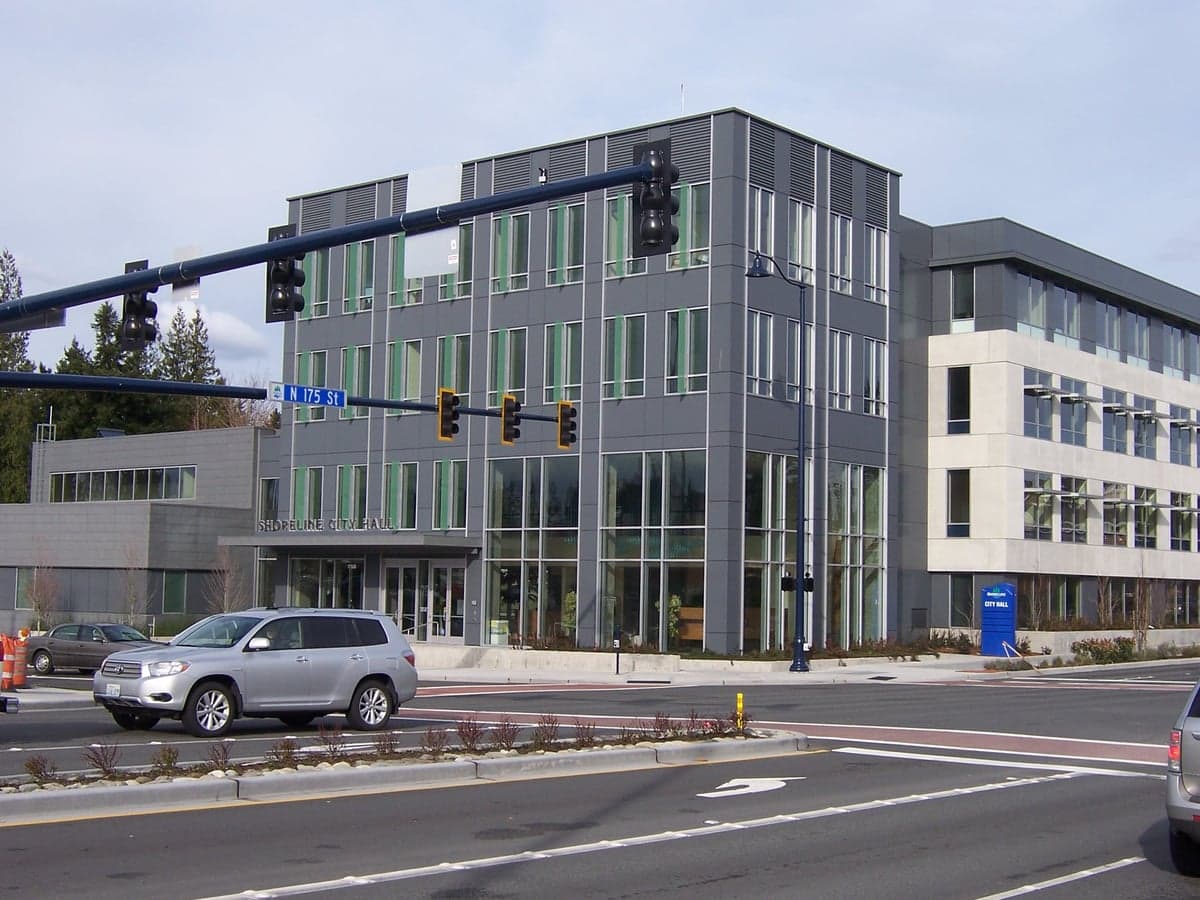
Photo: Wikipedia
Strategic Assessment of Shoreline, WA
High tactical risk. This location is likely close to major population centers, strategic targets, or sits in a high-disaster corridor. A retreat property and careful exit planning is required.
What does the Strategic Assessment tell us?
Our Strategic Assessment grades tactical survivability of an area. Major population centers, military targets, fallout zones, natural disasters, and border exposure all drive risk — lower exposure means a more defensible position in a crisis.
This is heavily inspired by Joel Skousen's Strategic Relocation book. Highly recommended you checkout the book ($)What does this tell us?
Our Strategic Assessment grades tactical survivability of an area. Major population centers, military targets, fallout zones, natural disasters, and border exposure all drive risk — lower exposure means a more defensible position in a crisis.
This is heavily inspired by Joel Skousen's Strategic Relocation book. Highly recommended you checkout the book ($)Strategic Pillars

Key Distances
Regional Safe Places
Below is our recommended "safe zones" in Washington and the surrounding area based on our strategic heuristics. For most people, it's unrealistic to live in a “safe zone” full-time due to work, family or other personal reasons. They tend to be more rural. However, many of these areas are perfect for second homes and retreat properties that double as a vacation home or even a short-term rental.
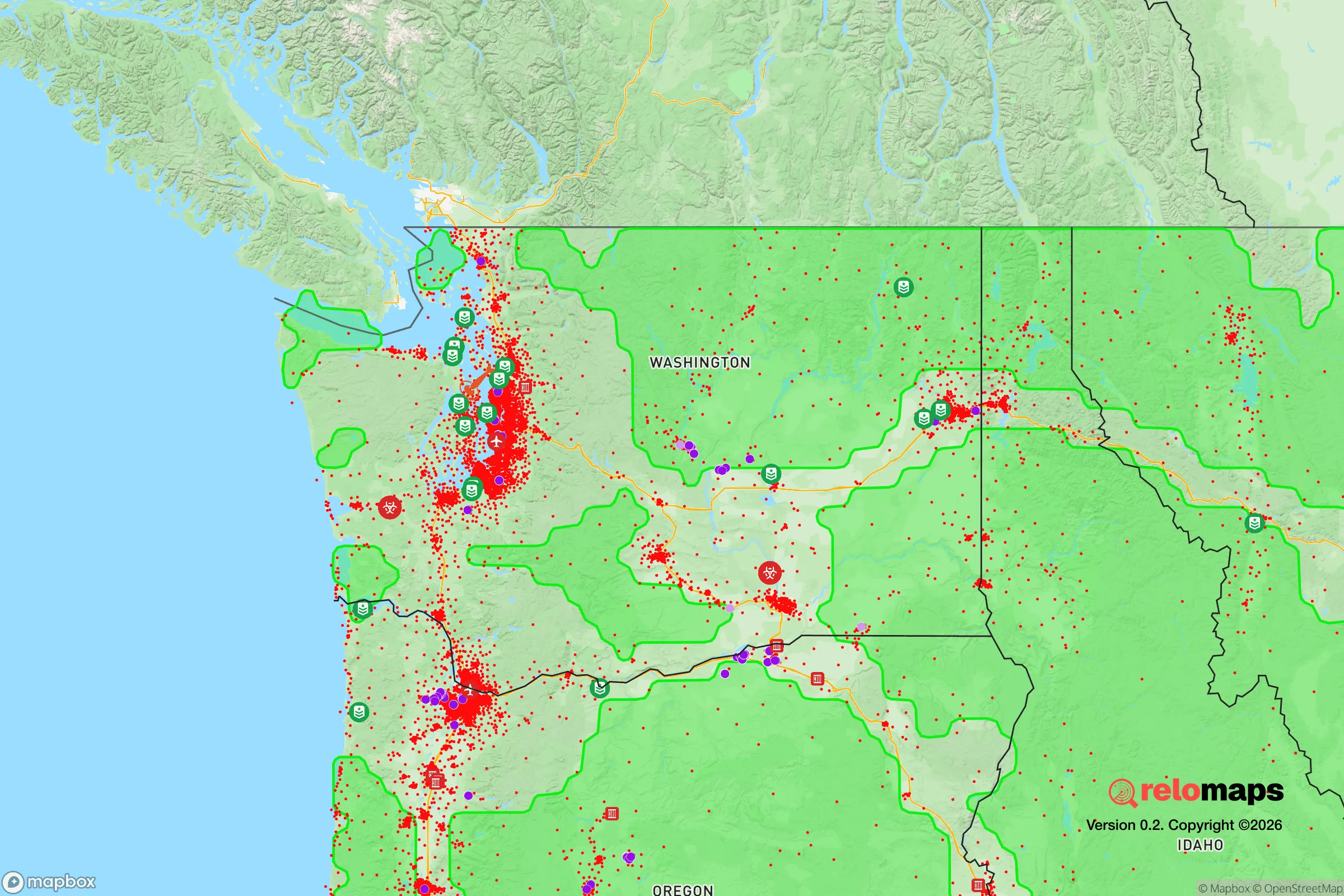
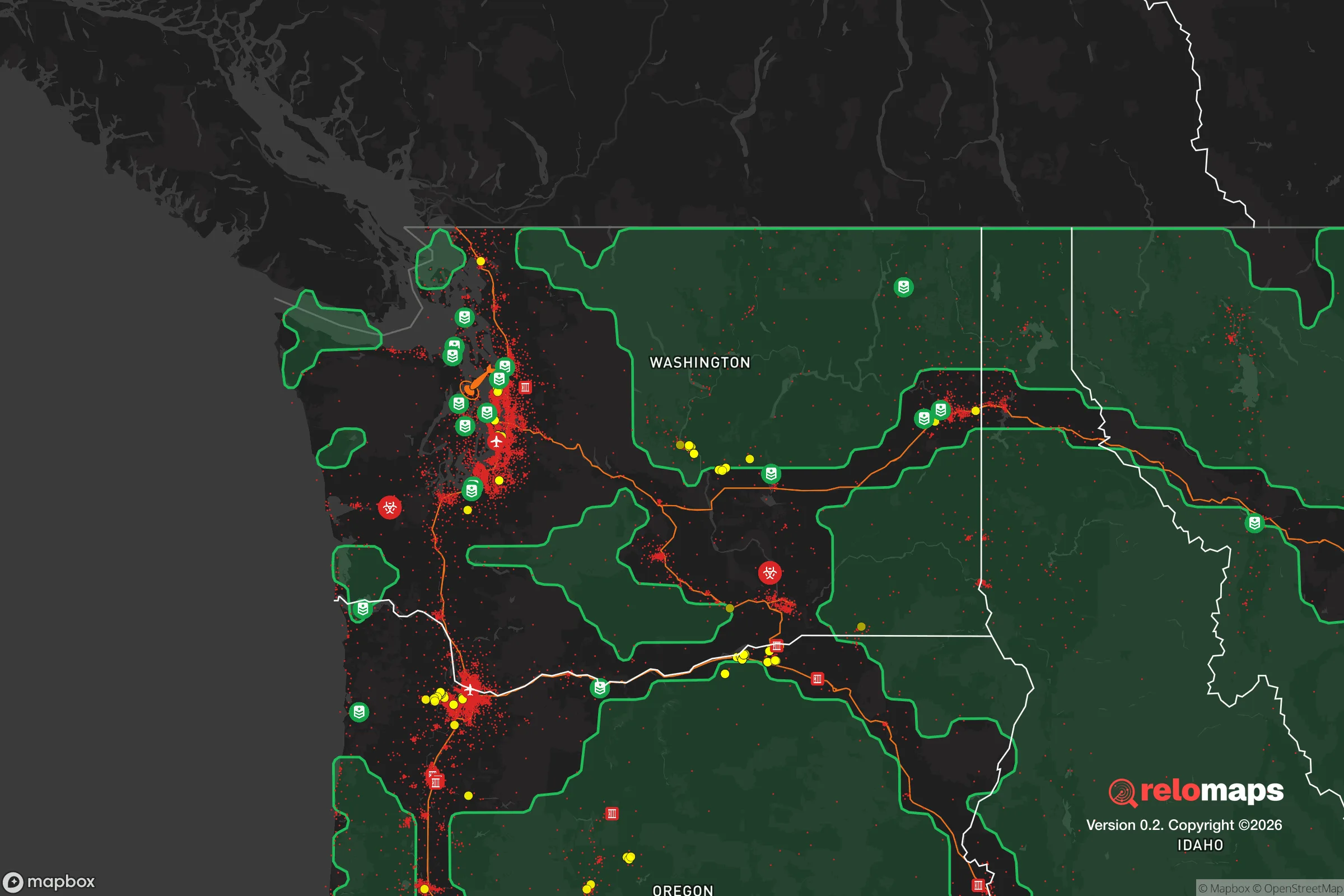


Important Note: For informational purposes only. This does not mean nothing bad ever happens in the green zones. Please use common sense. This is based on public data and modeled with AI. We tried to take a conservative approach but mistakes happen. We update this regularly as new information becomes available.
Solar Generator Recommendations
Backup power matters more here than in safer locations. We've picked three solar generators across budgets and capacity tiers — start with the budget unit if you only need a few essentials, or step up if you want to run a fridge and HVAC for days at a time.

Jackery Portable Power Station Explorer 300
Budget OptionPower on the Go: Weighing only 11 lbs, it's convenient to set up and store with book-sized foldable solar panels

BLUETTI Portable Power Station AC180
Designed for both indoor and outdoor scenarios, AC180 is highly capable as it has a robost capacity and continuous output power.

EF ECOFLOW DELTA Pro Ultra Power Station
Upgraded PickEcoFlow DELTA Pro Ultra is a whole-home energy system designed to grow with your family. Integrated with the Smart Home Panel 2, it scales to meet your evolving energy needs — keeping your home powered, intelligent, and secure through every stage of life.
We earn a commission, at no additional cost to you.
Strategic Assessment Analysis
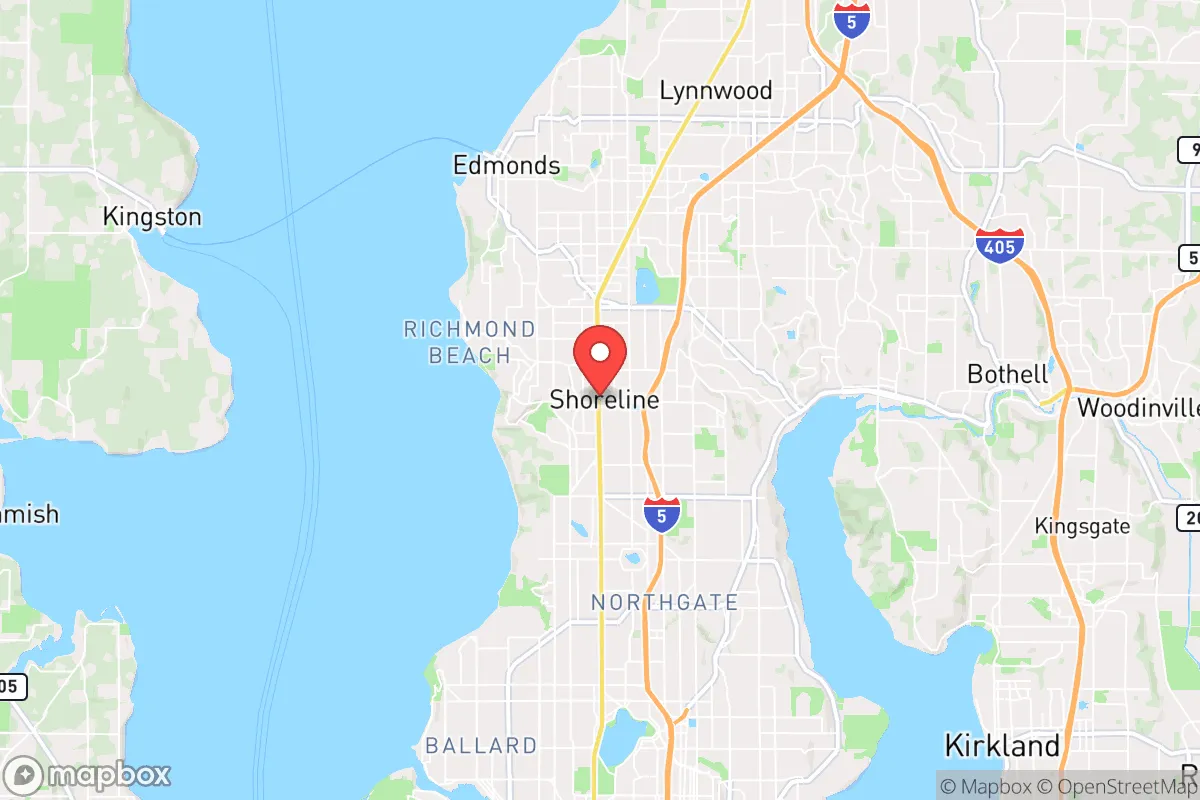
Shoreline, Washington, sits in a precarious strategic position that demands a hard-eyed assessment from anyone serious about resilience. Located just north of Seattle, this suburban city of roughly 58,000 offers proximity to Puget Sound and the Olympic Mountains, but that same geography places it within the blast radius of a major metropolitan target. For a relocator weighing civic unrest, natural disasters, and societal breakdown, Shoreline presents a mixed bag: defensible terrain in some directions, but exposure to cascading failures from a nearby urban core. The key question is whether its natural advantages outweigh the liabilities of being a bedroom community for a city that could become a liability in a crisis.
Geographic position and natural advantages for long-term survival
Shoreline’s location along the Puget Sound coastline gives it access to marine resources, but the real strategic value lies in its proximity to the Cascade foothills and the Olympic Peninsula. The city is bounded by the Sound to the west and the Interstate 5 corridor to the east, creating a narrow strip of developable land that funnels movement north-south. In a grid-down scenario, this chokepoint could be both a blessing and a curse—easy to monitor, but also easy to cut off. The area’s temperate maritime climate means mild winters and moderate summers, reducing the need for extreme heating or cooling, which is a plus for off-grid living. However, the region’s heavy rainfall (roughly 37 inches annually) can complicate long-term food storage and outdoor activities without proper shelter. The nearby Cascade watershed, including the Skagit and Snohomish river systems, provides abundant freshwater sources, but accessing them requires travel through increasingly congested corridors. For a prepper, the natural advantages are real but conditional on securing a defensible position away from the I-5 corridor, which is a primary evacuation route and likely target for looting or military checkpoints during unrest.
Risks, exposures, and proximity to fallout-relevant landmarks
The single biggest liability for Shoreline is its proximity to Seattle, just 12 miles south. In a major disaster—whether a Cascadia Subduction Zone earthquake, a terrorist attack, or civil unrest—Seattle’s population of over 750,000 would likely trigger a mass exodus north along I-5, directly through Shoreline. The city is also within 20 miles of Naval Base Kitsap (Bangor), which houses a significant portion of the U.S. nuclear submarine fleet. While this provides a deterrent, it also makes the region a potential target for a first-strike scenario or a radiological incident. Shoreline’s location near the Puget Sound fault zone adds seismic risk; a major quake could liquefy the sandy soils along the shoreline, damaging infrastructure and cutting off road access. The city’s reliance on the Seattle water supply (the Tolt River and Cedar River watersheds) means that a disruption to those systems would leave residents without potable water for weeks. Additionally, the nearby Boeing Everett factory and Sea-Tac Airport are high-value targets for sabotage or attack, with fallout patterns that could drift north depending on wind conditions. For a relocator, the calculus is clear: Shoreline is too close to too many high-consequence targets to be considered a safe haven in a major crisis.
Practical resilience for a relocator: food, water, energy, and defensibility
On the ground, Shoreline’s practical resilience is underwhelming for a serious prepper. The city’s water system is entirely grid-dependent, with no backup wells or community cisterns in most neighborhoods. Residents would need to stockpile at least two weeks of water per person, or invest in rainwater catchment systems—which are feasible given the rainfall, but require space and filtration. Food security is limited; the city has no significant agricultural land within its borders, and the nearest reliable farmland is in the Skagit Valley, 60 miles north. Grocery stores like the Shoreline QFC and Safeway would be stripped within hours of a panic event. Energy is another weak point: Puget Sound Energy’s grid is vulnerable to windstorms and earthquakes, and solar generation is hampered by the region’s cloud cover. A propane generator or wood stove is almost mandatory for winter heating. Defensibility is poor in the suburban core, with dense housing and limited sightlines. However, the northern neighborhoods near the King-Snohomish county line offer more rural pockets with acreage, where a family could set up a perimeter. The nearby Boeing Creek Park and Shoreview Park provide some cover for bug-out routes, but they are not large enough for sustained evasion. For a single individual or family, the best bet is to secure a property with a well, a septic system, and a defensible layout—but such properties are rare and expensive in Shoreline’s real estate market, where the median home price exceeds $800,000.
The overall strategic picture for Shoreline is one of calculated risk with diminishing returns. It offers a temperate climate, marine resources, and proximity to wilderness escape routes, but these are offset by its position as a satellite of a major urban target, its vulnerability to seismic and infrastructure failures, and its lack of self-sufficient food and water systems. For a conservative-minded relocator who values community stability and low crime, Shoreline’s current reality is relatively safe—violent crime rates are below the national average, and the city has a strong local police presence. But in a long-term collapse scenario, the city’s dependence on Seattle’s supply chains and its position along a primary evacuation corridor make it a liability. The prudent move would be to treat Shoreline as a temporary staging point, not a final destination. If you’re looking for a place to ride out a short-term disruption (a week-long power outage or a localized riot), it’s workable. For a multi-year grid-down event, you’d want to be farther north, in the foothills of the Cascades or on the Olympic Peninsula, where water, timber, and isolation offer a better hand to play. Shoreline is a decent fallback, but it’s not a fortress.

* Values derived from national, state, county, city and local statistics and may differ in a specific area. Last updated: 2026-04-21T11:05:56.000Z
Narrative content on this page is AI-generated and may contain mistakes. Verify any details that matter before acting on them.
ReloMaps may earn a commission from affiliate links at no extra cost to you.

