Photo: Wikipedia
Demographics of Silver City, NM
Affluence Level in Silver City, NM
A below-average socioeconomic profile. Incomes, home values, and educational attainment trail the U.S., with higher poverty and unemployment.
People of Silver City, NM
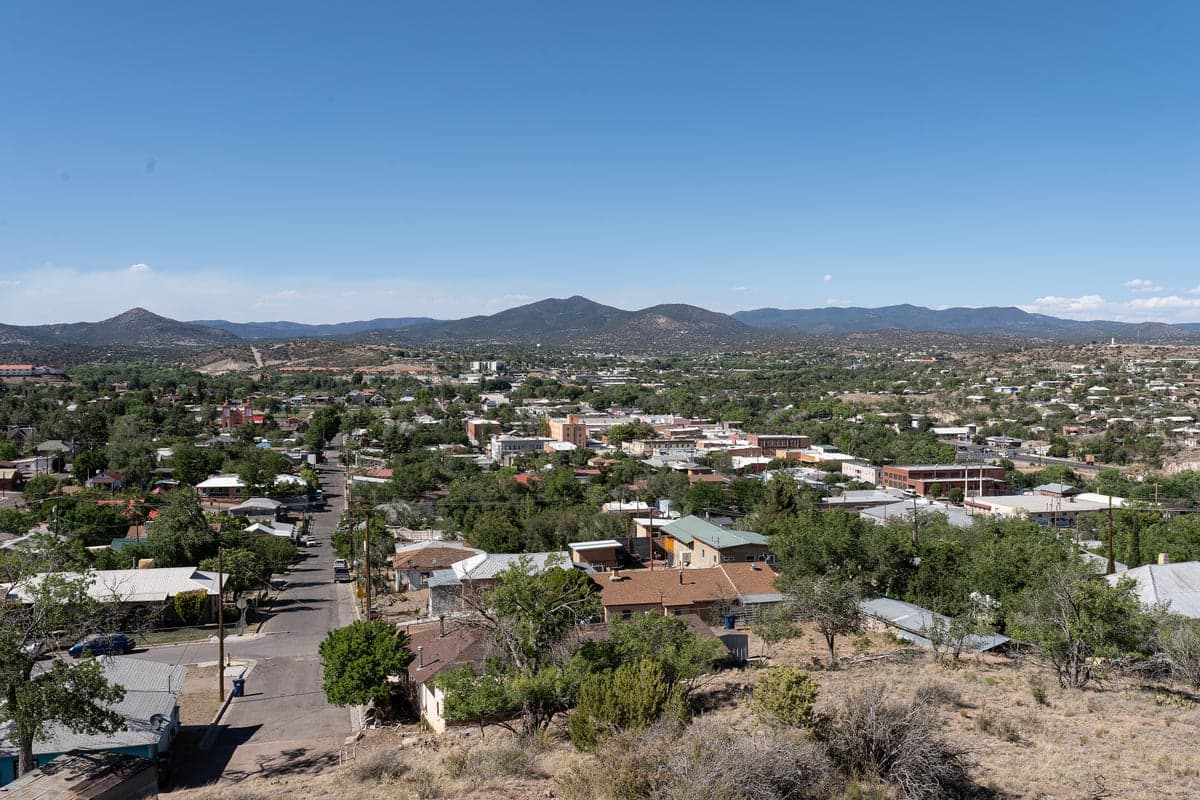
The people of Silver City, New Mexico, today number 9,574, forming a community defined by a near-perfect demographic split between White (46.6%) and Hispanic (46.5%) residents, with a small but notable East/Southeast Asian population (2.4%) and a foreign-born share of just 2.1%. This is a historically rooted, bicultural town where old mining families, Hispanic land-grant descendants, and a growing cohort of out-of-state retirees and remote workers coexist. The city’s identity is neither homogenously Anglo nor exclusively Hispanic, but a layered, often segregated-by-neighborhood blend shaped by distinct waves of settlement.
How the city was settled and grew
Silver City’s population history begins with the Apache, who inhabited the region for centuries before Spanish and Mexican land grants brought Hispanic settlers to the Mimbres Valley in the 1700s and early 1800s. The town itself was founded in 1870 after the discovery of silver, gold, and copper in the surrounding mountains, triggering a boom that drew Anglo-American miners, Cornish and Irish immigrants, and Mexican laborers. The original Anglo and Cornish miners settled in Chihuahua Hill, a historic neighborhood on the south side that still bears the name of the Mexican state many laborers came from, while wealthier Anglo merchants and mine owners built homes in the Historic District around Broadway and Bullard Street. By the early 1900s, the mining economy had stabilized, and a distinct Hispanic working-class enclave formed in the Barrio de la Gente (now often called “The Barrio”) near the San Vicente Creek, where Mexican-American families lived in adobe homes and worked the mines and railroads. The population peaked around 7,000 in the 1910s, then declined as mining mechanized, but the ethnic geography was set: Anglos on the north and west sides, Hispanics in the south and east.
Modern era (post-1965)
After the 1965 Immigration and Nationality Act, Silver City did not experience the large-scale immigration seen in border cities like El Paso or Las Cruces. The foreign-born share remains low at 2.1%, and the Hispanic population has grown primarily through natural increase and internal migration from other parts of New Mexico and northern Mexico. The most significant post-1965 shift has been domestic in-migration: retirees, artists, and remote workers from California, Texas, and the Pacific Northwest, drawn by the mild climate, low cost of living, and proximity to the Gila National Forest. These newcomers—overwhelmingly White and college-educated—have concentrated in the Historic District and the newer subdivisions on the city’s west side, such as the Ridge area near the Western New Mexico University campus. Meanwhile, the Hispanic population has remained anchored in the Barrio and the south side around Little Walnut Road, though younger Hispanic families have begun moving into previously Anglo-dominated neighborhoods like the North Valley as housing prices rise. The East/Southeast Asian community (2.4%), small but visible, is largely composed of Filipino and Vietnamese families who arrived in the 1980s and 1990s, many working in healthcare at Gila Regional Medical Center; they are scattered across the city but have a modest cluster near the hospital on 32nd Street. The Black population (0.7%) and Indian-subcontinent population (0.0%) are negligible, making Silver City one of the least diverse small cities in the Southwest by those measures.
The future
Silver City’s population is trending older and more Anglo, driven by continued retirement migration and the outmigration of younger Hispanic residents seeking jobs in Las Cruces, Albuquerque, or Phoenix. The city’s population has been essentially flat since 2010 (9,574 in 2020, down from 10,315 in 2000), and projections suggest slow decline or stagnation through 2040. The Hispanic share is likely to remain stable or grow slightly through higher birth rates, but the city is not tribalizing into hostile enclaves—rather, it is experiencing a quiet, class-based sorting: wealthier newcomers (mostly White) buy historic homes and new construction on the west side, while long-term Hispanic families remain in older, more affordable neighborhoods on the south and east sides. The East/Southeast Asian community is too small to form a distinct enclave and is assimilating into the broader population. No major immigrant influx is expected, given the remote location and limited job growth outside healthcare, education, and tourism.
For someone moving in now, Silver City is becoming a retirement and remote-work haven with a stable, bicultural character—neither rapidly diversifying nor homogenizing. The practical reality is a town where your neighbors are likely either White retirees from out of state or multi-generational Hispanic families, with little in between. The neighborhoods to watch are the Historic District (increasingly expensive, Anglo-dominated) and the Barrio (still Hispanic-majority, but seeing gradual gentrification as newcomers discover its historic adobes). If you value a quiet, small-town atmosphere with a visible Hispanic heritage and a growing arts scene, Silver City fits. If you seek racial or ethnic diversity beyond the White-Hispanic binary, you will not find it here.

* Values derived from national, state, county, city and local statistics and may differ in a specific area. Last updated: 2026-05-01T11:10:40.000Z
Narrative content on this page is AI-generated and may contain mistakes. Verify any details that matter before acting on them.
ReloMaps may earn a commission from affiliate links at no extra cost to you.

