
Photo: Wikipedia
Personal Sovereignty in Simpsonville, SC
Viable for self-reliance. Generally workable, though some barriers may limit total independence.
What does Personal Sovereignty tell us?
Personal Sovereignty measures your capacity for self-reliance and independence with minimal government friction. Higher scores mean fewer barriers between you and the way you want to live... but it assumes you have the space you need and good neighbors.
What does this tell us?
Personal Sovereignty measures your capacity for self-reliance and independence with minimal government friction. Higher scores mean fewer barriers between you and the way you want to live... but it assumes you have the space you need and good neighbors.
State Policy
Energy independence: Importer (25% of energy produced in-state)
Personal Liberty
Homesteading

Personal Liberty Analysis
Simpsonville, South Carolina, offers a personal sovereignty environment that is among the most favorable in the Southeast, driven by a state-level commitment to low taxation, permissive self-defense laws, and minimal regulatory interference in daily life. For individuals and families who prioritize autonomy—whether in financial decisions, home-based enterprises, or lifestyle choices—the city sits within a legal and cultural framework that consistently ranks in the top tier for freedom. The combination of South Carolina's constitutional carry law, absence of state income tax on retirement income, and right-to-work protections creates a baseline of personal liberty that is further reinforced by local governance that tends toward light-touch enforcement rather than aggressive regulation.
Tax burden and regulatory climate for residents and small businesses
South Carolina's tax structure is a significant draw for those seeking to maximize personal financial sovereignty. The state imposes a flat income tax rate of 6.2% on all taxable income above a modest threshold, but critically, retirement income from Social Security, military pensions, and up to $10,000 of other retirement income is fully exempt. Property taxes in Simpsonville are assessed at a state-mandated rate of 4% of fair market value for owner-occupied primary residences, with an additional local millage rate that typically keeps effective rates below 0.6% of actual home value—well under the national average. The regulatory posture in Greenville County, where Simpsonville is located, is notably business-friendly: there is no county-level business license tax for home-based enterprises under certain revenue thresholds, and zoning enforcement is generally complaint-driven rather than proactive. For individuals operating small-scale side businesses, freelance work, or cottage food operations, the absence of intrusive permitting requirements means less bureaucratic friction compared to neighboring states like North Carolina or Georgia. The state's right-to-work law, codified in Title 41 of the South Carolina Code, ensures that no worker can be compelled to join a union or pay dues as a condition of employment, reinforcing individual economic choice.
Self-defense rights and gun law specifics in South Carolina
South Carolina is a constitutional carry state, meaning that as of 2024, any law-abiding adult 18 or older may carry a concealed firearm without a permit. This represents a significant expansion of personal sovereignty for residents who view self-defense as a fundamental right. For those who still wish to obtain a permit for reciprocity purposes—South Carolina honors permits from over 30 states—the process requires a background check, fingerprinting, and a four-hour training course, with permits issued by the state's Law Enforcement Division (SLED) typically within 30 days. The state's Castle Doctrine, codified in Section 16-11-440 of the South Carolina Code, establishes a legal presumption that a homeowner who uses deadly force against an intruder in their residence had a reasonable fear of imminent death or great bodily injury, and there is no duty to retreat in one's home, vehicle, or place of business. Stand Your Ground protections extend to any place where a person has a legal right to be, removing the obligation to retreat before using force in self-defense. Magazine capacity is unrestricted, and there are no state-level bans on specific firearm types, including AR-15-style rifles. Simpsonville itself has no local ordinances that further restrict state law, meaning the regulatory environment for firearms is uniform and predictable.
Self-reliance and homesteading viability: lot sizes, zoning, and off-grid feasibility
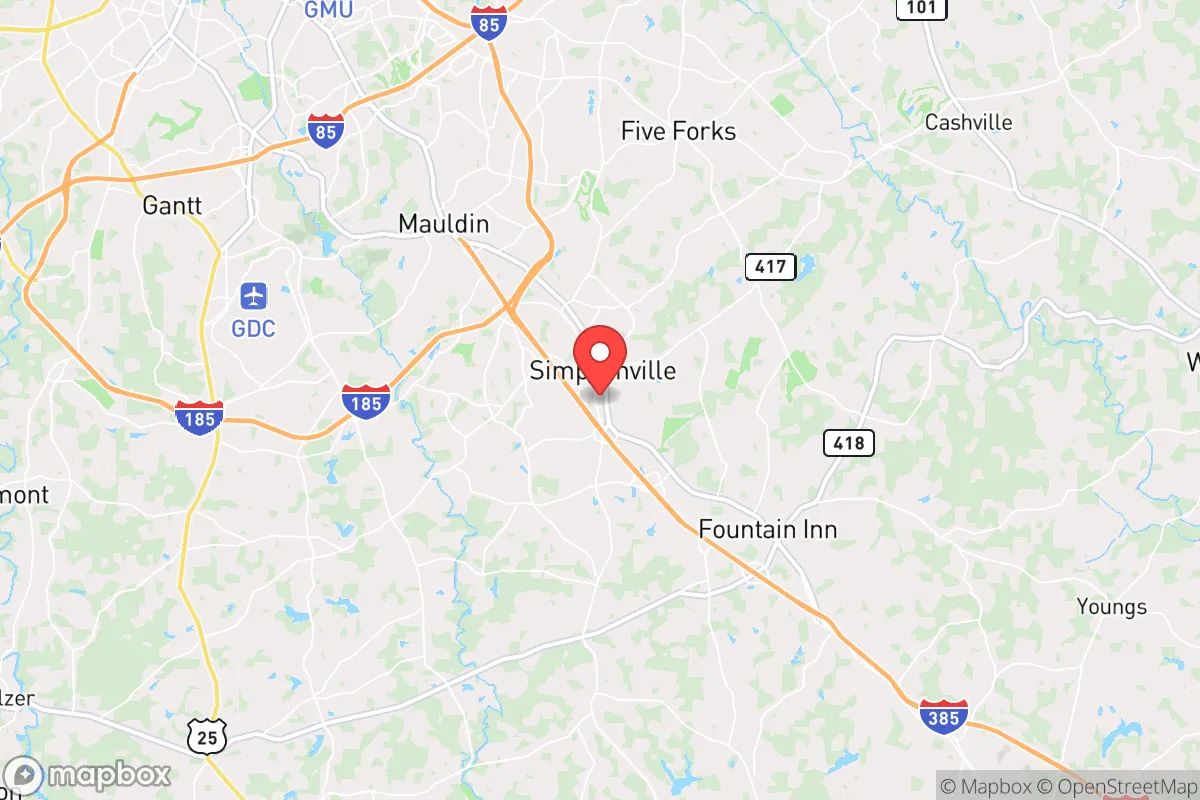
Simpsonville's position on the suburban-rural fringe of Greenville County makes it a viable location for those pursuing a self-reliant lifestyle, though with important caveats. Within the city limits, standard residential lots range from 0.25 to 0.5 acres in newer subdivisions, while older neighborhoods and unincorporated areas of Greenville County offer parcels of 1 to 5 acres at prices significantly lower than comparable land in the Atlanta or Charlotte metros. Zoning in the city permits backyard chickens on lots of at least 0.25 acres, with no limit on the number of hens (roosters are prohibited), and beekeeping is allowed with a simple registration. For those seeking more extensive homesteading—livestock such as goats, sheep, or horses—properties in the Five Forks area or farther south toward Fountain Inn on parcels of 2+ acres are the practical starting point. Off-grid feasibility is limited by state and local building codes: South Carolina follows the International Residential Code, which requires connection to the electrical grid for new construction in most subdivisions, though solar panels with net metering are permitted and incentivized through a 25% state tax credit (capped at $3,500). Rainwater collection for non-potable uses is legal and unregulated, but full off-grid water systems (wells) require permits and testing through the Department of Health and Environmental Control. Composting toilets are allowed under state code for properties without sewer access, but septic system approval is required. For the committed homesteader, the regulatory burden is moderate—not as permissive as rural Texas or Montana, but far lighter than the Pacific Northwest or Northeast.
Personal liberties: parental rights, medical autonomy, speech, and property
South Carolina has enacted several measures that strengthen parental rights in education. The state's Parental Bill of Rights, passed in 2023, explicitly affirms that parents have the fundamental right to direct the upbringing, education, and health care of their minor children, and requires school districts to notify parents of any changes in a student's services or monitoring related to mental, emotional, or physical health. School choice is robust: South Carolina offers charter schools, magnet programs, and the Education Scholarship Trust Fund program, which provides state-funded education savings accounts for eligible students to use toward private school tuition, tutoring, or homeschooling expenses. Homeschooling is regulated but straightforward—parents must hold a high school diploma, submit a simple annual notification to the local school district, and maintain a portfolio of student work, with no standardized testing requirement. Medical autonomy is more limited: South Carolina has not expanded Medicaid under the Affordable Care Act, and the state maintains strict licensing requirements for alternative health practitioners. However, vaccine mandates for adults are prohibited by state law, and there are no state-level restrictions on the purchase of raw milk (though it must be labeled as not for human consumption). Property rights are strongly protected under South Carolina's eminent domain laws, which restrict the use of condemnation for private economic development. The state's Right to Farm Act provides strong protections for agricultural operations against nuisance lawsuits, which benefits those pursuing small-scale farming or homesteading on rural parcels.
Overall, Simpsonville offers a personal sovereignty profile that places it among the most liberty-oriented suburban communities in the Carolinas. The combination of constitutional carry, low and predictable taxes, strong parental rights, and a regulatory environment that permits a meaningful degree of self-reliance creates a foundation for individual autonomy that is difficult to match in the Northeast, West Coast, or even much of the Midwest. For the relocation researcher comparing options, Simpsonville's primary trade-off is between the convenience of suburban infrastructure and the deeper freedom found in more remote rural areas—but within its class, it ranks highly for those who value personal independence as a core priority.

* Values derived from national, state, county, city and local statistics and may differ in a specific area. Last updated: 2026-10-20T13:03:54.000Z
Narrative content on this page is AI-generated and may contain mistakes. Verify any details that matter before acting on them.
ReloMaps may earn a commission from affiliate links at no extra cost to you.

