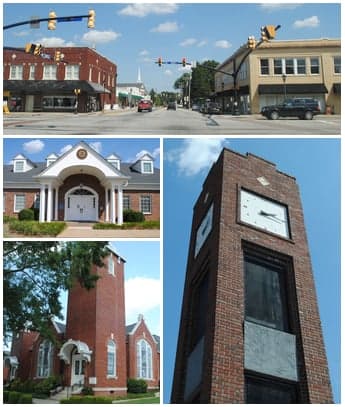
Photo: Wikipedia
Political ClimatePolitical Climate in Simpsonville, SC
District shown is the primary district for this city’s centroid. Cities may span multiple districts.
Local Political AnalysisPolitical Analysis of Simpsonville, SC
Simpsonville leans solidly Republican, with a Cook PVI of R+11 that places it to the right of South Carolina as a whole (R+8). This isn't a new development — the area has been reliably red for decades — but the intensity of that lean has sharpened as Greenville County's explosive growth has drawn in conservative-leaning transplants from the Northeast and Midwest. If you've been here since the 1990s, you've watched Simpsonville shift from a quiet, deeply traditional mill town into a fast-growing suburb where the politics still feel familiar but the conversations have gotten louder and more nationalized.
How it compares
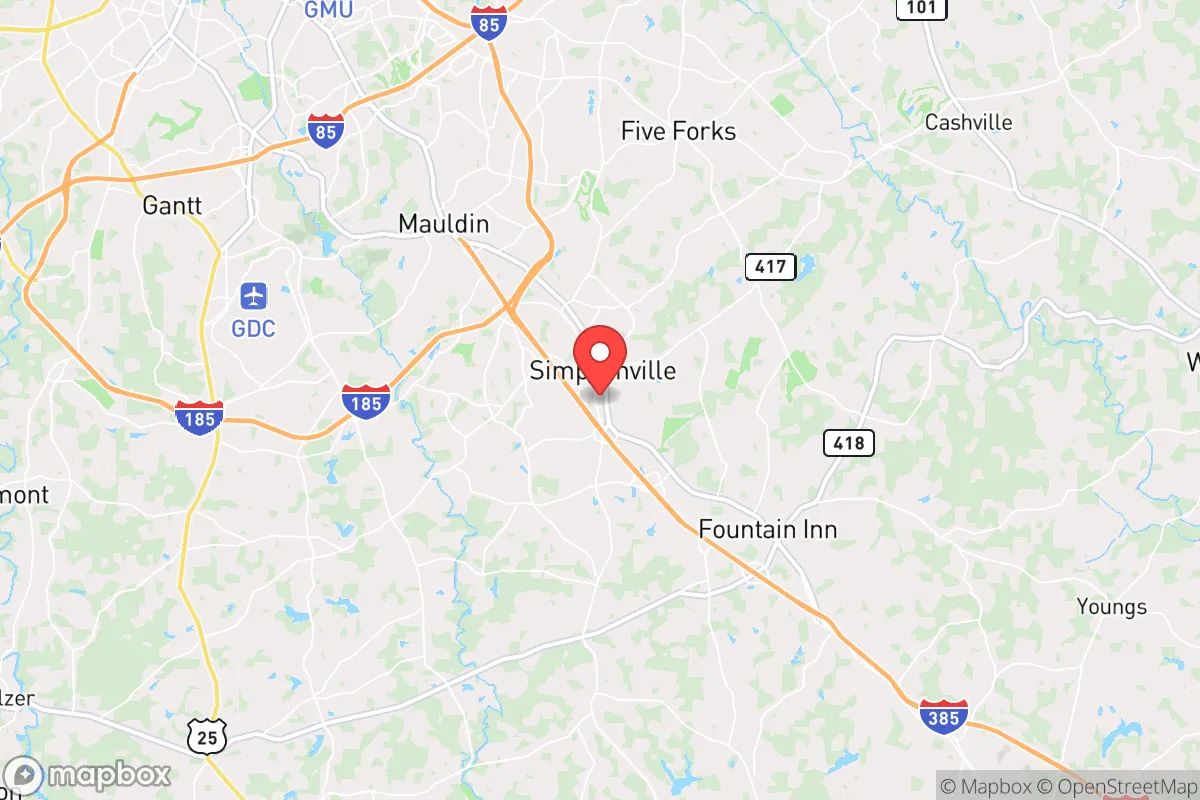
Simpsonville's R+11 rating is three points more conservative than the statewide average, which matters more in local primaries than in general elections. In practice, that means the city council and county commission races are decided in the Republican primary, and Democratic candidates rarely run competitive campaigns here. For contrast, drive 20 minutes east to Mauldin or 15 minutes north to Greenville proper, and you'll find slightly more moderate pockets — Greenville city itself has trended purple in recent cycles, with younger professionals and transplants nudging it toward the center. Simpsonville hasn't followed that path. The surrounding unincorporated areas of Five Forks and Fountain Inn are similarly conservative, creating a contiguous belt of deep-red suburbs that wraps around the more moderate urban core of Greenville. Statewide, South Carolina's R+8 reflects a mix of deep-red rural counties, competitive coastal districts around Charleston, and the increasingly purple I-85 corridor — but Simpsonville sits firmly in the reddest part of that corridor.
What this means for residents
For conservative residents, Simpsonville's political climate means their values are reflected in local policy without much friction. The city and county governments consistently prioritize low taxes, limited regulation, and conservative social positions. School board meetings and zoning hearings tend to draw crowds that lean right, and candidates who run on fiscal conservatism and traditional values have a clear path. For liberal residents, the reality is different but not hostile. You won't find many elected officials who share your views, and local political activism can feel isolating — but you're also not facing the kind of intense polarization you'd see in a deeply divided swing suburb. Most people here are neighborly first and political second. The practical trade-off is that progressive policy goals — from affordable housing initiatives to diversity programming — face an uphill climb in public funding and official support, but private advocacy groups and church-based social services fill some of those gaps without the same political friction.
One cultural distinction that sets Simpsonville apart from some other conservative suburbs is the strong influence of the area's evangelical Christian community, which shapes both the social calendar and the policy priorities. You'll see it in the number of large church campuses along Fairview Road, in the prominence of faith-based nonprofits, and in the relative quiet around issues like alcohol sales and Sunday business hours — though those restrictions have loosened considerably in the last decade. The trajectory over the next five to ten years likely depends on who keeps moving here. If the growth continues to draw families from more moderate states, Simpsonville could see a slow drift toward the center, similar to what Greenville experienced in the 2010s. But for now, the political center of gravity here remains firmly to the right of both Greenville and the state as a whole.

State Political ClimatePolitical Climate in South Carolina
State Political AnalysisPolitical Environment in the State
South Carolina is a solidly Republican state with a Cook PVI of R+8, meaning it typically votes about eight points more Republican than the national average. The dominant coalition is a mix of traditional conservatives in the suburbs and rural areas, evangelical Christians, and a growing number of fiscally conservative transplants from the Northeast and Midwest. Over the last 10-20 years, the state has shifted rightward on cultural and economic issues, though the fast-growing coastal and Upstate metros are injecting a more moderate, business-friendly conservatism that sometimes clashes with the deeply entrenched rural and Lowcountry traditionalists.
Urban vs. rural divide
The political map breaks down into three distinct zones. The Upstate, anchored by Greenville and Spartanburg, is the conservative engine of the state — these counties routinely vote 60-70% Republican, driven by a strong evangelical presence and a booming manufacturing and corporate sector. The Lowcountry, including Charleston and Mount Pleasant, is more of a mixed bag: Charleston County itself has trended purple, with the city of Charleston voting reliably Democratic while the surrounding suburbs lean red. The Pee Dee and Midlands, including Columbia, are the swingiest areas — Richland County (Columbia) is a Democratic stronghold, but Lexington County just across the river is deeply Republican. The rural counties along the I-95 corridor, like Allendale and Marlboro, are among the poorest in the state and vote heavily Democratic, but their populations are small and shrinking. The real story is the suburban ring around Myrtle Beach in Horry County, which has grown explosively and now votes reliably Republican, powered by retirees and second-home owners from the North.
Policy environment
South Carolina’s policy environment is broadly conservative. The state has a flat income tax rate of 6.4% (phasing down to 6.0% by 2026), no estate tax, and a relatively low property tax burden thanks to a state-imposed cap on assessment increases. Sales tax is 6% at the state level, but local options can push it to 9% in some counties. The regulatory posture is business-friendly — the state is a right-to-work state with weak unions and a reputation for fast permitting. Education policy is a flashpoint: the state has a robust school choice program, including the Education Scholarship Trust Fund, which provides state dollars for private school tuition, but public school funding remains uneven, with rural districts chronically underfunded. Healthcare is a mixed bag — the state did not expand Medicaid under the ACA, leaving roughly 200,000 low-income adults in the coverage gap, but the private insurance market is stable and telehealth has expanded significantly. Election laws are restrictive by national standards: voter ID is required, early voting was expanded to two weeks in 2022, but absentee voting requires an excuse. The state also has a six-week abortion ban (the "Fetal Heartbeat Act") that took effect in 2023 after the Dobbs decision, with no exceptions for rape or incest.
Recent policy direction
The last few years have seen a sharp rightward turn on cultural and social issues. In 2023, the legislature passed a constitutional carry law allowing permitless carry of handguns, making South Carolina the 25th state to do so. The same year, the state enacted a Parents' Bill of Rights (H. 3728), which requires schools to notify parents about curriculum changes and gives them the right to opt their children out of certain materials. On education, the state banned instruction on gender identity and sexual orientation in K-5 classrooms (the "Don't Say Gay" law) and restricted transgender girls from participating in female sports. On the economic side, the state has continued to phase down the corporate income tax (now 5%) and has aggressively recruited manufacturing and tech investment, including a $1.7 billion Scout Motors EV plant near Columbia. On voting, the state passed a law in 2021 that tightened absentee ballot rules and banned ballot drop boxes, though it also expanded early voting. On property rights, the state has a strong "right to farm" law that protects agricultural operations from nuisance lawsuits, and it has resisted most forms of rent control. On medical and bodily autonomy, the six-week abortion ban is the most restrictive in the Southeast outside of Texas and Florida, and the state has not moved to protect access to gender-affirming care for minors, though a ban on such care for minors was passed in 2024.
Civil unrest & political movements
South Carolina has a history of political activism that is both deep and polarized. The Confederate flag removal from the Statehouse grounds in 2015 after the Charleston church shooting was a watershed moment, but it also galvanized a more assertive conservative movement that has since focused on "heritage" and "culture war" issues. The state has seen periodic protests over abortion rights, particularly after the 2023 ban, with large rallies at the Statehouse in Columbia. Immigration politics are less heated than in border states, but there is a vocal faction pushing for stricter enforcement, and the state has a law (the "Sanctuary Cities" ban) that prohibits local governments from adopting non-cooperation policies with ICE. Election integrity remains a live issue: the 2020 election was not seriously contested in the state, but the legislature has nonetheless tightened voting laws, and there is a small but persistent "Stop the Steal" movement that resurfaces around each election cycle. Secession and nullification rhetoric is mostly confined to fringe groups, though the state's history as the first to secede in 1860 is still invoked by some on the far right. A new resident would notice that political conversations are common in everyday life — at church, at the barbecue joint, at the gun range — but they are generally civil, especially outside of the most polarized urban areas.
Projection
Over the next 5-10 years, South Carolina is likely to remain solidly Republican, but the nature of that conservatism is shifting. The influx of transplants from New York, New Jersey, and California — particularly to Greenville, Charleston, and the Myrtle Beach area — is slowly moderating the state on economic issues while reinforcing cultural conservatism. These newcomers tend to be fiscally conservative but socially moderate, and they are pushing the state toward more investment in infrastructure, parks, and quality-of-life amenities. At the same time, the rural counties are losing population and political clout, which means the center of gravity is moving toward the suburbs and exurbs. The state's Republican primary electorate is still dominated by evangelicals, but the influence of the business wing is growing. On policy, expect continued tax cuts, further expansion of school choice, and a slow but steady move toward more permissive gun laws. The abortion debate will remain a flashpoint, but the state is unlikely to move further right on that issue given the current law. The biggest wild card is the growth of the coastal and Upstate metros — if they continue to attract diverse, educated newcomers, the state could become more competitive at the presidential level within a decade, though it is unlikely to flip blue.
For a new resident, the practical takeaway is this: if you are conservative, you will find a state that largely aligns with your values on taxes, guns, education, and culture, and you will be in the majority. If you are liberal, you will find a state where your vote matters less in statewide elections but where you can still find like-minded communities in Charleston, Columbia, and parts of Greenville. The state is not a political monoculture — the divide between the fast-growing, amenity-rich metros and the struggling rural counties is real, and it shapes everything from school quality to tax policy to the feel of daily life. The best advice is to visit the specific city or town you are considering, because the political climate in Mount Pleasant is very different from Greenwood, and the experience of living in a red state depends heavily on which shade of red your neighborhood leans.
* Values derived from national, state, county, city and local statistics and may differ in a specific area. Last updated: 2026-10-20T13:03:54.000Z
Narrative content on this page is AI-generated and may contain mistakes. Verify any details that matter before acting on them.
ReloMaps may earn a commission from affiliate links at no extra cost to you.

