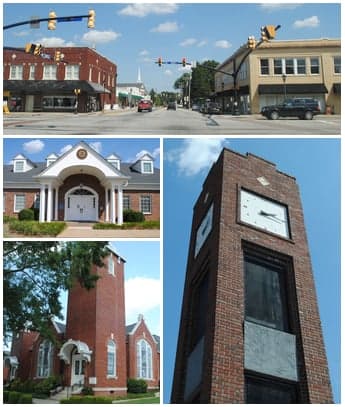
Photo: Wikipedia
Demographics of Simpsonville, SC
Affluence Level in Simpsonville, SC
A middle-class area roughly in line with national averages across income, home values, education, and employment.
People of Simpsonville, SC
The people of Simpsonville, South Carolina, today number roughly 25,125, forming a predominantly White (62.0%) but increasingly diverse suburban community with significant Black (19.5%) and Hispanic (11.2%) populations. The city is characterized by a family-oriented, slightly conservative-leaning culture, with a college-educated rate of 34.0% and a relatively low foreign-born share of 4.1%. Simpsonville’s identity is that of a rapidly growing Greenville suburb where newcomers are drawn by good schools, newer housing, and a quieter pace of life, while longtime residents maintain a strong sense of local heritage.
How the city was settled and grew
Simpsonville was originally settled in the early 19th century by Scots-Irish and English farmers who were drawn to the rolling Piedmont foothills for cotton and subsistence agriculture. The town was formally established in the 1830s around a stagecoach stop and a general store, and it remained a small rural crossroads for over a century. The arrival of the railroad in the late 1800s spurred modest growth, but the population remained overwhelmingly White and native-born through the 1950s. The historic downtown district, centered on Main Street and Stockbridge Avenue, was built by these early families and still contains many of the original 19th-century commercial buildings and churches. The West Georgia Road corridor and the area around Simpsonville Cemetery contain some of the oldest residential lots, originally settled by the founding families who gave the town its name.
Modern era (post-1965)
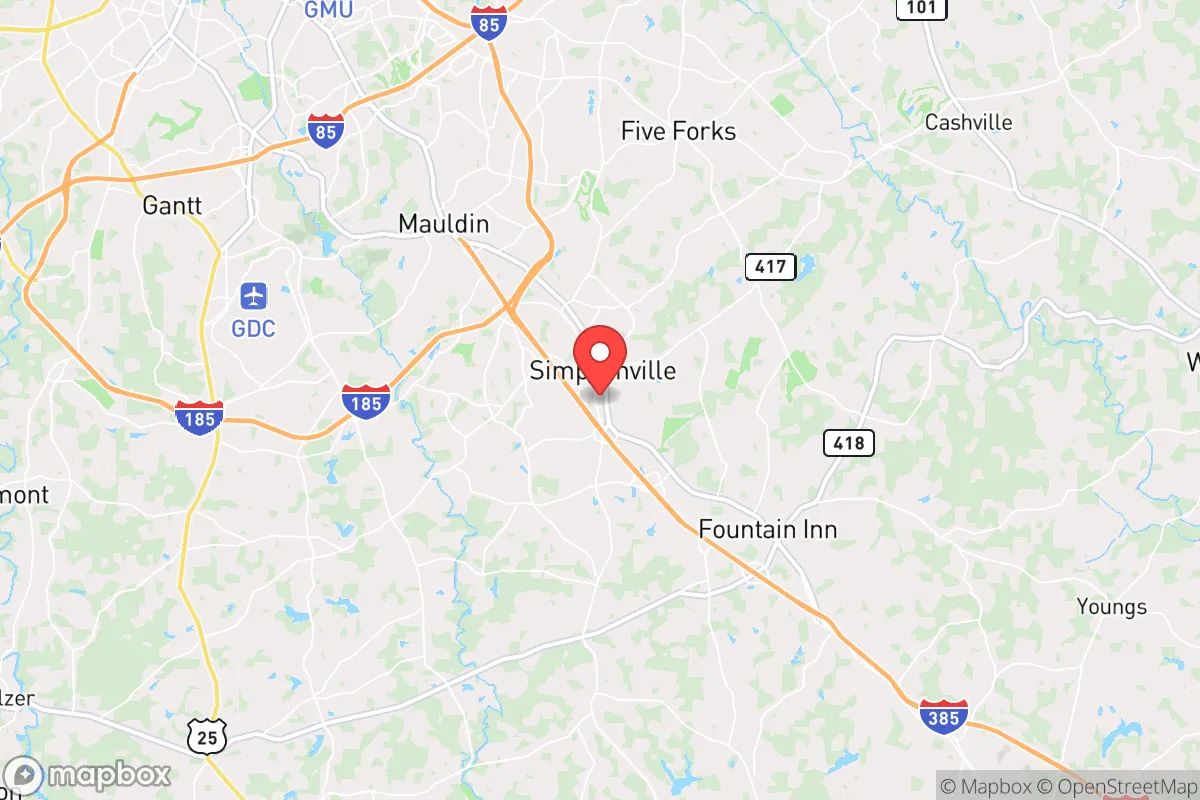
The modern transformation of Simpsonville began in earnest after the 1965 Hart-Cellar Act and, more directly, with the suburban expansion of Greenville in the 1980s and 1990s. The construction of Interstate 385 made Simpsonville a viable commuter suburb, and the population exploded from roughly 1,500 in 1970 to over 25,000 today. This wave of domestic in-migration was overwhelmingly White, drawn by new subdivisions and the reputation of Five Forks area schools. The Five Forks area, particularly neighborhoods like Glynwood and Hillside at Five Forks, became the primary landing zone for middle- and upper-middle-class families relocating from the Northeast and Midwest. A smaller but significant wave of Black families moved into Simpsonville during this period, many settling in the Fairview Road corridor and the Simpsonville Crossing area, which offered more affordable housing stock. The Hispanic population began growing notably after 2000, concentrated in the Grandview Drive and West Georgia Road areas, drawn by construction and service jobs in the broader Greenville metro. The Asian population remains very small (0.5% East/Southeast Asian, 0.7% Indian subcontinent), with most families living in the newer subdivisions near Five Forks and Neely Road.
The future
Simpsonville’s population is projected to continue growing steadily, driven by Greenville’s broader economic expansion and the city’s reputation for safe neighborhoods and strong schools. The White share is slowly declining as the Hispanic and Black populations grow, though the city remains less diverse than Greenville proper. The foreign-born share, currently just 4.1%, is likely to rise modestly as Hispanic families continue to settle in the West Georgia Road and Grandview Drive areas, and as a small number of Indian and East Asian professionals move into the Five Forks subdivisions. New master-planned communities, such as those along Neely Road and Fairview Road, are attracting a mix of younger families and retirees, further dispersing the population across the city rather than concentrating it in the historic downtown. The cultural identity is evolving from a quiet, predominantly White small town into a more diverse, family-focused suburb that still leans conservative politically but is becoming more politically mixed as newcomers arrive from other states.
For someone moving in now, Simpsonville offers a stable, growing community with a clear trajectory: it is becoming more diverse, more suburban, and more connected to Greenville’s economy, while retaining a distinct small-town feel. The city’s future is one of managed growth, where new subdivisions and commercial development are balanced by a strong sense of local identity and a population that values schools, safety, and community involvement.

* Values derived from national, state, county, city and local statistics and may differ in a specific area. Last updated: 2026-10-20T13:03:54.000Z
Narrative content on this page is AI-generated and may contain mistakes. Verify any details that matter before acting on them.
ReloMaps may earn a commission from affiliate links at no extra cost to you.

