Photo: Wikipedia
Demographics of Smyrna, DE
Affluence Level in Smyrna, DE
A middle-class area roughly in line with national averages across income, home values, education, and employment.
People of Smyrna, DE
Today, Smyrna, Delaware is a town of 13,031 residents with a distinctly working-class, family-oriented character, shaped by a history of agricultural settlement and recent suburban expansion. The population is notably diverse for a small Kent County town, with a White majority (54.9%) alongside a substantial Black community (30.1%) and growing Hispanic (8.5%) and Indian-subcontinent (2.2%) populations. The foreign-born share is low at just 1.9%, and only 22.2% of adults hold a college degree, reflecting a community rooted in trade, manufacturing, and service jobs rather than white-collar professions. Smyrna’s identity is one of a quiet, affordable alternative to Dover or Wilmington, where newcomers are drawn by lower housing costs and a slower pace of life.
How the city was settled and grew
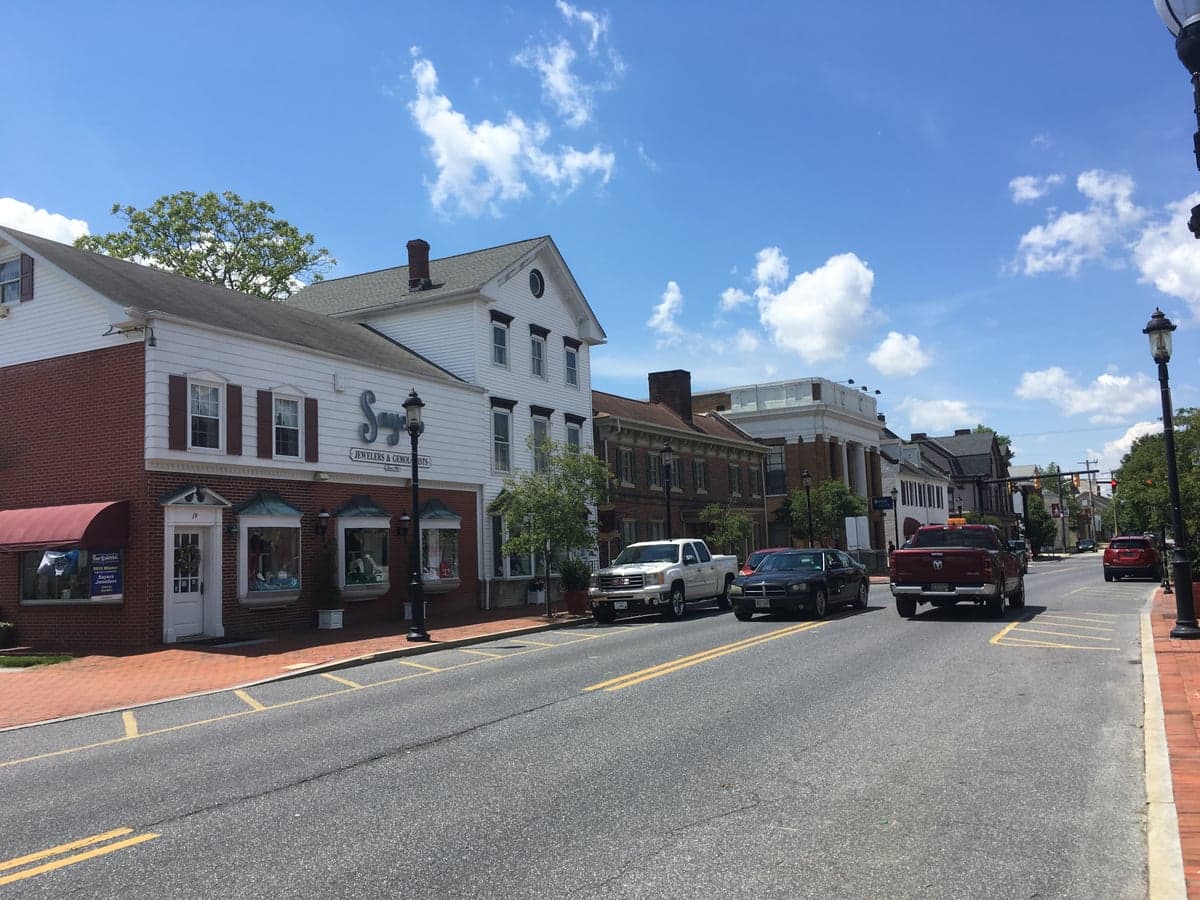
Smyrna’s original population was shaped by its role as a colonial-era port and agricultural hub along the Duck Creek and Smyrna River. The town was formally laid out in the early 18th century, with settlers arriving primarily from England, Scotland, and Ireland to farm tobacco and later grain. The historic Downtown Smyrna district, centered on Main Street and Commerce Street, was built by these early Anglo-American families, who erected brick and frame homes that still stand today. By the mid-19th century, the arrival of the railroad spurred a second wave of growth, drawing German and Irish laborers who settled in the South Smyrna area near the rail yards. The town remained overwhelmingly White through the early 1900s, with a small Black population concentrated in the East Smyrna neighborhood, near the former segregated school and churches along East Commerce Street. The post-World War II era brought little change, as Smyrna stayed a sleepy farm town until the 1990s, when the construction of the Smyrna Rest Area on I-95 and the expansion of the Dover Air Force Base began attracting new residents.
Modern era (post-1965)
The modern demographic transformation of Smyrna began in earnest after 2000, driven by suburban spillover from Dover and Wilmington and by the growth of the nearby Harrington Raceway & Casino and industrial parks. The 1965 Hart-Cellar Act had little immediate effect on Smyrna, but by the 1990s, domestic migration from the Mid-Atlantic and Northeast brought a wave of Black families, many from Philadelphia and Baltimore, seeking affordable housing. These newcomers settled primarily in the Brenford Station subdivision, a large planned community off Route 13 that now anchors the town’s eastern edge, and in the Woodland Heights area near the high school. The Hispanic population, now 8.5%, grew from the 2000s onward as Mexican and Central American laborers arrived for work in poultry processing and construction, clustering in the West Smyrna neighborhoods around Wheatleys Pond. The Indian-subcontinent community (2.2%) is a more recent arrival, largely professionals employed at Dover Air Force Base or in healthcare, and tends to settle in newer subdivisions like Brenford Station rather than older neighborhoods. The East/Southeast Asian population (0.7%) remains very small, with no distinct enclave. The Black population share has risen steadily from roughly 20% in 2000 to 30.1% today, while the White share has declined from over 70% to 54.9%, reflecting both in-migration and out-migration of younger White families to more rural areas.
The future
Smyrna’s population is likely to continue growing modestly, driven by its reputation as an affordable alternative to the increasingly expensive coastal suburbs of Delaware and Maryland. The town is not homogenizing; rather, it is becoming more ethnically segmented by neighborhood, with older White residents concentrated in historic Downtown and South Smyrna, Black families in Brenford Station and Woodland Heights, and Hispanic households in West Smyrna. The Indian-subcontinent community is small but growing, and may form a more visible presence if professional job growth continues at Dover Air Force Base. The foreign-born share (1.9%) is unlikely to rise dramatically, as Smyrna lacks the immigrant-heavy industries or ethnic networks of larger cities. Over the next 10-20 years, the town will likely see further suburban infill, with new subdivisions on the northern and eastern edges attracting a mix of Black and White families, while the Hispanic population plateaus. The college-educated share (22.2%) may increase slowly as more remote workers and commuters to Dover arrive, but Smyrna will remain a predominantly blue-collar community.
For a conservative-leaning individual or family considering a move, Smyrna offers a stable, affordable environment with a clear sense of community, but one that is increasingly diverse and segmented by neighborhood. The town is not a melting pot but a collection of distinct residential areas, each with its own character. Newcomers should expect a place where traditional values and family life are central, but where the demographic landscape is shifting steadily toward a more multi-ethnic, working-class identity.

* Values derived from national, state, county, city and local statistics and may differ in a specific area. Last updated: 2026-10-10T16:29:01.000Z
Narrative content on this page is AI-generated and may contain mistakes. Verify any details that matter before acting on them.
ReloMaps may earn a commission from affiliate links at no extra cost to you.

