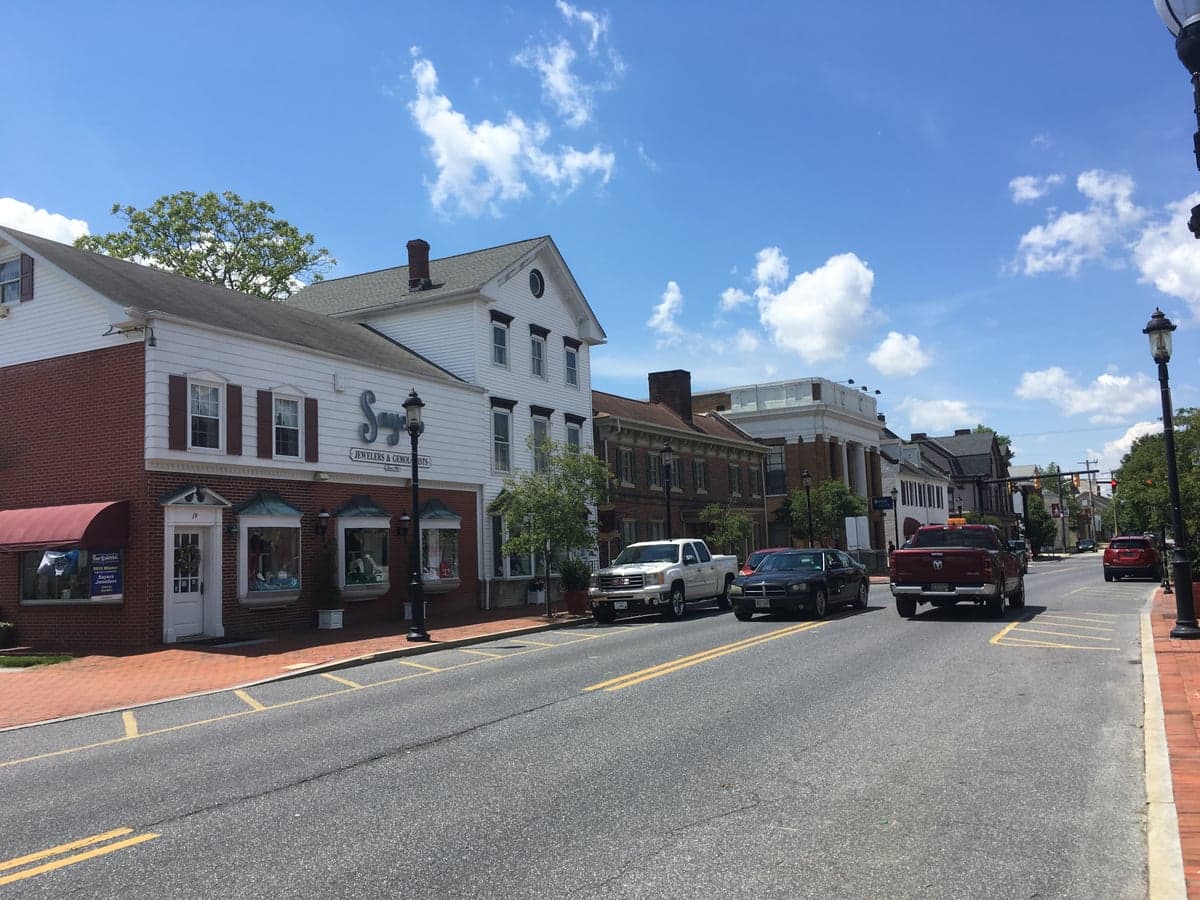
Photo: Wikipedia
Political ClimatePolitical Climate in Smyrna, DE
District shown is the primary district for this city’s centroid. Cities may span multiple districts.
Inherited from parent state — no local data available.
Local Political AnalysisPolitical Analysis of Smyrna, DE
Smyrna, Delaware, has a Cook PVI of D+8, meaning it leans significantly more Democratic than the national average, but that number doesn't tell the whole story for a town that's been changing fast. I've lived here long enough to remember when this was a reliably conservative, quiet farming community where folks kept to themselves and the government mostly stayed out of your business. Now, you're seeing a real shift, driven by newcomers from places like New York and New Jersey who bring a different set of priorities, and it's changing the whole feel of the place. The trajectory is clear: Smyrna is moving left, and for those of us who value personal freedoms and limited government, it's a trend worth watching closely.
How it compares
To really understand Smyrna's politics, you have to look at what's around it. Head a few miles south to Dover, the state capital, and you're in a solidly Democratic stronghold with a D+8 PVI of its own, driven by state government workers and a more diverse population. But drive north or west into Kent County's rural towns like Clayton or even parts of Middletown, and you'll find areas that still vote reliably Republican, often by double digits. Smyrna sits right on that dividing line, and the D+8 rating reflects the influx of commuters and retirees who are less concerned with local traditions and more focused on expanding government services. It's a stark contrast to the surrounding countryside, where you'll still see plenty of "Don't Tread on Me" flags flying.
What this means for residents
For a long-time resident like me, the practical effects of this political shift are already showing up in ways that hit close to home. You're seeing more zoning regulations that make it harder to do what you want with your own property, and there's a growing push for higher taxes to fund new schools and public transit projects that many of us never asked for. The local government is getting more involved in day-to-day life, from mask mandates during the pandemic to discussions about restricting certain businesses. If you value the freedom to make your own choices without a bureaucrat's approval, that's a red flag. The newer residents tend to vote as a bloc for more government oversight, and it's slowly eroding the live-and-let-live culture that made Smyrna a great place to raise a family.
There's also a cultural distinction that's hard to miss. Smyrna used to have a strong sense of community where neighbors helped each other out without needing a government program. Now, you see more reliance on state services and a growing divide between the old-timers and the newcomers. The local school board meetings have gotten heated over curriculum changes and library books, and the push for progressive policies like diversity initiatives feels like it's coming from outside, not from the people who've been here for generations. If this trend keeps up, I'd expect to see more ballot initiatives and local elections where the fight is over preserving our rights versus expanding the government's reach. It's not all doom and gloom—there are still plenty of folks fighting to keep Smyrna free—but you have to stay informed and vote if you want to keep things from sliding too far.

State Political ClimatePolitical Climate in Delaware
State Political AnalysisPolitical Environment in the State
Delaware has long been a blue state in presidential elections, but its political climate is far more nuanced than a simple partisan label suggests. The state has voted for Democrats in every presidential election since 1992, but the margins have tightened in recent cycles, with Joe Biden’s home state giving him just 59% of the vote in 2020, down from Hillary Clinton’s 53% in 2016. Over the past 20 years, the dominant coalition has been a mix of progressive-leaning urbanites in Wilmington and moderate suburbanites in New Castle County, but the rural and exurban areas in Kent and Sussex counties have been steadily trending red, creating a growing urban-rural divide that is reshaping the state’s political landscape.
Urban vs. rural divide
The political map of Delaware is essentially a tale of three counties. New Castle County, home to Wilmington and the state’s largest population center, is the Democratic stronghold. Wilmington itself is heavily Democratic, with precincts routinely delivering 70-80% of the vote to Democratic candidates. The northern suburbs like Greenville and Hockessin are more moderate but still lean blue, driven by a mix of corporate professionals and government workers. In contrast, Sussex County, the southernmost and most rural county, has become a Republican bastion. Towns like Georgetown and Seaford are deeply conservative, with the county voting +15 points for Trump in 2020. Kent County, with its capital Dover, is the true battleground. Dover itself is a Democratic-leaning city due to its state government workforce and minority population, but the surrounding rural areas in Kent are reliably red. The 2020 election saw Kent County flip to Biden by just 1,200 votes, a razor-thin margin that underscores the state’s growing polarization. The divide is not just about party—it’s about lifestyle. The northern corridor is dense, educated, and tied to the pharmaceutical and financial sectors, while the southern counties are agricultural, more religious, and increasingly populated by retirees and exurbanites fleeing higher taxes in the Northeast.
Policy environment
Delaware’s policy environment is a mixed bag that should give any freedom-minded resident pause. The state has no sales tax, which is a plus, but it has one of the highest effective property tax rates in the region, and income taxes are steep, with a top marginal rate of 6.6% on income over $60,000. The regulatory posture is decidedly pro-business in some areas—Delaware’s corporate law is famously business-friendly, attracting over half of all publicly traded companies to incorporate here—but for individuals, the story is different. The state has a strict gun control regime, including a 2022 law banning the sale of assault weapons and high-capacity magazines, and a 2023 law requiring a permit to purchase a handgun. Education policy is dominated by the teachers’ union, with school choice limited and charter schools facing heavy regulation. Healthcare is heavily regulated, with the state expanding Medicaid under Obamacare and imposing a mandate for paid family leave in 2024. Election laws are among the most permissive in the country: no-excuse absentee voting, same-day registration, and universal mail-in ballots were made permanent in 2023. For a conservative, the policy environment feels like a slow but steady march toward a more European-style social democracy, with the state government increasingly acting as a provider and regulator of daily life.
Trajectory & freedom
Delaware is becoming less free by almost any measure of personal liberty. The most concerning trend is the erosion of Second Amendment rights. The 2022 assault weapons ban and the 2023 permit-to-purchase law were passed without a single Republican vote, and a 2024 law further restricted concealed carry by expanding “sensitive places” where guns are prohibited. On parental rights, the state has moved in the opposite direction of many red states: a 2023 law prohibits schools from notifying parents if a child changes their gender identity or pronouns, a clear infringement on family autonomy. Medical freedom took a hit with the 2021 passage of a law requiring all healthcare workers to be vaccinated against COVID-19, a mandate that remains in effect. Property rights are under pressure from a 2024 law that allows local governments to impose rent control, a policy that historically reduces housing supply and drives up costs. On the tax front, there is no relief in sight—the state’s budget has grown by over 30% in the last five years, and a 2023 law indexed the gas tax to inflation, meaning it will rise automatically every year. The trajectory is unmistakable: more regulation, higher taxes, and less individual autonomy.
Civil unrest & political movements
Delaware has not seen the kind of large-scale civil unrest seen in other states, but there have been notable flashpoints. The 2020 Black Lives Matter protests in Wilmington were relatively peaceful, but they did lead to the removal of a Christopher Columbus statue and a push to defund the police, which ultimately failed. The most organized political movement on the right is the Delaware GOP’s “Election Integrity” task force, which has been vocal about concerns over the state’s universal mail-in voting system. In 2022, a lawsuit challenged the constitutionality of no-excuse absentee voting, but the state Supreme Court upheld it. The immigration debate is muted compared to border states, but Delaware is a sanctuary state in practice—a 2019 executive order by Governor John Carney limits cooperation with ICE, and a 2023 law prohibits state and local law enforcement from inquiring about immigration status. The most visible flashpoint for a new resident would likely be the culture war in schools: in 2023, a heated school board meeting in Middletown over LGBTQ curriculum drew hundreds of parents, with both sides clashing. The state’s political movements are not as intense as in Texas or Florida, but the underlying tensions are real and growing.
Projection
Over the next 5-10 years, Delaware is likely to become more Democratic and more progressive. The demographic trends are clear: New Castle County is growing faster than the rest of the state, driven by an influx of young professionals and remote workers from the Northeast who bring their politics with them. The rural areas in Sussex and Kent are also growing, but at a slower pace, and they are aging. The 2020 census showed that Delaware’s population grew by 10.2% over the decade, with most of that growth concentrated in the northern suburbs. The state’s in-migration is coming disproportionately from high-tax, high-regulation states like New York and New Jersey, which means new residents are often acclimated to—and even supportive of—the policies that are driving conservatives out. The Republican Party in Delaware is struggling to adapt, with its base increasingly confined to the rural south and its message failing to resonate in the suburbs. A conservative moving to Delaware now should expect that in a decade, the state will have a permanent Democratic trifecta, with even tighter gun laws, higher taxes, and more progressive social policies. The only wildcard is if the state’s corporate-friendly reputation starts to fray, but that seems unlikely given the legal industry’s deep roots.
For a conservative considering a move to Delaware, the bottom line is this: you are moving to a state that is politically hostile to your values, and it is only going to get worse. The tax burden is high, the regulatory environment is restrictive, and the culture is increasingly progressive. If you are looking for a place where your rights are respected and your voice matters, Delaware is not it. The best you can hope for is to find a conservative enclave in Sussex County, like Lewes or Rehoboth Beach (which is surprisingly mixed), but even there, the state government in Dover will be working against you. If you are moving for a job or family reasons, be prepared to fight for your freedoms at the local level—school boards, town councils, and county commissions are where you can still make a difference. But if you have the flexibility to choose another state, look south or west, where the political climate is more aligned with your values.
* Values derived from national, state, county, city and local statistics and may differ in a specific area. Last updated: 2026-10-10T16:29:01.000Z
Narrative content on this page is AI-generated and may contain mistakes. Verify any details that matter before acting on them.
ReloMaps may earn a commission from affiliate links at no extra cost to you.

