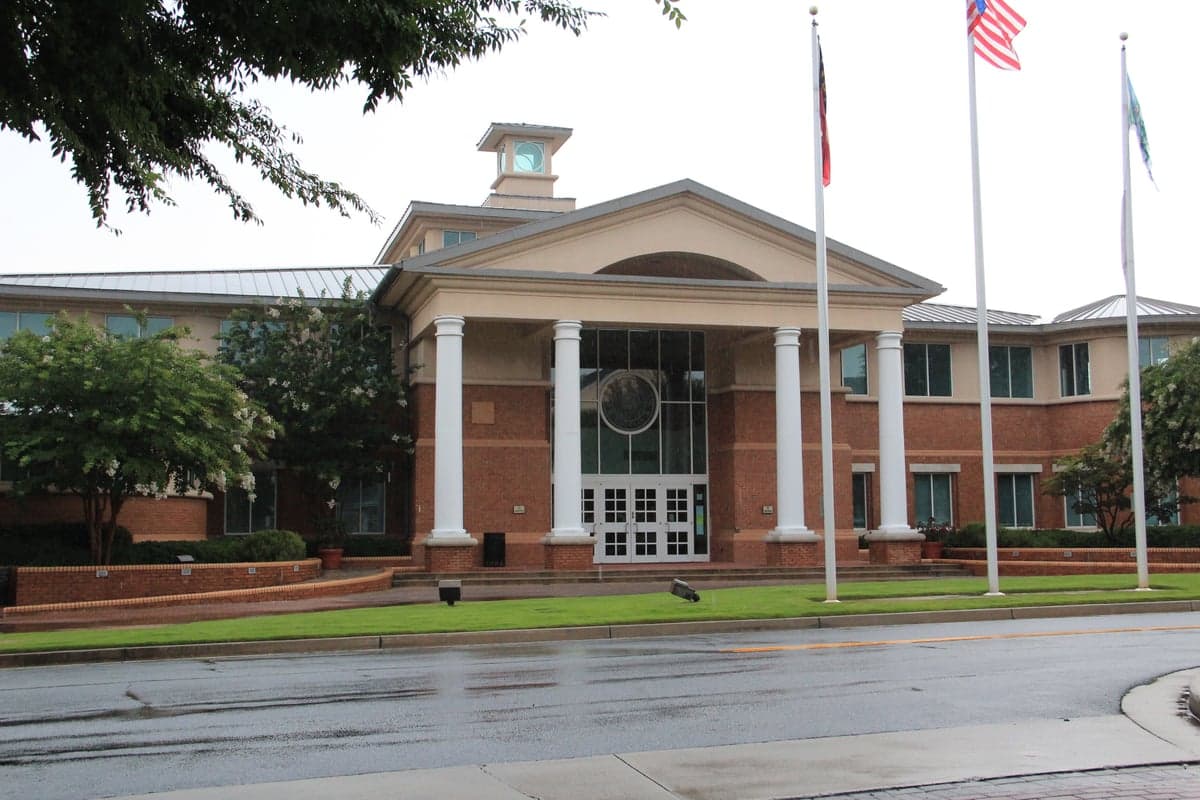
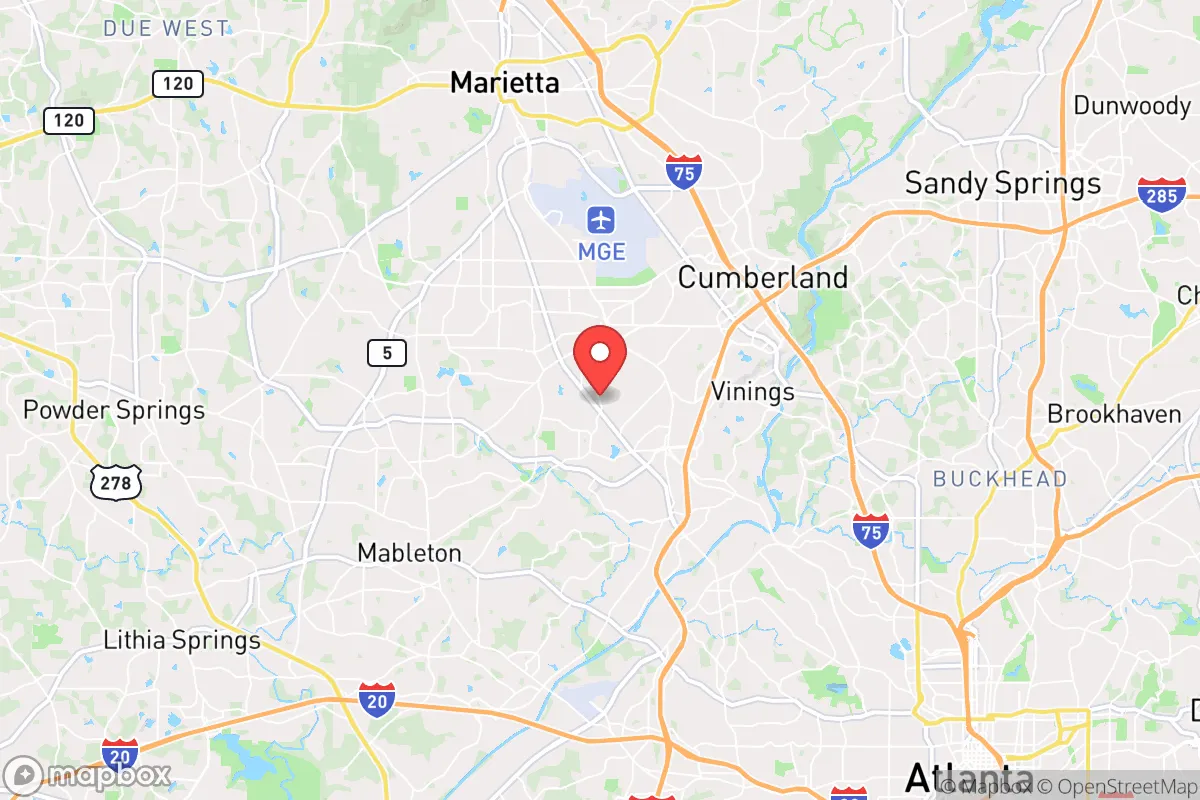
Photo: Wikipedia
Demographics of Smyrna, GA
Affluence Level in Smyrna, GA
An upper-middle-class area. Household wealth, education levels, and homeownership run ahead of national benchmarks.
People of Smyrna, GA
The people of Smyrna, Georgia today form a densely settled, majority-minority suburb of 56,285 residents, where no single racial or ethnic group holds a numerical majority. The city is notably more diverse than Cobb County as a whole, with a 42.4% White population, 31.6% Black or African American, 12.4% Hispanic or Latino, 4.4% Indian (subcontinent), and 3.5% East/Southeast Asian. With 59.0% of adults holding a bachelor’s degree or higher, Smyrna’s population is also among the most educated in metro Atlanta, a profile that reflects its transformation from a small railroad town into a sought-after inner-ring suburb.
How the city was settled and grew
Smyrna’s original population was drawn by the Western & Atlantic Railroad in the 1840s, when the state chartered a depot stop roughly halfway between Atlanta and Marietta. The first permanent residents were white yeoman farmers and merchants from the Georgia Piedmont, many of Scots-Irish and English descent, who built homes along what is now Atlanta Road and near the original town square. The community remained a small agricultural hamlet through the Civil War and Reconstruction, with cotton and timber as the economic base. The first major population wave came after 1900, when the railroad expanded freight service and the Concord Woolen Mill opened, drawing white mill workers from rural north Georgia into neighborhoods like Oakdale and Ruff’s Mill. A second wave followed World War II, as returning veterans and defense workers from Bell Aircraft (later Lockheed) in nearby Marietta settled in new subdivisions such as Briarcliff and Brookwood, transforming Smyrna from a village of 2,000 into a bedroom suburb of 15,000 by 1960.
Modern era (post-1965)
The 1965 Hart-Cellar Act and the subsequent expansion of Atlanta’s economy reshaped Smyrna’s population dramatically. The first major shift was the arrival of Black families during the 1970s and 1980s, as white flight from Atlanta pushed middle-class African Americans into previously white subdivisions like Riverview and Leland Drive. By 1990, Smyrna’s Black population had risen to roughly 25%, and it continued climbing through the 2000s as the city’s housing stock—especially the 1960s-era ranch homes and townhouses—remained affordable relative to Buckhead and East Cobb. The second major shift was the growth of the Indian and East/Southeast Asian populations, which accelerated after 2000. Indian families, many working in IT and engineering at companies like Home Depot, Coca-Cola, and IBM, concentrated in newer infill developments and townhome communities near the Windy Hill corridor and the Braves Stadium area. East/Southeast Asian residents—primarily Vietnamese, Korean, and Chinese—settled in similar patterns, drawn by the highly rated Cobb County schools and proximity to the Atlanta Perimeter. The Hispanic population, now 12.4%, grew steadily from the 1990s onward, with many families from Mexico and Central America finding work in construction, hospitality, and landscaping; they are most concentrated in the older, denser blocks around South Cobb Drive and the Spring Road corridor.
The future
Smyrna’s population is likely to continue diversifying, but the pace of change is slowing. The city is nearly built out, with little vacant land for large-scale new development, so future demographic shifts will come primarily through redevelopment and turnover of existing housing. The White population, which was 55% as recently as 2010, is projected to fall below 40% by 2030, while the Black and Hispanic shares are expected to hold steady or grow modestly. The Indian and East/Southeast Asian populations are likely to plateau, as many families now move farther out to suburbs like Kennesaw and Suwanee for larger lots and newer schools. The city is not tribalizing into distinct ethnic enclaves; rather, most neighborhoods are becoming more mixed, particularly in the Concord Road and Braves Stadium districts, where new apartment and condo construction has attracted a younger, more diverse demographic. The biggest wildcard is the redevelopment of the old Smyrna Village and the former Cobb County government complex, which could bring several thousand new residents—likely a mix of young professionals and empty-nesters—over the next decade.
Smyrna is becoming a mature, stable, and increasingly diverse inner-ring suburb where no single group dominates and where educational attainment is high. For a conservative-leaning family or individual moving in now, the city offers a well-established community with strong schools, low crime relative to Atlanta proper, and a population that is politically moderate to conservative—Cobb County voted +2.5 R in 2024—but socially accustomed to diversity. The key trade-off is that Smyrna is no longer a cheap place to enter the housing market; the median home value has risen above $450,000, and the city’s character is now defined more by its professional-class majority than by its working-class roots.

* Values derived from national, state, county, city and local statistics and may differ in a specific area. Last updated: 2026-04-30T02:33:07.000Z
Narrative content on this page is AI-generated and may contain mistakes. Verify any details that matter before acting on them.
ReloMaps may earn a commission from affiliate links at no extra cost to you.

