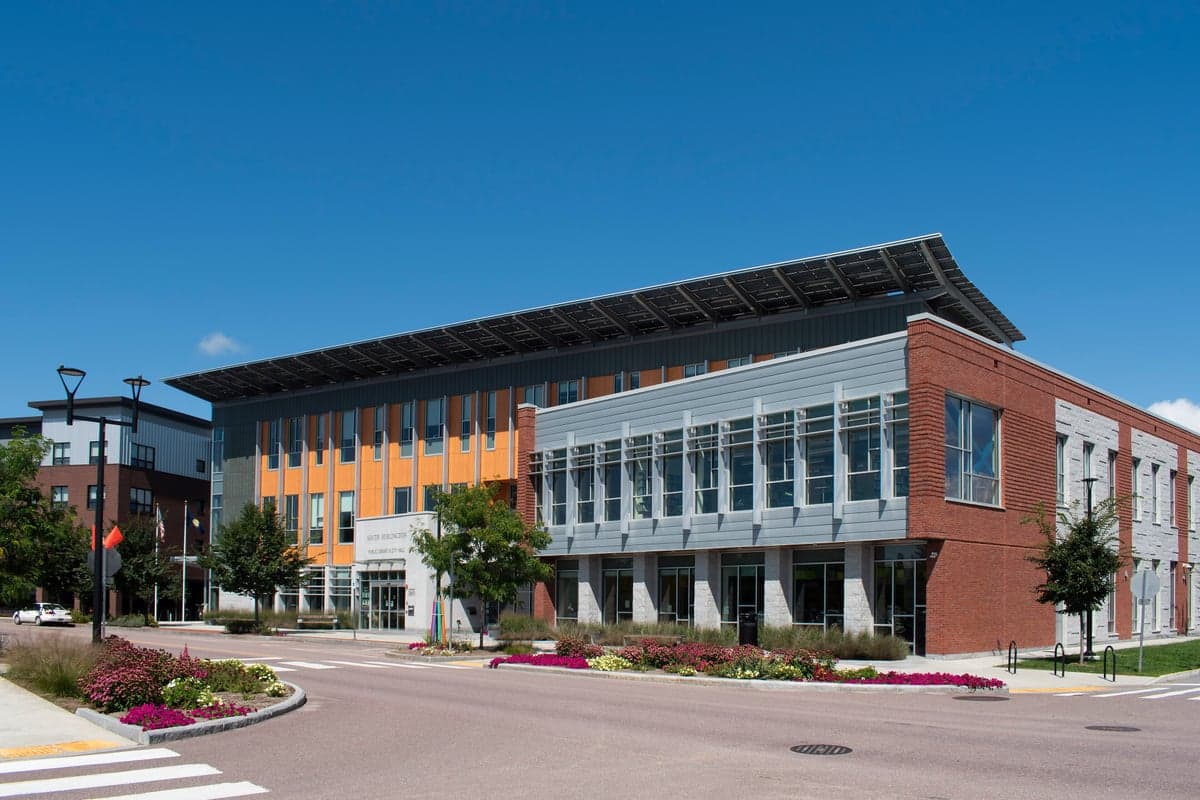
Photo: Wikipedia
Demographics of South Burlington, VT
Affluence Level in South Burlington, VT
An upper-middle-class area. Household wealth, education levels, and homeownership run ahead of national benchmarks.
People of South Burlington, VT
South Burlington, Vermont, is a small, densely populated city of 20,488 residents that functions as a suburban and commercial anchor for the Burlington metro area. It is notably well-educated, with 65.1% of adults holding a college degree, and remains predominantly white (80.9%) while hosting small but distinct immigrant communities. The city’s identity is shaped by its post-war suburban growth, its role as a regional employment hub, and a population that is stable in size but slowly diversifying through professional migration and refugee resettlement.
How the city was settled and grew
South Burlington’s human history is not one of colonial founding but of 20th-century suburban expansion. Originally part of the larger Burlington township, the area was farmland and small hamlets through the 1800s. The city incorporated separately in 1864, but its population remained sparse—under 1,000 residents—until after World War II. The first significant wave of settlement came in the 1950s and 1960s, driven by the construction of Interstate 89 and the expansion of the University of Vermont and IBM’s Essex Junction facility. This drew middle-class families, largely of French-Canadian and Irish Catholic descent, from Burlington’s older neighborhoods and from rural Vermont. These families built the Dorset Street corridor and the Kimball Avenue area, which remain the city’s core residential districts, characterized by ranch-style homes and mid-century subdivisions. A smaller, older cluster of homes near Airport Park housed workers from the Burlington International Airport and local dairy farms. No major immigrant groups settled here during this era; the population was overwhelmingly native-born white, with a small number of Italian and Polish families arriving via Burlington’s urban core.
Modern era (post-1965)
After the 1965 Hart-Cellar Act, South Burlington saw modest demographic change compared to larger U.S. cities. The most notable shift began in the 1980s and 1990s, when refugee resettlement programs brought small numbers of East/Southeast Asian families—primarily Vietnamese and Cambodian—to the Burlington area. These families concentrated in the White Street and Patchen Road neighborhoods, near affordable apartment complexes and the city’s public housing stock. Today, East/Southeast Asian residents make up 5.0% of the population, a share that has held steady through chain migration and family reunification. A separate, more recent wave of Indian-subcontinent immigrants (3.7% of the population) arrived after 2000, drawn by professional jobs at the University of Vermont Medical Center, GlobalFoundries (formerly IBM), and tech startups along the Williston Road corridor. These Indian families tend to settle in newer subdivisions near Hinesburg Road and the I-89 interchange, areas with larger homes and top-rated schools. The Hispanic population (3.5%) is smaller and more dispersed, with no single neighborhood concentration, while the Black population (1.6%) is largely composed of African refugees (Somali, Congolese) resettled through the Vermont Refugee Resettlement Program, many living in the Dorset Street apartment complexes. The foreign-born share stands at 4.9%, below the national average but significant for Vermont.
The future
South Burlington’s population is not homogenizing into a single bloc; instead, it is tribalizing into distinct enclaves by income and origin. The white, college-educated majority remains dominant in the single-family-home districts of Kimball Avenue and Hinesburg Road, while immigrant communities cluster in rental-heavy zones near Dorset Street and Williston Road. The East/Southeast Asian population appears stable, with second-generation families assimilating into the broader suburban culture. The Indian community is growing slowly through professional recruitment, but high housing costs limit new arrivals. The Hispanic and Black populations are plateauing, as refugee resettlement numbers have declined since 2017. Over the next 10–20 years, South Burlington will likely see continued slow growth (projected to reach 22,000–23,000 by 2040), with the white share declining slightly to the mid-70% range as second-generation immigrants and new professional migrants diversify the city. No major ethnic enclave is forming; instead, the city is becoming a more layered version of its current self—still predominantly white and highly educated, but with small, stable pockets of East/Southeast Asian, Indian, and African communities.
For a conservative-leaning individual or family considering relocation, South Burlington offers a stable, safe, and well-run suburban environment with excellent schools and low crime. The population is not experiencing rapid demographic upheaval; change is gradual and concentrated in specific apartment districts. The city’s character remains that of a mid-century suburb gently evolving into a diverse, professional-class community—a place where newcomers will find established neighborhoods, clear community boundaries, and a predictable trajectory.

* Values derived from national, state, county, city and local statistics and may differ in a specific area. Last updated: 2026-04-30T18:26:34.000Z
Narrative content on this page is AI-generated and may contain mistakes. Verify any details that matter before acting on them.
ReloMaps may earn a commission from affiliate links at no extra cost to you.

