
Photo: Wikipedia
Demographics of Walworth County
Affluence Level in Walworth County
A middle-class area roughly in line with national averages across income, home values, education, and employment.
People of Walworth County
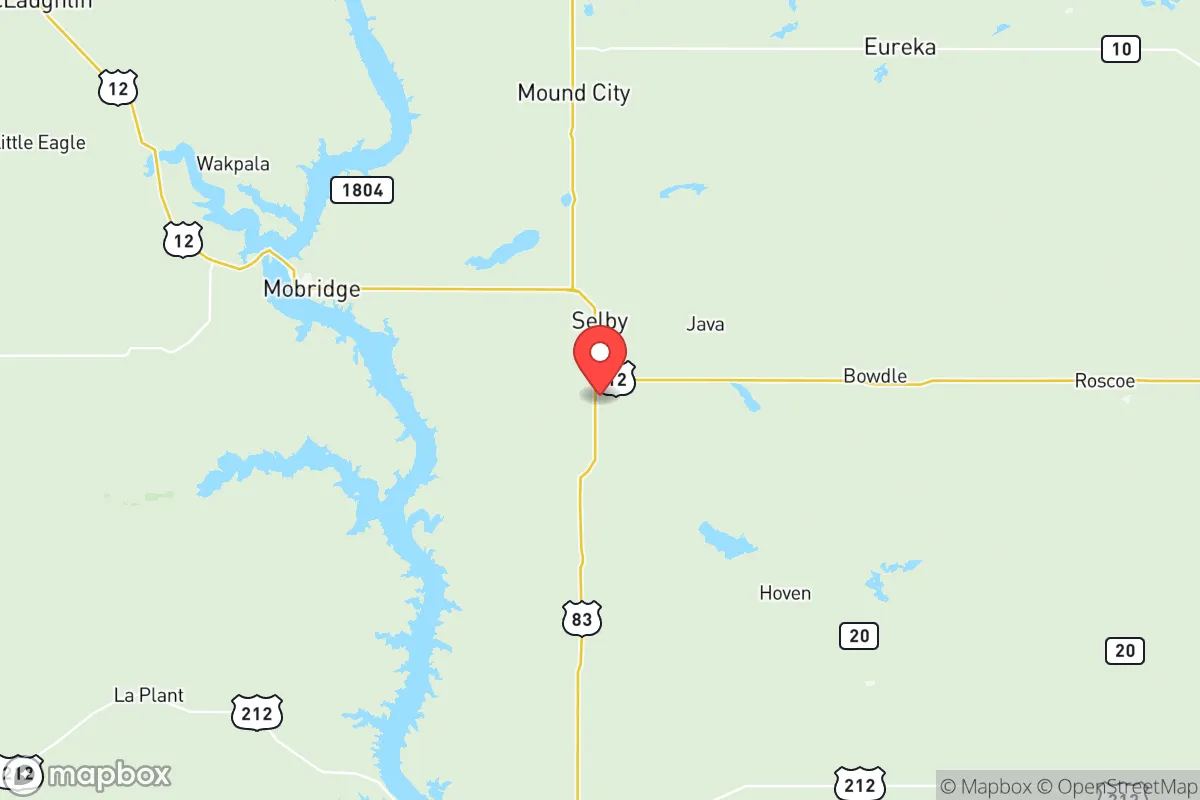
Walworth County, South Dakota, is home to 5,298 residents who live in a predominantly white, rural landscape where the population is older than the national median and deeply rooted in the agricultural and small-town economy. The county's identity is shaped by its low population density, a foreign-born share of just 0.2%, and a strong sense of local governance centered around the county seat of Selby and the largest town, Mobridge. With 78.9% of residents identifying as white and a modest 31.1% holding a college degree, the population reflects a stable, homogenous community with limited recent immigration and a gradual demographic shift toward an older median age.
Settlement & growth (pre-1960)
Before American settlement, the land that is now Walworth County was part of the traditional territory of the Lakota Sioux, particularly the Hunkpapa and Blackfeet bands, who followed bison herds across the Missouri River breaks. The 1851 Treaty of Fort Laramie recognized this area as part of the Great Sioux Reservation, but the 1868 treaty and subsequent land cessions opened the region to non-Native settlement after the 1874 Black Hills Expedition and the discovery of gold. The U.S. government forcibly removed most Lakota to reservations by the 1880s, with the Standing Rock Reservation lying just north of the county line, a legacy that still shapes the region's demographics today.
The first permanent American settlers arrived in the 1880s, drawn by the 1862 Homestead Act and the promise of 160-acre parcels of prairie land. The Milwaukee Railroad extended its line through the area in 1886, establishing towns like Mobridge (originally a railroad camp called "Mobridge" for the Missouri River bridge) and Selby as agricultural service centers. These early settlers were overwhelmingly of German and Scandinavian descent—Germans from Russia, Norwegians, and Swedes—who had previously farmed in the Midwest and sought cheap land. The town of Java was platted in 1901 as a grain shipping point, while Glenham (founded 1907) grew around a general store and post office. By 1910, the county's population had surged to 6,488, nearly all white and native-born, with farming and ranching as the economic backbone.
The Dust Bowl and Great Depression of the 1930s hit Walworth County hard, causing a population decline as families abandoned marginal farms. The county's population bottomed out at 5,981 in 1940, then stabilized as World War II brought economic recovery through agricultural price supports and the construction of the Oahe Dam on the Missouri River, which began in 1948. The dam project, completed in 1962, brought temporary construction workers and permanently altered the landscape, flooding river-bottom farmland and forcing some families to relocate. The post-war period saw a modest rebound, with the 1960 census recording 6,391 residents, still predominantly white and employed in agriculture, retail, and government services tied to the county seat.
Modern era (post-1965)
The 1965 Hart-Cellar Act had virtually no impact on Walworth County's demographics. The foreign-born population remained negligible—0.2% in the most recent data—and no new immigrant enclaves formed. Instead, the county's modern demographic story is one of domestic out-migration and aging. From a peak of 6,391 in 1960, the population declined steadily to 5,298 by the 2020s, driven by young adults leaving for jobs in larger cities like Aberdeen, Pierre, or Bismarck, North Dakota. The county's economy shifted from small-scale family farms to larger, mechanized operations, reducing the need for farm labor and accelerating rural depopulation.
Suburbanization did not occur in Walworth County in the traditional sense. The towns of Mobridge (population ~3,500) and Selby (~600) remain compact, with no significant exurban development. The county's racial composition has remained overwhelmingly white, with the only notable minority group being Native American residents, who are not captured in the supplied data but are present due to the proximity of the Standing Rock Reservation. The Hispanic share is 1.2%, Black share 0.3%, and East/Southeast Asian share 0.1%, all reflecting small, transient populations tied to seasonal agricultural work or healthcare jobs at the Mobridge Regional Hospital. The Indian subcontinent share is 0.0%, meaning no measurable community exists.
The college-educated share of 31.1% is slightly below the national average, reflecting the county's reliance on blue-collar and service-sector employment. The largest employers are the Mobridge-Pollock School District, the hospital, and agricultural cooperatives. The county's population is older than the state median, with a median age of approximately 47 years, as younger generations leave for education and career opportunities elsewhere.
The future
Walworth County's population is projected to continue its slow decline, with the state demographer estimating a drop to around 4,800 by 2040. The county is homogenizing rather than tribalizing—the small Hispanic and Native American populations are not forming distinct enclaves but are dispersed within the existing white-majority towns. Immigration from abroad is unlikely to increase significantly, as the county lacks the job base or ethnic networks to attract newcomers. The primary demographic shift will be aging: the share of residents over 65 is expected to rise from roughly 22% to over 30%, straining local healthcare and social services.
In-migration is limited to a small number of retirees seeking low-cost living and outdoor recreation on the Missouri River, plus a trickle of remote workers attracted by cheap housing. These newcomers are culturally similar to the existing population—mostly white, midwestern, and conservative—so they are absorbed without altering the county's identity. The county's cultural character will remain rooted in its agricultural heritage, Lutheran and Catholic church traditions, and a political lean that consistently votes Republican by wide margins (e.g., 78% for Trump in 2020).
For someone moving in now, Walworth County offers a stable, quiet, and safe environment with low crime rates and strong community ties, but it is not a place of demographic dynamism or diversity. The population is shrinking and aging, and the economic opportunities are limited to agriculture, healthcare, education, and small retail. New residents will find a welcoming but insular community where social life revolves around church, school events, and local government, and where the population's future is one of gradual contraction rather than growth.

* Values derived from national, state, county, city and local statistics and may differ in a specific area. Last updated: 2026-05-09T19:29:46.000Z
Narrative content on this page is AI-generated and may contain mistakes. Verify any details that matter before acting on them.
ReloMaps may earn a commission from affiliate links at no extra cost to you.

