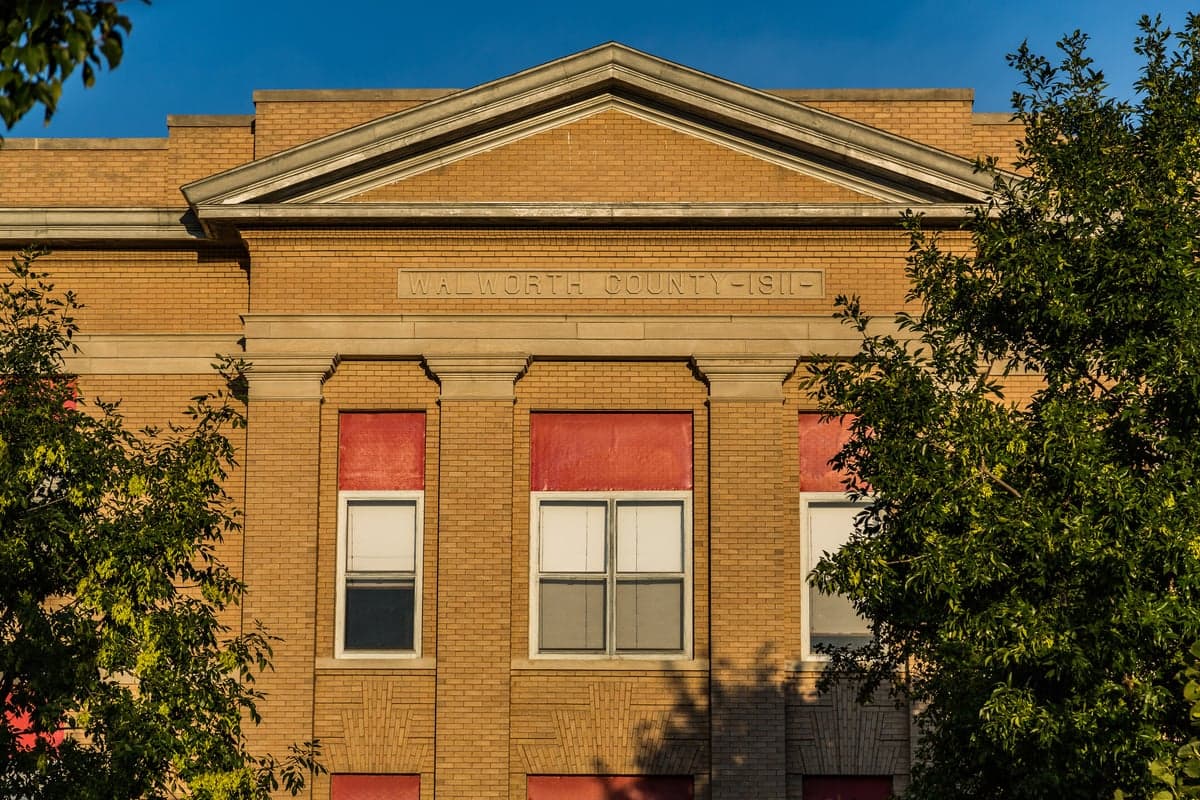
Photo: Wikipedia
Political ClimatePolitical Climate in Walworth County
Showing state-level results — no local-only data available.
Local Political AnalysisPolitical Analysis of Walworth County
Walworth County, South Dakota, has long been a rock-solid conservative stronghold, and while it still leans heavily Republican, you can see the cracks forming if you know where to look. The county as a whole votes red by a wide margin, but the surrounding state of South Dakota carries a Cook PVI of R+15, meaning Walworth County is actually a bit more conservative than the state average in most elections. That said, the political winds are shifting, and not in a way that sits well with folks who value personal freedoms and limited government.
How it compares
Compared to the rest of South Dakota, Walworth County is a bit of a bellwether for the state's rural conservative base. In the 2024 presidential election, the county voted for Donald Trump by a margin of roughly 78% to 19%, which is significantly redder than the state's overall R+15 rating. But here's where it gets interesting: the county isn't a monolith. Mobridge, the largest town, is reliably conservative, but its precincts near the Missouri River and the casino area show a slightly softer shade of red, with a few precincts tipping toward 65-70% Republican instead of the 80%+ you see in the outlying farm communities. Selby and Java are deep red, no question, but Glenham has a small but vocal progressive streak that pops up in local school board races. The real swing precincts are around Akaska and Lowry, where independent-minded ranchers sometimes vote against the party line if they feel the candidate is too cozy with federal land policies. That's a red flag for anyone who values local control—when the feds start meddling, even conservative voters get restless.
What this means for residents
For the average resident, this political climate means you can still expect a government that stays out of your business for the most part. Property taxes are low, gun rights are respected, and there's no talk of progressive zoning laws or green energy mandates that would drive up your cost of living. But the concerning trend is the slow creep of progressive ideology into local institutions. The Mobridge school board has seen a few members push for diversity, equity, and inclusion (DEI) initiatives, which is a direct threat to the merit-based, colorblind approach that built this community. If you're a long-time resident like me, you remember when the biggest political fight was over the county road budget, not whether your kid's classroom should have a "safe space" poster. The shift is subtle, but it's there, and it's a sign that the coastal values are seeping into the heartland through federal funding and state mandates.
Culturally, Walworth County still holds onto its traditional values—church attendance is high, hunting and fishing are a way of life, and the Fourth of July parade in Mobridge is a bigger deal than any election. But the policy distinctions are starting to show. The county commission has pushed back against state-level efforts to expand Medicaid, seeing it as a federal overreach that would balloon the budget. Meanwhile, the local sheriff's office has publicly refused to enforce any federal gun control measures, a stance that's popular here but could put the county at odds with future administrations. If you're looking for a place where the government still answers to the people, Walworth County is it—for now. But keep an eye on those school board meetings and the precincts around Akaska. That's where the future of this county's freedom will be decided.

State Political ClimatePolitical Climate in South Dakota
State Political AnalysisPolitical Environment in the State
South Dakota is about as reliably Republican as a state gets, with a Cook PVI of R+15 that has only hardened over the past two decades. The dominant coalition is a mix of rural conservatives, libertarian-leaning ranchers, and a growing number of freedom-minded transplants from blue states, all united by a deep skepticism of federal overreach. Over the last 10-20 years, the state has shifted from a quiet, low-tax outpost into a deliberate laboratory for conservative governance, with Sioux Falls and Rapid City anchoring the population while the vast rural expanse drives the state's unapologetically red tilt.
Urban vs. rural divide
The political map is stark: the state's two population centers, Sioux Falls and Rapid City, are the only places where Democrats can reliably compete, but even there the margins are shrinking. Sioux Falls, home to a growing professional class and some out-of-state transplants, has a slight purple tint in local races, but it still votes Republican by double digits in statewide contests. Rapid City, with its military and tourism base, leans red but has a small progressive enclave around the downtown arts scene. The real action is in the rural counties—places like Harding County in the northwest, which routinely goes 90%+ Republican, and Lake County around Madison, where the farming and manufacturing base keeps things solidly conservative. The divide isn't just about population density; it's about worldview. In the small towns of Brookings and Vermillion, the university populations introduce a slight liberal tinge, but those are islands in a sea of red. The urban-rural split is less a battle and more a confirmation of the state's overall direction.
Policy environment
South Dakota's policy environment is a conservative dream, built on a foundation of no state income tax, a flat property tax structure, and a regulatory posture that actively courts businesses. The state has no corporate income tax, no personal income tax, and no inheritance tax—a trifecta that makes it a magnet for entrepreneurs and retirees alike. Education policy is dominated by school choice, with a robust voucher program and a growing charter school presence, though the rural districts still rely heavily on local control. Healthcare is a mixed bag: the state expanded Medicaid under Trump-era waivers, but the legislature has consistently blocked any move toward a state-run system, keeping it private and market-driven. Election laws are among the most secure in the nation—voter ID is required, same-day registration is not allowed, and the state has resisted mail-in ballot expansions. Governor Kristi Noem has been a national figure in pushing parental rights in education, signing the "Parents' Bill of Rights" in 2022, which requires schools to notify parents about curriculum changes and medical services. The regulatory environment is deliberately thin: no state-level environmental review for most projects, no rent control, and a right-to-work law that keeps unions weak.
Trajectory & freedom
The trajectory is unmistakably toward more personal freedom, at least as conservatives define it. In 2023, the legislature passed a constitutional carry law, allowing any law-abiding adult to carry a concealed firearm without a permit—a move that expanded Second Amendment rights significantly. The same year, the state enacted a "medical freedom" law that prohibits employers from mandating COVID-19 vaccines, a direct response to federal overreach during the pandemic. On parental rights, the 2022 "Parents' Bill of Rights" was followed by a 2024 law that bans transgender procedures for minors, making South Dakota one of the most aggressive states in protecting children from medical experimentation. Property rights have been strengthened by a 2023 law that limits eminent domain for carbon pipeline projects, a direct shot at the controversial CO2 pipeline proposed by Summit Carbon Solutions. Taxation has actually become more friendly: in 2024, the legislature cut the state sales tax on groceries from 4.5% to 4.2%, with a path to elimination. The only area where freedom has contracted is in the realm of abortion: the state has a near-total ban with no exceptions for rape or incest, passed via trigger law in 2022. For the conservative audience, this is a feature, not a bug. The overall direction is clear: South Dakota is doubling down on individual liberty in the areas that matter most to its base.
Civil unrest & political movements
Civil unrest is minimal compared to coastal states, but there are flashpoints. The most visible is the ongoing battle over the Summit Carbon Solutions pipeline, which has sparked a grassroots movement of landowners—many of them lifelong Republicans—who see the project as a violation of property rights. Protests have been held in Huron and Mitchell, with farmers and ranchers forming coalitions that cross party lines. On the left, the most organized movement is around the Pine Ridge Indian Reservation, where activists have pushed for tribal sovereignty and opposed the Keystone XL pipeline in the past. The 2020 protests in Rapid City over the murder of George Floyd were small and quickly dissipated, but they left a lingering tension between the city's progressive minority and the conservative majority. Immigration politics are largely absent—South Dakota has a tiny foreign-born population, and the state has no sanctuary policies. Election integrity controversies are nonexistent; the state's system is widely trusted. The most notable political movement is the "Free Dakota" strain, which has flirted with nullification rhetoric on federal gun laws and environmental regulations, though it remains fringe. For a new resident, the political landscape is calm but not sleepy—the pipeline fight and the parental rights battles show that people here are willing to organize and push back.
Projection
Over the next 5-10 years, South Dakota is likely to become even more conservative, driven by two demographic forces. First, the in-migration of conservatives from California, Illinois, and Minnesota—drawn by the tax structure and cultural alignment—is accelerating. Towns like Spearfish and Box Elder are seeing new subdivisions filled with transplants who explicitly chose South Dakota for its freedom. Second, the rural population is aging and shrinking, but those who remain are deeply conservative, and the state's legislative districts are drawn to amplify rural voices. The urban centers of Sioux Falls and Rapid City will continue to grow, but they are not liberalizing—they are absorbing conservative transplants. The biggest wildcard is the pipeline fight: if the carbon capture industry takes off, it could bring federal money and environmentalist pressure, but the state's political class is already hostile to that. Expect more laws on school choice, further tax cuts, and a continued push to shield the state from federal mandates. The only potential leftward shift would come from a sudden influx of tech workers or remote professionals, but so far, those moving here are choosing it for the politics, not despite them.
For someone moving to South Dakota, the bottom line is this: you are choosing a state that is actively building a conservative haven, not just passively leaning red. The tax burden is minimal, the gun laws are among the freest in the nation, and the culture is one of self-reliance and local control. You won't find the political drama of a swing state, but you will find a government that is generally on your side—as long as your side is individual liberty, parental rights, and limited government. The trade-off is a slower pace of life and a climate that demands resilience, but for the conservative audience, that's the point.
* Values derived from national, state, county, city and local statistics and may differ in a specific area. Last updated: 2026-05-09T19:29:46.000Z
Narrative content on this page is AI-generated and may contain mistakes. Verify any details that matter before acting on them.
ReloMaps may earn a commission from affiliate links at no extra cost to you.

