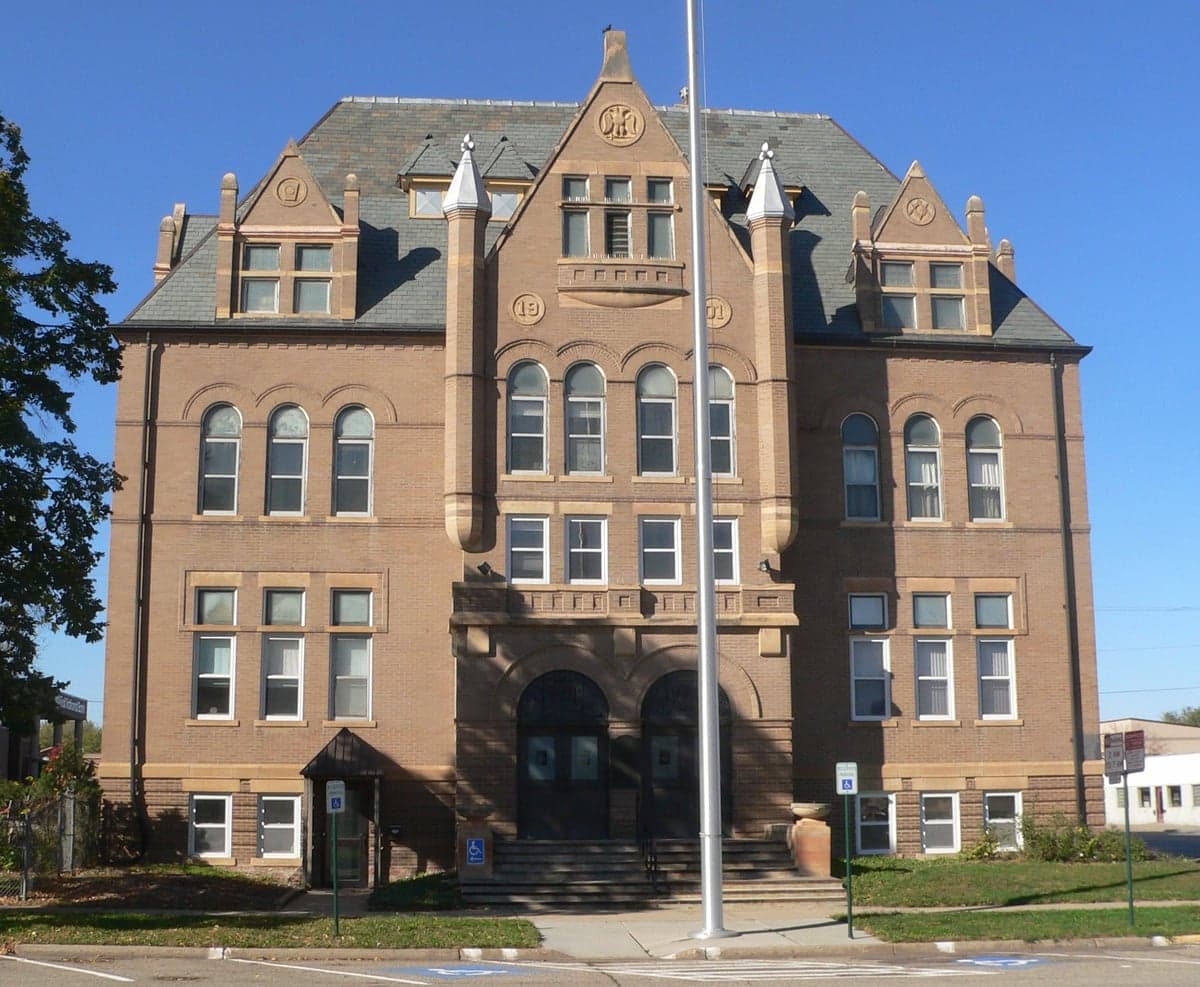
Photo: Wikipedia
Demographics of Yankton County
Affluence Level in Yankton County
A middle-class area roughly in line with national averages across income, home values, education, and employment.
People of Yankton County
Yankton County, home to 23,379 residents, remains a predominantly white, rural community shaped by its Missouri River valley agricultural roots and the regional hub of Yankton. The county’s identity is anchored in a conservative, family-oriented culture with a 2.3% foreign-born share, a 5.6% Hispanic population, and a 0.3% East/Southeast Asian presence, reflecting modest postwar diversification layered over a deep European-settlement foundation.
Settlement & growth (pre-1960)
The land that became Yankton County was originally the territory of the Yankton Sioux (Ihanktonwan) people, who relied on the Missouri River bottomlands for hunting and agriculture. The 1858 Yankton Treaty ceded much of present-day southeastern South Dakota to the United States, opening the region to American settlement. The town of Yankton itself was founded in 1859 as the capital of the Dakota Territory, a political decision that drew government officials, merchants, and land speculators upriver from Sioux City.
The first major European wave arrived in the 1860s and 1870s via steamboat and wagon, attracted by the Homestead Act of 1862 and the promise of fertile bottomland. German immigrants were the largest single group, settling in and around Yankton and pushing into the rural townships that became Gayville (founded 1870) and Mission Hill (1875). German Lutheran and Catholic congregations anchored these communities. Czech (Bohemian) settlers arrived concurrently, establishing Utica (1871) and Volin (1873) as tight-knit agricultural enclaves where Czech remained the household language well into the 1900s. Scandinavian immigrants, primarily Swedes and Norwegians, clustered in Lesterville (founded 1884) and the area around Irene (partially in the county’s northwest corner), bringing Lutheran pietism and an emphasis on cooperative grain elevator systems.
By 1900, Yankton County’s population had reached roughly 12,000, almost entirely native-born of European descent or foreign-born from Germany, Bohemia, Scandinavia, and Ireland. The Missouri River railroad bridges and the 1904 establishment of the Yankton State Hospital (a psychiatric facility) provided nonfarm employment. The Dust Bowl and Great Depression hit the region hard, spurring out-migration, but the county’s population stabilized around 20,000 during the 1950s as Yankton grew as a medical and retail center. No significant post-1900 immigration waves arrived before 1965; the county remained culturally and ethnically homogenous, shaped by its rural German-Czech-Scandinavian blend.
Modern era (post-1965)
The 1965 Hart-Cellar Act had minimal direct impact on Yankton County. The foreign-born population today is just 2.3%, and the East/Southeast Asian share (0.3%) and Indian-subcontinent share (0.0%) are negligible. The county’s modest diversification has come primarily from domestic migration and a small but growing Hispanic population (5.6% as of 2026). Most Hispanic residents are of Mexican descent and began arriving in the 1990s and 2000s for work in Yankton’s meatpacking plants (e.g., the DemKota Ranch Beef facility) and in regional agriculture—corn and soybean harvesting, and hog operations. This community is concentrated in Yankton itself, with smaller clusters in Gayville and Mission Hill, where housing costs remain low. The Black population (1.5%) is small and largely consists of professional families attached to the Yankton medical and state government sectors.
Domestic in-migration has been limited but notable. Yankton has attracted retirees and telecommuters from Sioux Falls, Omaha, and Minneapolis who seek lower property taxes and a slower pace. The Lewis and Clark Lake recreation area on the Missouri River has drawn seasonal residents and some permanent relocations from other Midwest states. However, the county’s overall population has remained flat (23,379 in 2026, compared to 22,814 in 2010), held back by a lack of major employment expansion and by out-migration of native-born youth to larger metro areas.
Suburbanization is weak; Yankton itself is a compact town of about 15,000, and the rural townships have seen little new construction. The Czech heritage of Utica and Volin is preserved through annual festivals (Utica Czech Days), but those villages have shrunk to under 100 residents. The county retains a strong conservative political character—Yankton County voted +32 R in the 2024 presidential election—and religious life remains centered on mainline Protestant and Catholic congregations, with a single small mosque in Yankton serving the small Asian and Indian professional population.
The future
Yankton County is likely to remain a predominantly white, culturally conservative rural community over the next decade. The Hispanic population, while growing slowly, is being absorbed into the existing economic and social fabric rather than forming distinct enclaves; Spanish-language services are limited, and intermarriage with the white majority is increasing. No large new immigrant wave is anticipated given the county’s small industrial base and distance from major transit corridors. The East/Southeast Asian and Indian populations will likely remain at trace levels, as the county offers few of the professional or academic environments that attract those groups.
The aging of the white population (median age 42.6, above the state median) and the continued out-migration of 18–35-year-olds will place pressure on the county’s tax base and school enrollments. If the trend holds, the population may edge down toward 22,000 by 2035, unless new employers locate in Yankton. The county’s cultural identity will remain rooted in its German, Czech, and Scandinavian settler heritage, with the Hispanic growth adding a layer rather than replacing it. In-migration from outside

* Values derived from national, state, county, city and local statistics and may differ in a specific area. Last updated: 2026-05-27T19:50:13.000Z
Narrative content on this page is AI-generated and may contain mistakes. Verify any details that matter before acting on them.
ReloMaps may earn a commission from affiliate links at no extra cost to you.

