Photo: Wikipedia
Demographics of South Sioux City, NE
Affluence Level in South Sioux City, NE
A middle-class area roughly in line with national averages across income, home values, education, and employment.
People of South Sioux City, NE
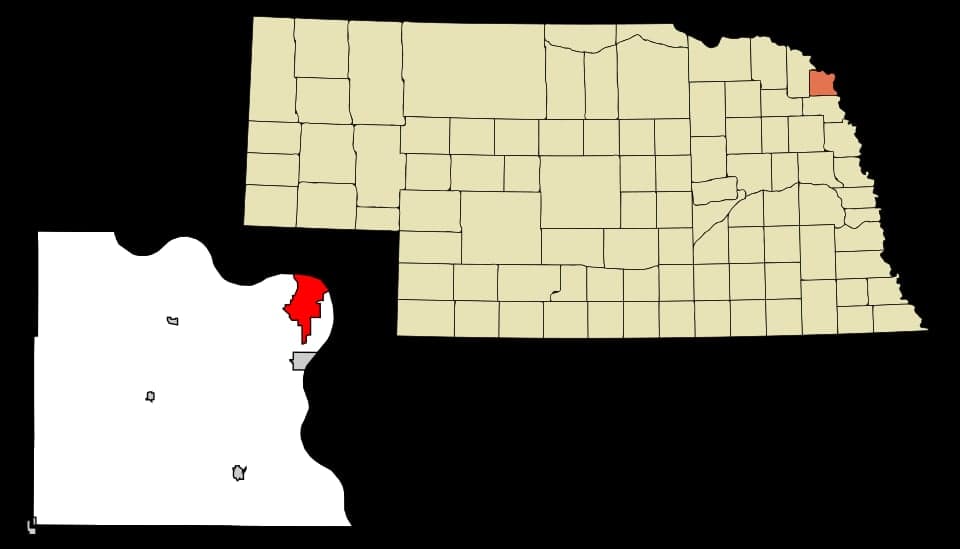
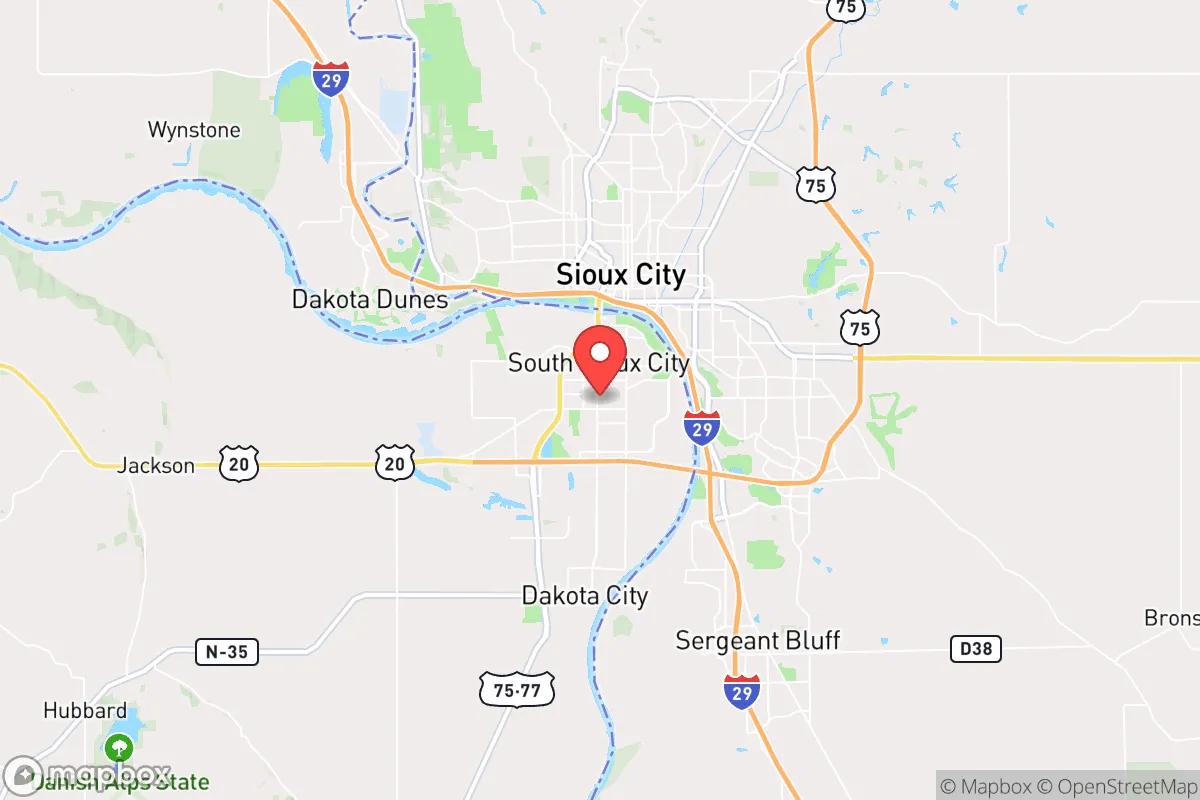
South Sioux City, Nebraska, is a compact, majority-Hispanic city of 13,871 residents where nearly one in seven people is foreign-born, giving it a distinctly binational character that sets it apart from the rest of Dakota County. The city’s population is young, with a median age around 30, and its identity is shaped by a working-class, family-oriented culture rooted in meatpacking and manufacturing. Unlike the more homogeneous, older communities to the north and west, South Sioux City feels like a border town—not just on the Missouri River, but between rural Nebraska and the industrial Sioux City metro area.
How the city was settled and grew
South Sioux City was platted in 1887 as a railroad town, but its real growth began in the early 20th century when the John Morrell & Co. meatpacking plant opened across the river in Sioux City, Iowa. The original settlers were largely German and Irish immigrants who built modest homes in what is now the Old Town district, the grid of streets between 1st and 10th Streets near the river. A second wave of European immigrants—Czechs, Poles, and Scandinavians—arrived between 1910 and 1930, settling in the North Riverside area along Dakota Avenue. These groups established the city’s first Catholic and Lutheran churches, which still anchor the older neighborhoods. The city incorporated in 1889 but remained a small satellite of Sioux City until the post-World War II boom, when the South Creek subdivision was developed to house returning veterans and their families, expanding the city’s footprint south of 29th Street.
Modern era (post-1965)
The 1965 Hart-Cellar Act opened the door for a new wave of immigration that would fundamentally reshape South Sioux City. Beginning in the 1970s, Mexican and Central American workers were recruited by the area’s meatpacking plants—first IBP (now Tyson Foods) in nearby Dakota City, and later the Seaboard Triumph Foods plant in Sioux City. These families settled in the Westside neighborhood, west of Dakota Avenue between 20th and 29th Streets, where rental duplexes and older single-family homes offered affordable entry points. By 1990, the Hispanic share of the population had reached 25%; by 2020, it was over 50%. A smaller but significant Black population (12.4%) arrived in the 1990s and 2000s, many from Chicago and Kansas City, drawn by lower housing costs and plant jobs; they concentrated in the Eastwood area near the river and in the Hickory Hills apartments off Highway 77. The East/Southeast Asian community (2.3%)—primarily Vietnamese and Laotian families—arrived as secondary migrants from other meatpacking towns like Garden City, Kansas, and settled in the Southridge subdivision, where newer, larger homes were built in the 2000s. The foreign-born share (13.8%) is nearly triple the Nebraska state average, and the city’s white population (28.3%) is now a minority, concentrated in the older Old Town and North Riverside enclaves.
The future
South Sioux City is not homogenizing; it is tribalizing into distinct ethnic neighborhoods, though with significant cross-group interaction in schools and workplaces. The Hispanic population is projected to grow to 60-65% by 2035, driven by continued immigration and higher birth rates, while the white population will continue to shrink as older residents age out and younger whites leave for larger cities. The Black and Asian communities are likely to plateau or grow slowly, as the meatpacking industry’s labor demand stabilizes and automation reduces new hiring. The Westside will remain the Hispanic core, while Eastwood and Hickory Hills will stay predominantly Black. The Southridge area is seeing some white and Asian in-migration from Sioux City, attracted by newer housing stock and lower property taxes. The city’s low college attainment rate (15.9%) and heavy reliance on manufacturing mean that upward mobility will depend on whether new employers—like the planned data center and logistics park near the Dakota City border—bring higher-skilled jobs.
For a conservative-leaning individual or family moving in now, South Sioux City offers a low-cost, family-oriented environment with a strong sense of community in each neighborhood, but it is a place where ethnic identity remains a defining feature of daily life. The city is becoming more Hispanic, more working-class, and more distinct from the rest of Dakota County—a trend that shows no sign of reversing. New arrivals should expect to find a city where Spanish is heard as often as English, where church and family anchor social life, and where the economy is tied to the fortunes of the meatpacking industry.

* Values derived from national, state, county, city and local statistics and may differ in a specific area. Last updated: 2026-04-19T07:51:22.000Z
Narrative content on this page is AI-generated and may contain mistakes. Verify any details that matter before acting on them.
ReloMaps may earn a commission from affiliate links at no extra cost to you.

