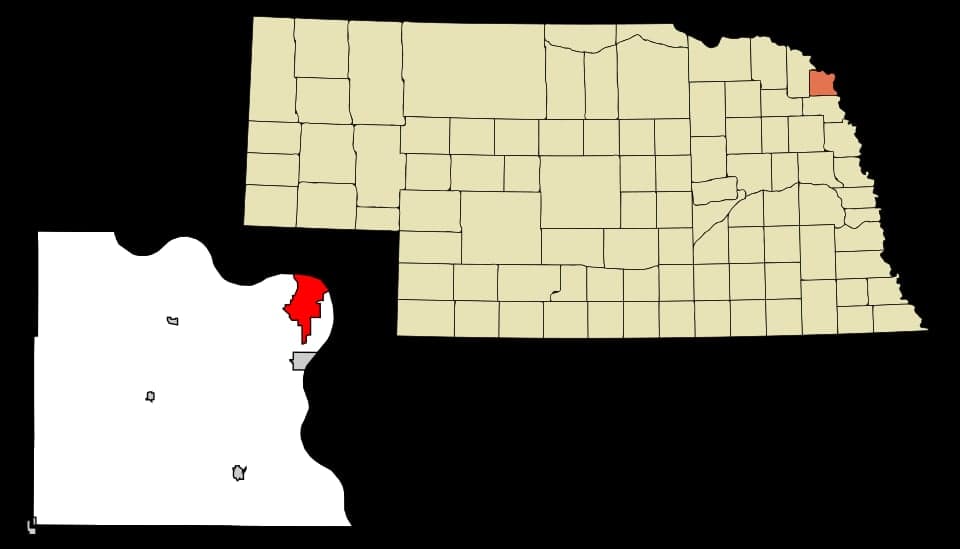
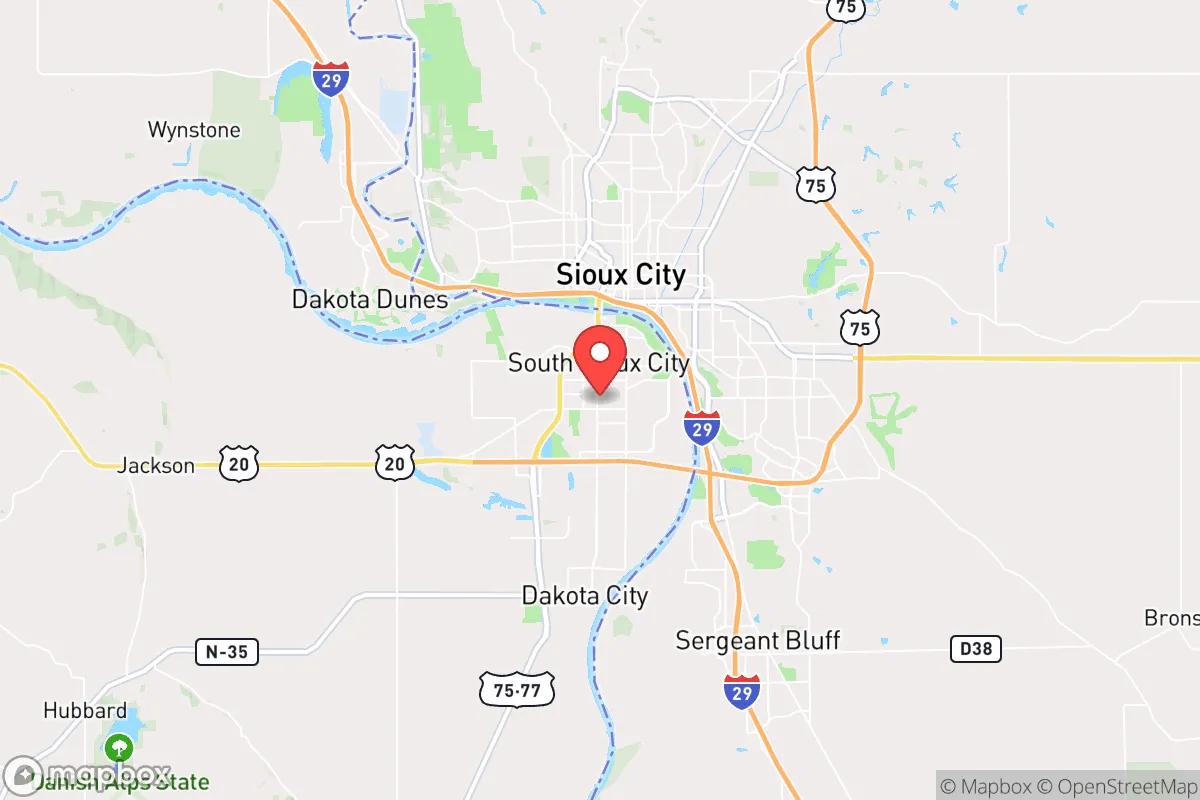
Photo: Wikipedia
Political ClimatePolitical Climate in South Sioux City, NE
District shown is the primary district for this city’s centroid. Cities may span multiple districts.
Local Political AnalysisPolitical Analysis of South Sioux City, NE
South Sioux City, Nebraska, sits in a deeply conservative corner of the state, and that’s not changing anytime soon. The Cook PVI of R+27 tells you everything you need to know about the baseline—this area votes Republican by a massive margin, and it has for as long as anyone can remember. But if you’ve lived here a while, you’ve seen the political winds shift in subtle ways, and not all of them are reassuring. The core is still solid, but there’s a creeping unease about how far government overreach might reach into our personal lives, even in a place this red.
How it compares
Drive across the Missouri River into Sioux City, Iowa, and you’ll feel the difference immediately. Sioux City proper is more purple, with a noticeable progressive tilt in city council races and school board elections—think diversity, equity, and inclusion initiatives that sound good on paper but end up as mandates nobody asked for. South Sioux City, by contrast, has held the line. Our neighbors in Dakota County vote about as red as you’d expect, but the real contrast is with Lincoln or Omaha, where the state’s urban centers have drifted left on everything from property rights to parental control in schools. Even nearby Norfolk, which is reliably conservative, has seen a few local fights over mask mandates and library books that would never fly here. South Sioux City remains a place where the old-school Nebraska values—mind your own business, keep the government out of your wallet and your home—still hold sway.
What this means for residents
For folks living here, the R+27 lean translates into a government that mostly stays out of the way. Taxes are low, zoning is minimal, and you’re not going to get a knock on the door for having a backyard shed that’s six inches too tall. That’s the good part. The concerning trend, though, is how even in a red county, progressive ideas seep in through state-level mandates or federal strings attached to funding. You see it in school curriculum battles—parents here are vigilant about what their kids are taught, and they’ve had to fight to keep critical race theory and gender ideology out of classrooms. The local city council has been good about pushing back, but it takes constant attention. The long-term worry is that as the state grows and diversifies, the pressure to adopt “best practices” from blue states will only increase. For now, residents enjoy a high degree of personal freedom, but it’s a freedom that requires active defense.
One cultural distinction that sets South Sioux City apart is its strong sense of local identity, rooted in agriculture and small business. You won’t find the kind of performative activism you see in bigger cities. People here judge you by your work ethic and your word, not by your political sign. That said, there’s a quiet frustration with how federal policies—like EPA regulations on farming or HUD rules on housing—trickle down and complicate life. The area’s political climate is best described as “leave us alone conservatism.” If that holds, South Sioux City will stay a refuge for those who value personal liberty over government convenience. But keep an eye on the school board meetings and the county commission—that’s where the real fights are happening, and they’re only going to get more intense.

State Political ClimatePolitical Climate in Nebraska
State Political AnalysisPolitical Environment in the State
Nebraska is a reliably red state in presidential elections, having voted Republican in every cycle since 1968, but its political climate is far more nuanced than a simple "red state" label suggests. The dominant coalition is a mix of rural conservatives and a growing suburban electorate, but the state’s unique unicameral, nonpartisan legislature and its split electoral vote system create a political landscape that is both stable and occasionally unpredictable. Over the last 10-20 years, the state has seen a slow but steady rightward shift in its rural areas, while the Omaha metro area has become a competitive battleground, and Lincoln has drifted leftward, creating a fascinating internal tension.
Urban vs. rural divide
The political map of Nebraska is a textbook example of the urban-rural divide. The vast, sparsely populated western and central regions—places like Scottsbluff, North Platte, and Kearney—are deeply conservative, often voting 70-80% Republican. These areas are the backbone of the state’s red identity, driven by agriculture, strong gun culture, and traditional social values. The real action, however, is in the state’s two major population centers. Omaha (Douglas County) is the political fulcrum: it contains Nebraska’s 2nd Congressional District, which has flipped between parties in recent cycles and awarded an electoral vote to Barack Obama in 2008 and Joe Biden in 2020. The city itself is a mix of moderate Republicans, independents, and a growing progressive base, while its western suburbs like Elkhorn and Gretna are solidly red. Lincoln (Lancaster County) has become increasingly blue, driven by the University of Nebraska-Lincoln and a younger, more diverse population. The rural counties surrounding these metros—like Saunders, Cass, and Seward—are reliably Republican, creating a "donut" effect where the urban cores are bluer than their hinterlands. The divide is stark: a voter in Chadron (far northwest) and a voter in Bellevue (south of Omaha) live in different political worlds.
Policy environment
Nebraska’s policy environment is broadly conservative, but with some notable wrinkles. The state has no income tax on Social Security benefits and a flat state income tax rate that was recently cut from 6.84% to 5.84%, with a path to 3.99% by 2027—a major win for fiscal conservatives. Property taxes, however, remain a persistent pain point, especially for rural landowners, and are a perennial legislative battleground. The state’s regulatory posture is business-friendly, with a right-to-work law and minimal red tape for small businesses. On education, Nebraska has seen a surge in school choice advocacy, with the passage of a tax-credit scholarship program in 2023 (LB 753) that allows dollar-for-dollar tax credits for donations to private school scholarship funds—a significant expansion of parental freedom. Healthcare policy is mixed: the state expanded Medicaid under the Affordable Care Act via a 2018 ballot initiative, but also passed a 12-week abortion ban in 2023 (LB 574), reflecting the conservative legislature’s priorities. Election laws are stable but not restrictive: Nebraska has no voter ID law (though one was debated in 2024), same-day voter registration, and mail-in voting is available with an excuse. The state’s unique unicameral, nonpartisan legislature means bills often pass with bipartisan coalitions, but the body’s conservative majority has grown more assertive in recent years.
Trajectory & freedom
Nebraska is trending toward more personal freedom in several key areas, which is encouraging for conservative newcomers. The most significant recent expansion is in gun rights: in 2023, the legislature passed LB 77, which eliminated the requirement for a permit to carry a concealed handgun (constitutional carry). This was a landmark victory for Second Amendment advocates. On parental rights, the state passed the "Parents’ Bill of Rights" (LB 107) in 2024, which requires school districts to notify parents of any changes to a student’s health or well-being and prohibits instruction on sexual orientation or gender identity in grades K-3. This aligns with a growing national movement. Medical autonomy saw a setback with the 12-week abortion ban, but the state also protects medical conscience rights for healthcare providers. Property rights remain strong, with no statewide rent control and limited eminent domain abuse. The biggest threat to freedom in Nebraska is arguably the property tax burden, which has led to calls for a more aggressive tax cap or a shift to consumption-based taxes. Overall, the trajectory is positive for conservatives, but vigilance is needed to prevent the Omaha metro from importing progressive policies from neighboring blue states.
Civil unrest & political movements
Nebraska is not a hotbed of civil unrest, but it has seen its share of political flashpoints. The most visible in recent years was the 2020 George Floyd protests in Omaha and Lincoln, which included some property damage and clashes with police, but were relatively subdued compared to larger cities. The state has a small but active progressive activist network, centered in Lincoln and the University of Nebraska, which has pushed for racial justice, LGBTQ+ rights, and environmental causes. On the right, the Nebraska Republican Party has seen a grassroots resurgence, with the "MAGA" wing gaining influence in local county parties and challenging establishment incumbents. Immigration politics are a simmering issue: while Nebraska is not a border state, the city of Omaha has seen a significant refugee resettlement program (primarily from Sudan, Iraq, and Somalia), which has sparked debates about resources and cultural integration. There is no sanctuary city policy in Nebraska; in fact, the legislature passed a law in 2024 (LB 123) requiring local law enforcement to cooperate with federal immigration authorities. Election integrity has been a hot topic, with the 2020 and 2022 cycles seeing allegations of irregularities in Douglas County, though no major fraud was proven. The state’s split electoral vote system (awarding one electoral vote per congressional district) remains a point of contention, with Republicans pushing to eliminate it and move to a winner-take-all system.
Projection
Over the next 5-10 years, Nebraska is likely to remain a red state, but the urban-rural divide will deepen. The Omaha metro area will continue to grow, attracting younger, more diverse residents from blue states, which could make the 2nd Congressional District a permanent swing seat. Lincoln will likely become more progressive, while the rural areas will hold firm or even shift further right. The biggest demographic wildcard is the influx of remote workers and retirees from California and Colorado, who are drawn by Nebraska’s low cost of living and conservative values. These newcomers tend to be fiscally conservative but socially moderate, which could soften the state’s edge on cultural issues. The legislature will likely continue to push for lower taxes, school choice expansion, and Second Amendment protections, but property tax reform will remain a festering issue. A new resident moving in now should expect a state that is broadly free and welcoming to conservatives, but with a growing progressive beachhead in its two largest cities. The key battleground will be the Omaha suburbs—places like Papillion and La Vista—where the fight for the soul of the state will play out.
For a conservative individual or family considering relocation, Nebraska offers a strong foundation: low taxes, constitutional carry, parental rights in education, and a stable, business-friendly environment. The downsides are the property tax burden and the need to stay engaged in local politics to prevent the Omaha metro from drifting left. If you value a state where your vote counts (especially in the 2nd District) and where traditional freedoms are respected, Nebraska is a solid bet. Just keep an eye on the unicameral—it’s where the real action happens.
* Values derived from national, state, county, city and local statistics and may differ in a specific area. Last updated: 2026-04-19T07:51:22.000Z
Narrative content on this page is AI-generated and may contain mistakes. Verify any details that matter before acting on them.
ReloMaps may earn a commission from affiliate links at no extra cost to you.

