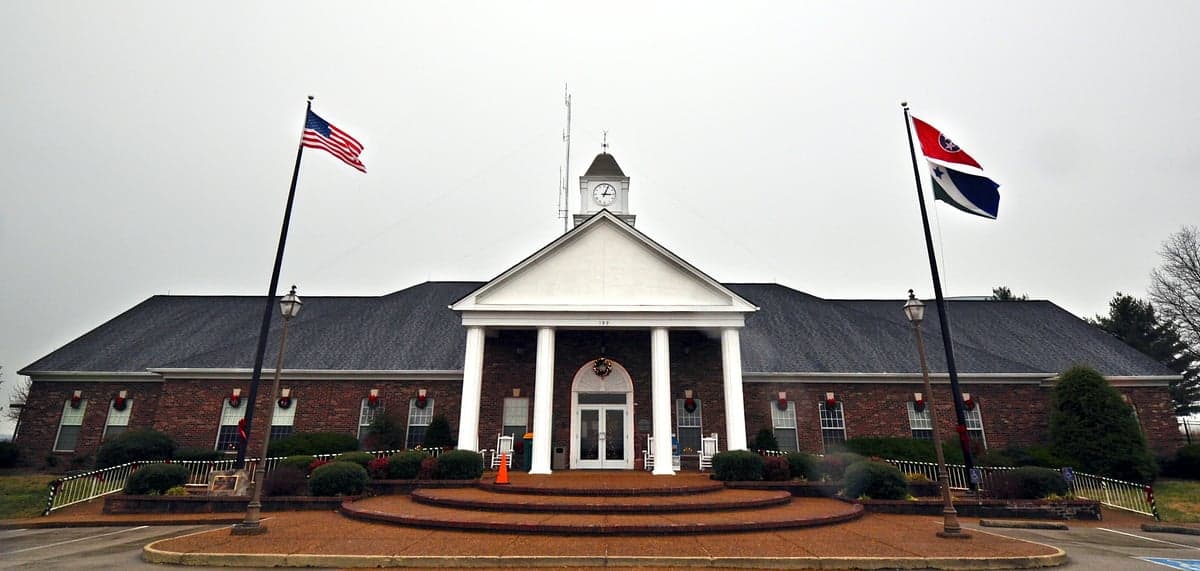
Photo: Wikipedia
Political ClimatePolitical Climate in Spring Hill, TN
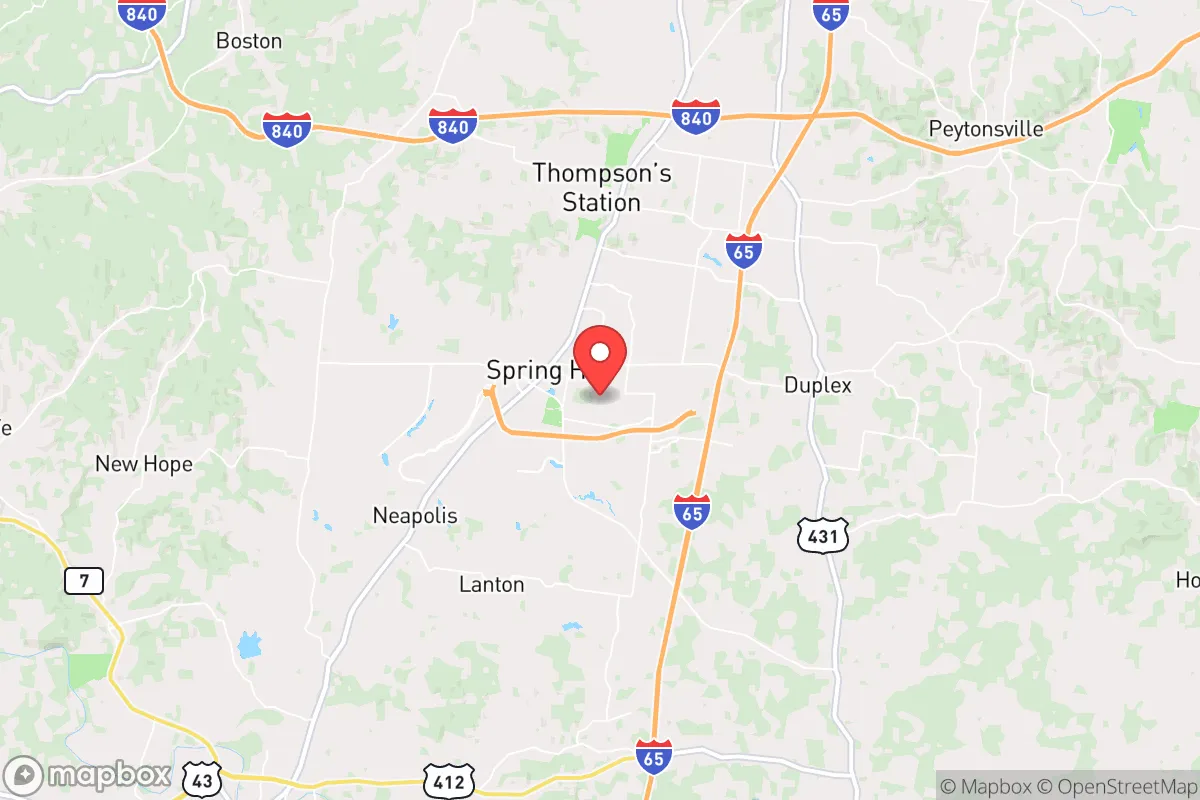
District shown is the primary district for this city’s centroid. Cities may span multiple districts.
Inherited from parent state — no local data available.
Local Political AnalysisPolitical Analysis of Spring Hill, TN
Spring Hill, Tennessee, sits solidly in conservative territory with a Cook PVI of R+8, meaning the area votes about eight points more Republican than the national average. That R+8 rating isn't just a number—it reflects a community that has long valued limited government, personal responsibility, and the right to live without excessive interference. Over the past decade, the political lean has held steady, even as the town has exploded in population, growing from around 30,000 residents in 2010 to over 50,000 today. The newcomers, many drawn from blue states like California and New York, have brought some cultural shifts, but the core voting patterns have remained reliably red, with Maury and Williamson counties both delivering decisive Republican margins in recent elections.
How it compares
Spring Hill’s politics stand out when you look at the surrounding area. Head north into Nashville’s Davidson County, and you’re in a deep-blue stronghold where progressive policies on taxes, zoning, and policing are the norm. Drive east to Columbia, the Maury County seat, and you’ll find a similar conservative vibe, though Spring Hill tends to be a bit more moderate on social issues due to its younger, more educated workforce. The real contrast is with Franklin, just 15 minutes north—Franklin has seen a noticeable uptick in progressive activism, with local school board races and city council debates increasingly dominated by left-leaning voices. Spring Hill, by comparison, has largely resisted that drift, with residents consistently voting for candidates who prioritize low taxes, Second Amendment rights, and school choice. The nearby town of Thompson’s Station is even more conservative, but Spring Hill strikes a balance: conservative enough to feel safe, but diverse enough to avoid the insular feel of some smaller rural communities.
What this means for residents
For folks living here, the political climate translates into tangible everyday freedoms. You won’t see the kind of government overreach that’s become common in blue cities—no mask mandates that drag on for years, no heavy-handed business closures, no zoning boards telling you what you can or can’t do with your own property. Property taxes remain among the lowest in the region, and the local school system, while growing, still emphasizes parental input over bureaucratic control. That said, there are warning signs. The rapid growth has brought pressure from developers and outside interests who want to push denser, more “progressive” housing policies. Some city council meetings have seen debates over things like inclusionary zoning and affordable housing mandates—ideas that sound nice in theory but often lead to higher taxes and less local control. If you value your right to live without a laundry list of government rules, Spring Hill is still a good bet, but you’ve got to stay engaged. The long-term trajectory depends on whether the new arrivals assimilate into the local culture or try to remake it in the image of the places they left.
Culturally, Spring Hill retains a distinct Tennessee flavor that sets it apart from the homogenized suburbs popping up nationwide. The annual Spring Hill Community Festival still feels like a small-town gathering, not a corporate-sponsored event. Politically, the area has resisted the urge to adopt sanctuary city policies or defund the police—two issues that have divided many mid-sized towns. The local sheriff’s office maintains a visible presence, and most residents see that as a good thing. The biggest policy distinction is probably the area’s approach to education: Spring Hill schools have largely avoided the critical race theory and gender ideology battles that have consumed districts in Franklin and Nashville. For now, the community holds the line, but keeping it that way requires paying attention at the ballot box and in local meetings. If you’re looking for a place where the government stays out of your business and your neighbors share your values, Spring Hill is still that place—but it’s not immune to the pressures that are reshaping the rest of the country.

State Political ClimatePolitical Climate in Tennessee
State Political AnalysisPolitical Environment in the State
Tennessee has long been a reliably red state, with a strong Republican trifecta controlling the governorship and both legislative chambers for over a decade. The state’s partisan lean is solid, with Donald Trump winning by 30 points in 2020 and 2024, and the GOP holding supermajorities in the state House and Senate. Over the last 20 years, the state has shifted from a more moderate, blue-dog Democratic tradition to a deeply conservative stronghold, driven largely by the exodus of rural and suburban voters from the Democratic Party and the in-migration of conservatives from blue states. The dominant coalition is a mix of rural traditionalists, suburban fiscal conservatives, and a growing number of evangelical activists who have pushed the state’s politics further right on cultural issues.
Urban vs. rural divide
The political map of Tennessee is a stark study in contrasts. The state’s three major metros—Nashville, Memphis, and Chattanooga—are blue islands in a sea of red. Nashville (Davidson County) is the most reliably Democratic, with Joe Biden winning it by 30 points in 2020, driven by a booming creative class, a large university population, and a growing number of transplants from coastal cities. Memphis (Shelby County) is also deeply blue, powered by a large African American population and unionized labor, though its turnout has been declining relative to the rest of the state. Chattanooga (Hamilton County) is a more recent flip: it went for Biden by a narrow margin in 2020, a shift from its previous Republican lean, as the city’s tech and outdoor recreation economy attracted a younger, more liberal demographic. Meanwhile, the rest of the state—places like Knoxville (Knox County), Franklin (Williamson County), and Johnson City (Washington County)—are solidly red. Williamson County, in particular, is one of the wealthiest and most conservative suburban counties in the country, with Trump winning it by 20 points. The rural counties in Middle and East Tennessee, like Giles County and Sevier County, vote Republican by margins of 70% or more. The divide is not just partisan but cultural: urban areas are increasingly cosmopolitan and secular, while rural and suburban areas remain deeply traditional and church-oriented.
Policy environment
Tennessee’s policy environment is aggressively conservative, with a focus on low taxes, limited regulation, and cultural traditionalism. The state has no income tax on wages, and its sales tax rate is among the highest in the nation at 7%, but with exemptions on groceries. Property taxes are low, especially compared to the Northeast and West Coast. The regulatory posture is business-friendly, with a right-to-work law and minimal zoning restrictions outside of major cities. On education, the state has a robust school choice program, including a new Education Savings Account (ESA) law passed in 2023 that allows parents to use public funds for private school tuition, homeschooling, or tutoring. The state also passed a “Parents’ Bill of Rights” in 2022, which requires schools to notify parents about curriculum changes and allows them to opt their children out of certain materials. Healthcare policy is limited: Tennessee has not expanded Medicaid under the Affordable Care Act, and the state’s insurance market is thin, with only a few carriers offering plans. On election laws, the state passed a voter ID law in 2011 and a law in 2023 that restricts absentee ballot drop boxes and requires stricter signature verification. The state also banned “ballot harvesting” in 2021. Overall, the policy environment is designed to maximize personal freedom in economic matters while enforcing conservative social norms.
Trajectory & freedom
Tennessee is becoming more free in many respects, particularly on gun rights, parental rights, and tax policy, but there are concerning trends on medical freedom and local control. In 2021, the state passed a permitless carry law, allowing any law-abiding adult to carry a handgun without a permit, making it one of the most gun-friendly states in the country. In 2023, the legislature passed a law banning gender-affirming care for minors, overriding the veto of Governor Bill Lee, and a law requiring schools to notify parents if a student requests to use a name or pronoun that differs from their birth certificate. On property rights, the state has a strong “right to farm” law that protects agricultural operations from nuisance lawsuits, and it passed a law in 2022 that limits the ability of local governments to regulate short-term rentals like Airbnb. However, there are red flags: in 2020, the state passed a law allowing the governor to declare a state of emergency and suspend certain laws without legislative approval, which was used during COVID to impose business closures. The state also has a law that allows the state to preempt local ordinances on everything from plastic bag bans to minimum wage increases, which some conservatives see as a violation of local autonomy. On medical freedom, the state has not passed any broad medical freedom laws, and vaccine mandates for healthcare workers were upheld in court. The trajectory is toward more freedom on cultural and economic issues, but with a growing willingness to use state power to enforce conservative values.
Civil unrest & political movements
Tennessee has seen relatively little civil unrest compared to other states, but there have been notable flashpoints. In 2020, Nashville saw protests following the murder of George Floyd, with some property damage and a few arrests, but the city’s police department was generally restrained. In 2021, a group of armed protesters demonstrated at the state capitol against COVID-19 mandates, leading to a tense but non-violent standoff. The most significant political movement in recent years has been the rise of the “Tennessee Three” — three Democratic state representatives who were expelled in 2023 for leading a gun control protest on the House floor after the Covenant School shooting in Nashville. Two were reinstated, but the incident galvanized the progressive base in Nashville and Memphis. On the right, the “Moms for Liberty” group has been active in Williamson and Rutherford counties, pushing for book bans and curriculum transparency. Immigration politics are relatively quiet, as Tennessee is not a border state and has a small foreign-born population, but the state passed a law in 2023 requiring local law enforcement to cooperate with ICE. There is no sanctuary city movement of note. Election integrity controversies have been minimal, though the state did create a Division of Election Integrity in 2022 to investigate voter fraud claims. Overall, the state is politically stable, but the urban-rural divide is widening, and the Covenant School shooting has created a new fault line on gun policy.
Projection
Over the next 5-10 years, Tennessee is likely to become more conservative, not less, driven by in-migration from blue states and the continued exodus of Democrats from rural areas. The state is projected to gain a congressional seat after the 2030 census, and the GOP supermajority is expected to hold or expand. The biggest wildcard is Nashville: as the city grows and attracts more transplants from California and New York, it could become a Democratic stronghold like Austin, Texas, but the state legislature is likely to continue preempting Nashville’s progressive policies on housing, transit, and environmental regulation. The state’s population is aging and becoming more white and suburban, which favors Republicans. However, the growing Hispanic population in Middle Tennessee, particularly in Murfreesboro and Shelbyville, could shift the political calculus over the long term. On policy, expect more school choice expansion, further tax cuts, and continued restrictions on abortion and gender-affirming care. The state is also likely to pass a law banning mask mandates and vaccine passports, following the lead of Florida and Texas. For a new resident, the state will feel increasingly like a conservative haven, but with the caveat that local control is being eroded by the state government.
For a new resident, the bottom line is that Tennessee offers a high degree of personal freedom on economic and cultural issues, with low taxes, strong gun rights, and a government that is actively pushing back against progressive trends. However, the state’s willingness to use government power to enforce conservative values — from banning gender-affirming care to preempting local ordinances — means that freedom is not absolute. If you are a conservative looking for a state that aligns with your values on family, faith, and fiscal responsibility, Tennessee is a strong choice. Just be aware that the state’s politics are becoming more polarized, and the urban areas are increasingly at odds with the rest of the state. If you move to a suburb like Franklin or Brentwood, you will find a community that shares your values. If you move to Nashville proper, you will be in a blue city that is increasingly at war with the state government. Choose your location carefully.
* Values derived from national, state, county, city and local statistics and may differ in a specific area. Last updated: 2026-05-01T08:11:38.000Z
Narrative content on this page is AI-generated and may contain mistakes. Verify any details that matter before acting on them.
ReloMaps may earn a commission from affiliate links at no extra cost to you.

