 Popular
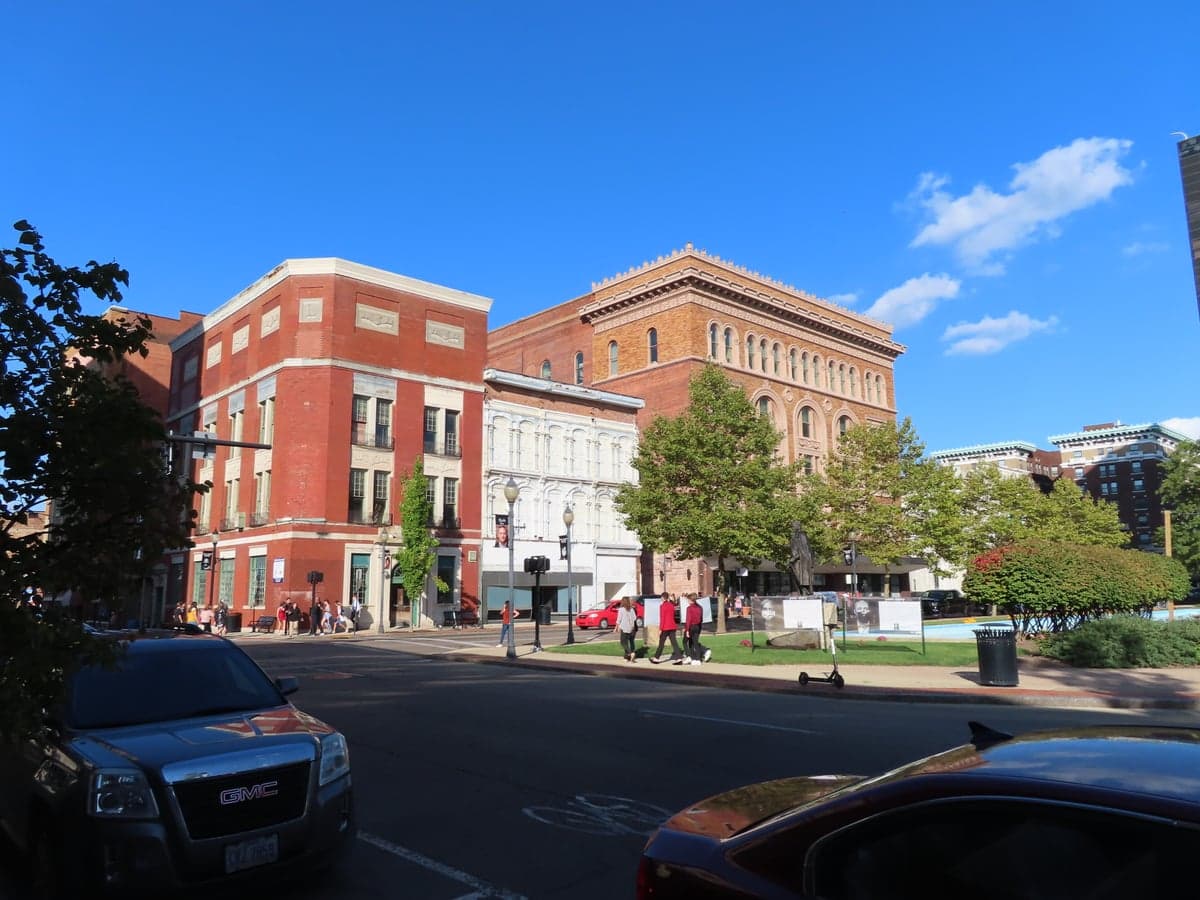
Photo: Wikipedia
Demographics of Springfield, OH
Affluence Level in Springfield, OH
A low-income area with significant economic hardship. Household wealth and educational attainment are well below national averages.
People of Springfield, OH
The people of Springfield, Ohio today form a predominantly white, working-class community of 58,410 residents, marked by a modest 1.9% foreign-born share and a 14.5% college-educated rate that reflects its industrial roots. The city is notably more diverse than surrounding Clark County, with a Black population of 17.6% and a Hispanic share of 4.8%, though East/Southeast Asian and Indian-subcontinent communities each account for just 0.3%. Distinctive identity markers include a strong sense of local pride tied to manufacturing heritage, a visible Haitian and Latino presence in certain blocks, and a population that has stabilized after decades of decline. For a conservative-leaning newcomer, Springfield offers a place where traditional Midwestern values persist, but where demographic shifts are reshaping neighborhoods and schools.
How the city was settled and grew
Springfield was founded in 1801 on Mad River land granted to Revolutionary War veterans, drawing its first wave of settlers from Kentucky, Pennsylvania, and New England. The National Road reached the city in 1838, spurring growth, but the real population boom came with the railroad and the rise of manufacturing after the Civil War. By 1900, Springfield was a major industrial hub, home to the International Harvester plant, Crowell-Collier Publishing, and the Ohio Steel Foundry. These factories attracted a wave of European immigrants—Germans, Irish, and Italians—who settled in working-class neighborhoods like South Fountain Avenue and the East End, building the city's brick streets and union halls. A smaller but significant wave of Black migrants arrived from the South during the Great Migration (1910–1940), settling primarily in the South Side and West Side neighborhoods near the factories. By 1950, Springfield's population peaked at over 82,000, a dense, blue-collar city where ethnic enclaves were distinct but integrated by shared factory work.
Modern era (post-1965)
After the 1965 Hart-Cellar Act, Springfield saw a modest influx of new immigrants, but the city's industrial collapse in the 1970s and 1980s—International Harvester closed in 1982, and other plants followed—triggered a sharp population decline. White flight to suburbs like Enon and Northridge hollowed out core neighborhoods, while the Black population concentrated in the South Side and West Side, where poverty rates rose. The Hispanic share grew from negligible to 4.8% by 2020, driven by Mexican and Puerto Rican families moving into the North Side near the former Navistar plant. A smaller but notable wave of Haitian immigrants arrived in the 2010s, settling in the East End and around East High Street, drawn by low housing costs and meatpacking jobs. The East/Southeast Asian and Indian-subcontinent communities remain tiny (0.3% each), concentrated among professionals at the local hospital and Wittenberg University. The foreign-born share of 1.9% is well below the national average, reflecting Springfield's limited draw for new international migration compared to larger Ohio cities.
The future
Springfield's population is stabilizing after a long decline—the 2020 census count of 58,410 was nearly flat from 2010, a stark contrast to the 20% loss in the 1980s. The Hispanic and Black shares are slowly growing, while the white share (70.1%) continues to shrink, a trend likely to persist as younger white families move to surrounding townships. The Haitian community, though small, is growing through family reunification and could double in the next decade, concentrating further in the East End. The city is not tribalizing into stark enclaves—most neighborhoods remain mixed—but the South Side is becoming more uniformly Black, and the North Side more Hispanic. The college-educated share (14.5%) is unlikely to rise quickly without a major employer shift, meaning Springfield will remain a predominantly blue-collar, high-school-educated population. The next 10–20 years will likely see continued slow diversification, with the city becoming more Hispanic and Black, but still overwhelmingly white and working-class.
Springfield is becoming a more diverse, but still modestly so, Midwestern industrial city—a place where the population is no longer shrinking, but where economic opportunity remains the key driver of who stays and who leaves. For a conservative-leaning newcomer, this means a community that is stable and affordable, but where the cultural and political landscape is slowly shifting with each new wave of residents. The neighborhoods that once defined Springfield's ethnic map are still visible, but the lines are blurring as the city finds its post-industrial footing.

* Values derived from national, state, county, city and local statistics and may differ in a specific area. Last updated: 2026-04-21T19:28:11.000Z
Narrative content on this page is AI-generated and may contain mistakes. Verify any details that matter before acting on them.
ReloMaps may earn a commission from affiliate links at no extra cost to you.

