
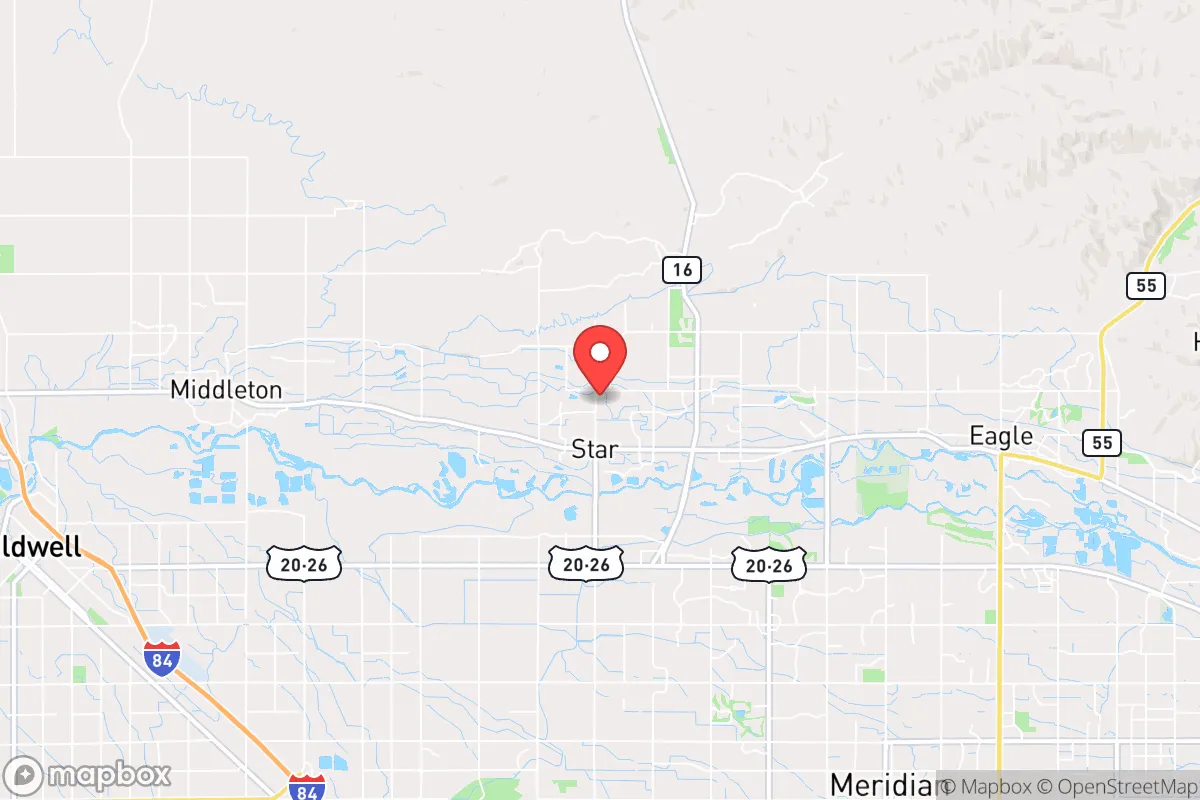

Demographics of Star, ID
Affluence Level in Star, ID
A middle-class area roughly in line with national averages across income, home values, education, and employment.
People of Star, ID
The people of Star, Idaho, today number roughly 13,231, forming a predominantly white, family-oriented community with a notably low foreign-born share of just 1.4%. The city’s character is defined by its rapid suburban growth, a strong sense of local identity rooted in agricultural history, and a demographic profile that is 82.3% white and 10.6% Hispanic, with very small East/Southeast Asian (1.0%), Black (0.9%), and Indian subcontinent (0.1%) populations. Distinctive markers include a high rate of homeownership, a median age slightly below the national average, and a population that is 33.8% college-educated, reflecting an influx of professionals and families seeking space and affordability near Boise.
How the city was settled and grew
Star’s settlement began in the late 19th century, driven by the Homestead Act and the promise of irrigated farmland along the Boise River. The original population was almost entirely white, drawn from Midwestern states and Northern European immigrant stock, who established small farms and orchards. The historic downtown Star district, centered around the railroad depot, became the commercial and social hub for these early families, many of whom were of German and Scandinavian descent. A second wave arrived during the 1910s and 1920s, spurred by the construction of the Arrowrock Dam and the expansion of irrigation canals, which opened more land for agriculture. These settlers clustered in the Star Bench area, a slightly elevated plateau south of the river, where dryland wheat farming and later sugar beet cultivation took hold. The population remained small and overwhelmingly white through the mid-20th century, with the 1960 census recording fewer than 500 residents, almost all of whom were native-born.
Modern era (post-1965)
The modern transformation of Star began in earnest after the 1965 Hart-Cellar Act, though its direct impact on Star was minimal due to the city’s small size and lack of industrial employment. Instead, the major demographic shift came from domestic in-migration, particularly after 1990, as the Boise metropolitan area expanded westward. The Floating Feather subdivision, developed in the 1990s and early 2000s, absorbed the first wave of these new residents—mostly white families from California and other Western states seeking lower housing costs and a rural lifestyle. A second, larger wave of domestic migrants arrived after the 2008 recession, filling the Star River subdivision and the North Star master-planned community. These neighborhoods attracted a more diverse mix, including a growing Hispanic population (now 10.6%) drawn to construction and service jobs in the broader Treasure Valley. The Hispanic community is concentrated in older housing stock near the downtown core and in the West Star area, where multi-generational families have established roots. The East/Southeast Asian and Indian subcontinent populations remain very small (1.0% and 0.1%, respectively), with most households in these groups living in newer subdivisions like Floating Feather and North Star, reflecting their arrival as part of the professional-class migration tied to Boise’s tech and healthcare sectors.
The future
Star’s population is projected to continue growing rapidly, likely exceeding 20,000 by 2035, driven by ongoing suburban expansion and annexation of surrounding farmland. The city is not tribalizing into distinct ethnic enclaves; rather, it is homogenizing around a white, native-born majority, with the Hispanic share expected to rise modestly to around 13-15% as second-generation families remain and new arrivals from other parts of Idaho and the West move in. The East/Southeast Asian and Indian subcontinent populations are likely to remain small, plateauing at 1-2% each, as Star lacks the dense employment base and cultural infrastructure that draw larger immigrant communities to Boise proper. The Black population, currently 0.9%, may see slight growth as Boise’s overall diversity slowly spreads to its suburbs, but Star will almost certainly remain one of the least diverse cities in Ada County. The key trend is the continued in-migration of white families from California, Oregon, and Washington, who are drawn by lower home prices and a conservative political climate, reinforcing the city’s existing demographic character.
Star is becoming a classic exurban bedroom community: predominantly white, family-centric, and politically conservative, with a small but stable Hispanic minority and negligible representation from other racial and ethnic groups. For a mover seeking a safe, growing, and demographically homogeneous environment with strong schools and easy access to Boise, Star offers a predictable and increasingly popular option.

* Values derived from national, state, county, city and local statistics and may differ in a specific area. Last updated: 2026-05-01T05:32:09.000Z
Narrative content on this page is AI-generated and may contain mistakes. Verify any details that matter before acting on them.
ReloMaps may earn a commission from affiliate links at no extra cost to you.

