 Popular
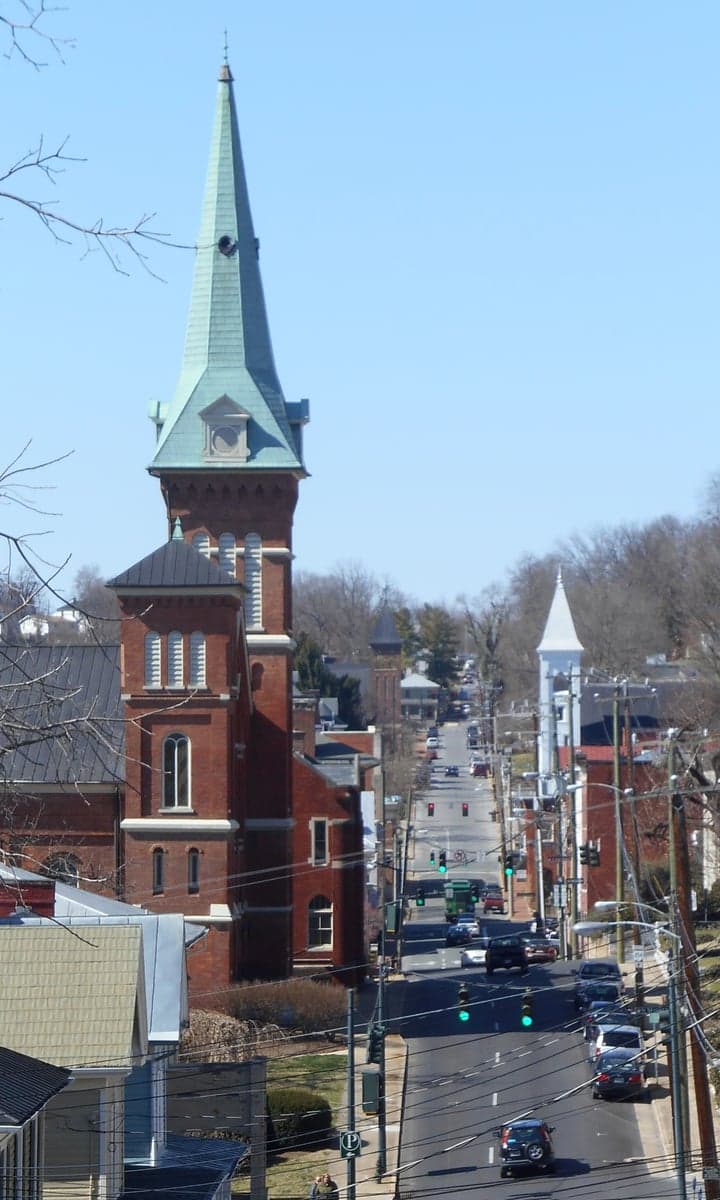
Photo: Wikipedia
Demographics of Staunton, VA
Affluence Level in Staunton, VA
A middle-class area roughly in line with national averages across income, home values, education, and employment.
People of Staunton, VA
The people of Staunton, Virginia today number 25,765, forming a predominantly white (78.9%) city with a notable Black minority (10.0%) and small but growing Hispanic (4.4%) and East/Southeast Asian (1.1%) communities. The city is older and more settled than many Virginia localities, with a college-educated rate of 35.1% that reflects the presence of Mary Baldwin University and state government employment. Staunton retains a distinctive Appalachian-Shenandoah character—politically moderate, historically rooted, and demographically stable—rather than the rapid suburban churn seen in Northern Virginia or Richmond exurbs.
How the city was settled and grew
Staunton was founded in 1747 as the seat of Augusta County, drawing its first wave of settlers from Scots-Irish and German migrants moving south and west along the Great Wagon Road from Pennsylvania. These early families—names like Koiner, Bickle, and Hanger—took up land grants in the surrounding valley and built the original town grid around what is now the Wharf Area (the historic commercial district near the railroad). By the early 19th century, Staunton became a regional trade and government hub, attracting English-descended professionals and merchants who built the grand homes in Gospel Hill, the historic neighborhood east of downtown. The arrival of the Virginia Central Railroad in the 1850s brought Irish laborers who settled in the Newtown district, a working-class area west of the tracks. The post-Civil War era saw a small but established free Black population grow, concentrated in the Staunton's West End (around the Booker T. Washington community) and the Fayetteville neighborhood, where many worked as domestic servants and laborers for the city's railroad and manufacturing industries. The early 20th century brought a wave of Italian and Eastern European immigrants to work in the city's furniture factories and the Western State Hospital, settling primarily in the Middlebrook Avenue corridor. By 1950, Staunton was a stable, majority-white city of roughly 20,000, with a Black population around 12% and almost no Hispanic or Asian residents.
Modern era (post-1965)
The 1965 Hart-Cellar Act had minimal direct impact on Staunton—the city's foreign-born population today is only 2.4%, far below the national average. Instead, the modern demographic story is one of domestic in-migration and suburbanization. From the 1970s through the 1990s, white families moved from older city neighborhoods like Gospel Hill and the Wharf Area to newer subdivisions on the city's northern and western edges, such as Beverley Manor and the Rolling Hills area. This left the historic core with an aging population and a higher concentration of Black residents in the West End and Fayetteville. The Hispanic population, now 4.4%, began growing in the 1990s, driven by agricultural and construction work; these families settled primarily in the Newtown and West End neighborhoods, where housing is more affordable. The East/Southeast Asian community (1.1%) is small and largely professional, often connected to Mary Baldwin University or the healthcare sector, and is scattered rather than concentrated in a single enclave. The Indian-subcontinent population (0.5%) is similarly dispersed. The Black share has declined from roughly 15% in 1970 to 10.0% today, reflecting both out-migration to larger cities and lower birth rates among older Black families.
The future
Staunton's population is projected to remain stable or grow slowly—perhaps reaching 27,000 by 2035—with the white share declining gradually as the Hispanic and Asian communities grow from a small base. The city is not homogenizing into a single demographic block; rather, it is becoming slightly more diverse in a measured, organic way. The Newtown and West End neighborhoods are likely to see continued Hispanic in-migration, while the Gospel Hill and Beverley Manor areas will remain predominantly white and older. The Black population is likely to plateau or decline further as younger Black residents move to larger metro areas for employment. The foreign-born share may rise to 4-5% by 2040, still well below national averages, with growth coming from Hispanic and East/Southeast Asian families rather than Indian or Arab immigration. The city's character will remain that of a small, historically rooted Shenandoah Valley town—not a melting pot, but a place where distinct neighborhoods retain their ethnic and economic identities.
For someone moving in now, Staunton offers a stable, low-diversity environment with a clear sense of place. The population is aging but not declining, and the city's demographic trajectory is one of slow, incremental change rather than rapid transformation. New residents—particularly those from more diverse or fast-growing regions—should expect a community where historic neighborhoods still define social boundaries and where the pace of demographic change is measured in decades, not years.

* Values derived from national, state, county, city and local statistics and may differ in a specific area. Last updated: 2026-04-24T19:56:10.000Z
Narrative content on this page is AI-generated and may contain mistakes. Verify any details that matter before acting on them.
ReloMaps may earn a commission from affiliate links at no extra cost to you.

